image description
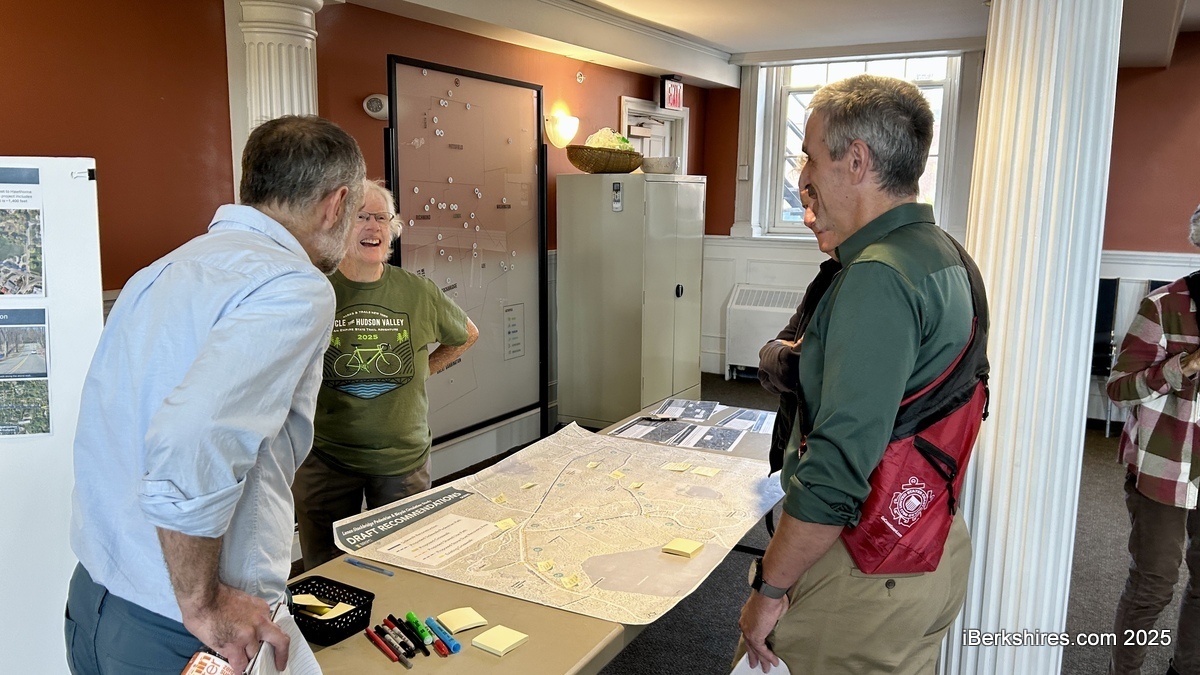
Officials and representatives from Lenox and Stockbridge attend the forum on plans for improving pedestrian and cycling access around Tanglewood.
image description
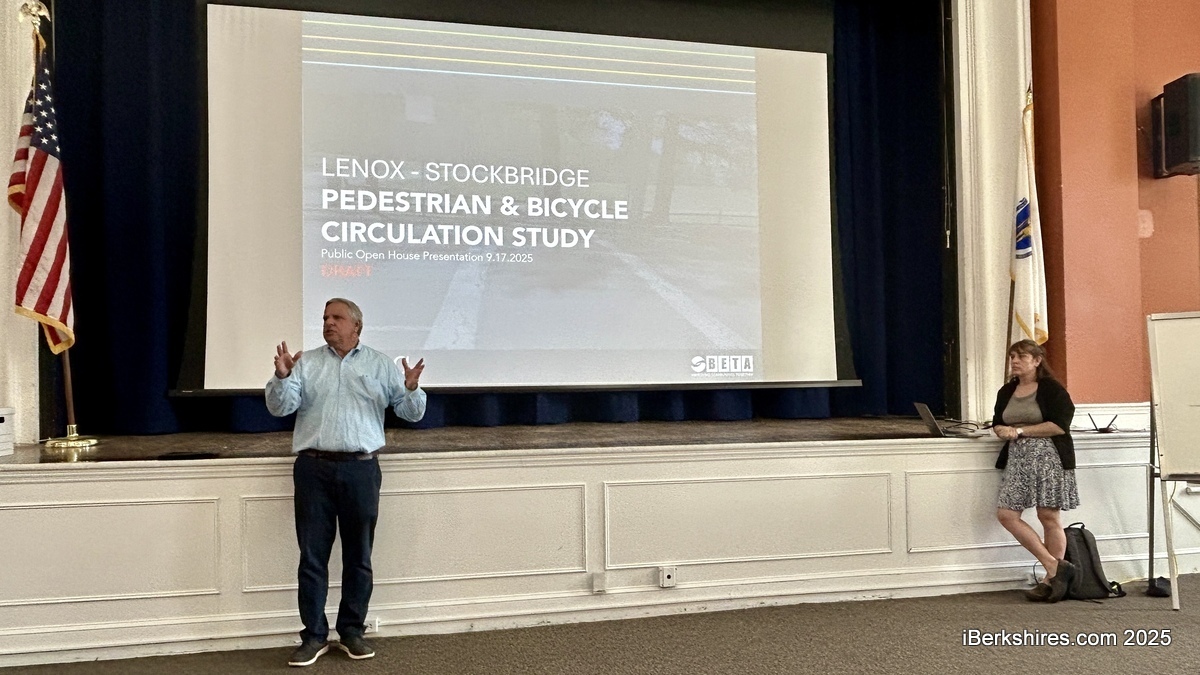
Jeff Maxtutis, project manager, and Anna Sangree, transportation planner review the transportation study at Town Hall.
image description
Full plans can be found in the presentation here
image description

BRPC Presents Pedestrian, Bike Study in Lenox
By Brittany PolitoiBerkshires Staff
Print Story | Email Story

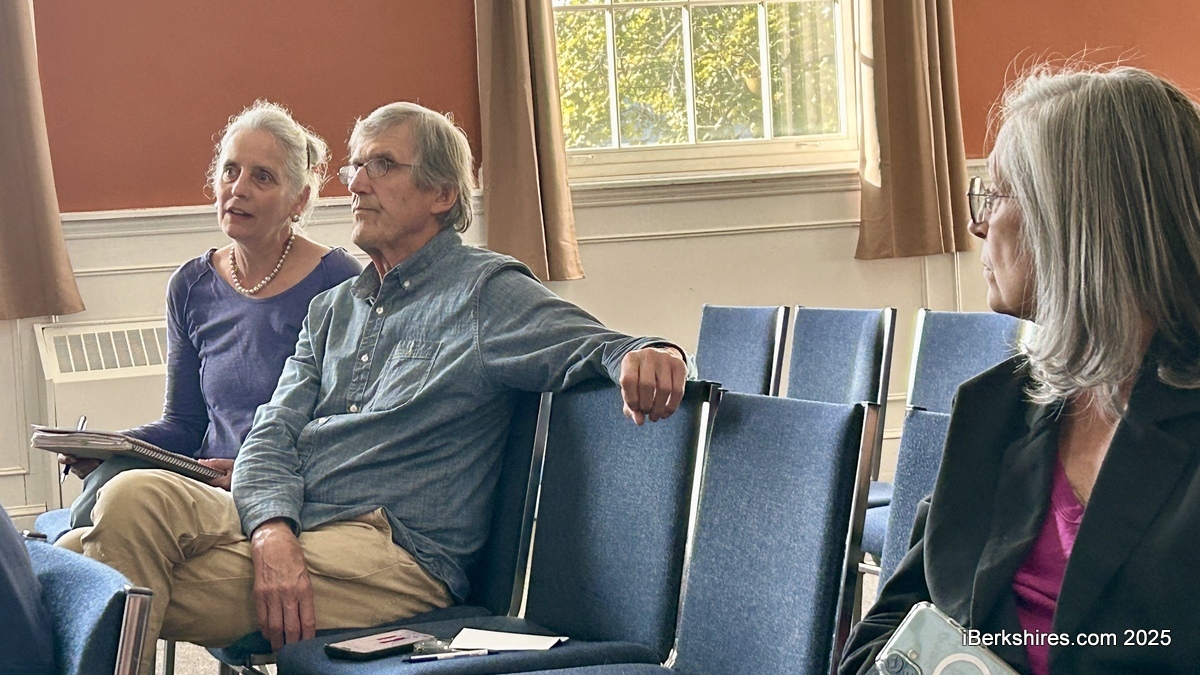
Residents of Hawthorne Street ask questions about the plans.

LENOX, Mass. — The Berkshire Regional Planning Commission is studying pedestrian and bicycle access opportunities around popular cultural institutions in town.  

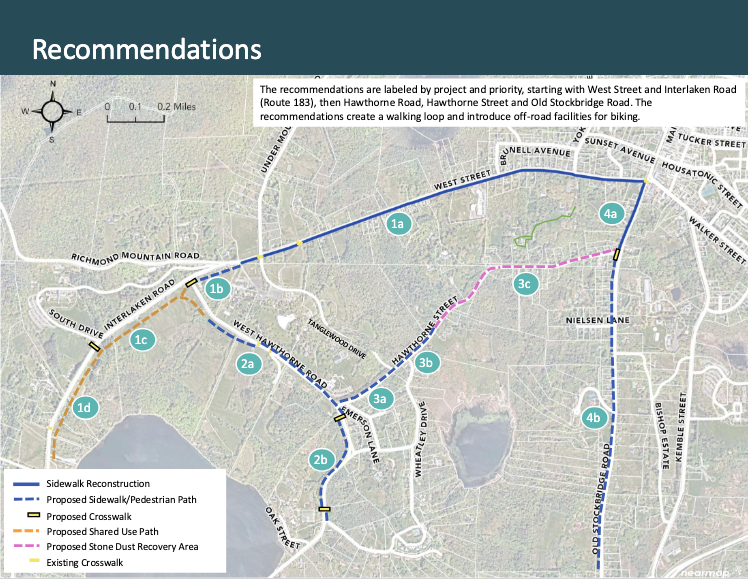
BRPC and members of Beta Group Inc. presented draft recommendations last week from the Lenox-Stockbridge Pedestrian and Bicycle Circulation Study, which would create a multimodal system around West Street, Interlaken Road, Hawthorne Road and Street, and Old Stockbridge Road. 

This includes sidewalks, stone-dust paths, crosswalks, and a shared-use path across about six miles in total. BRPC has been working with stakeholders and the technical consultant on this effort since April, and the final report is expected to be finalized within a couple of weeks.

Project Manager Jeff Maxtutis of Beta Group presented a visual of current walking and biking conditions to a group at Lenox Town Hall. 

"There's not a lot," he said, displaying a map that shows one existing sidewalk running down West Street and a small portion of Old Stockbridge Road to Hawthorne Street. 

"... And aside from that, you're either walking in the road or on the side of the road, in the grass, or biking in the street, so that's part of the issue that we're having. That some people can do that, some people are fine biking in the road, but it's not for everyone."

Recommendations aim to improve connections and address existing gaps for pedestrian and bike access. The design will also make transportation safer and, hopefully, more fun for people not driving while recognizing the area as a "cultural hub." 

Maxtutis emphasized that this is a preliminary feasibility study based on available information, site visits, and discussions with the towns, and does not include details such as land surveys, drainage and utilities, and grading. 

"It's just based on 'Is it feasible?' and most cases it is feasible, but there's flexibility in the details, which is not part of our feasibility study," he said. 

In a press release for the event, BRPC wrote, "No decisions have been made or will be made regarding any projects at this time; this study works to illustrate potential projects and their costs for future consideration by the respective towns." 


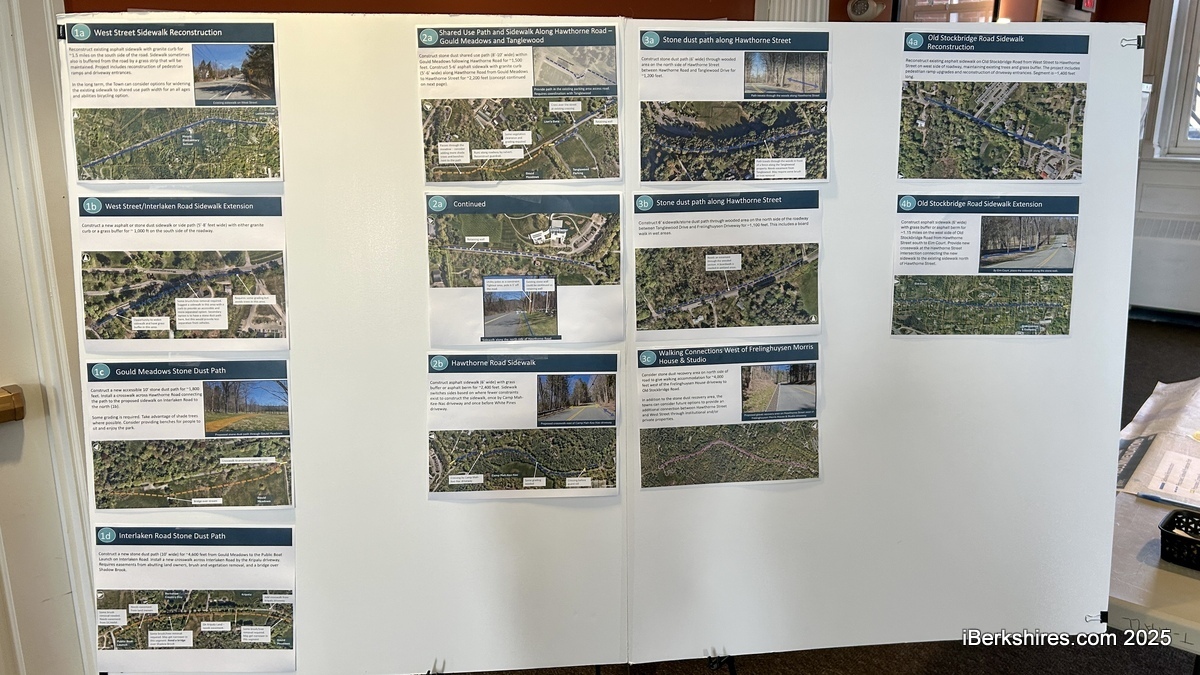
Transportation Planner Anna Sangree presented more than 10 recommendations for the area near Tanglewood: 

  • Reconstructing West Street's sidewalk and extending the sidewalk on Interlaken Road from West Street to Hawthorne Road 
  • A stone-dust path in Gould Meadows 
  • A shared-use path and sidewalk along Hawthorne Road
  • A stone-dust path on Hawthorne Street 
  • Walking Connections west of Frelinghuysen Morris House and Studio
  • Reconstructing Old Stockbridge Road's sidewalk and extending it from Hawthorne Street south to Elm Court

Sangree noted that there are nice paths in Gould Meadows, but they are not accessible. A 10-foot, stone-dust path is proposed for about 1,800 feet along the property. 

"And there's no opportunity to bike, really, along this stretch of roadway," she added. 

"So the idea is to kind of create an accessible path where people can walk, people can roll, and people can also bike on it." 

Maxtutis said they want to be sensitive to the environmental area, and the stone dust path has less impact.  This material is the byproduct of crushed stone and is used for patios, driveways, and walkways. 

A Hawthorne Street resident was concerned about losing character to the area and privacy from the road. 

"I've looked at plenty of plans, including these, and I recognize that the details are what really matter, and often when the details start to be implemented, people are surprised," she said. 

"…So my concern is with how this plays out? And I would favor looking at both calming, narrowing roads to slow that traffic down, and lighter surfaces, less gray infrastructure, addressing the heat island effect. These are the priorities I would value as a resident, as opposed to who looks to me like, ultimately adding more gray infrastructure, asphalt." 

Sangree explained that the natural beauty of the area is a priority, and the facilities aim to increase people's experience outdoors. 

"We want to make sure that we're within the character, and we're not changing the character of the neighborhood, but we're allowing people to enjoy these beautiful resources," she said. 

Because this is a feasibility study, the planners haven't set a cost for the whole of the improvements or a timeline. Recommendations will be presented in phases, recognizing that the whole project wouldn't be done at once. 


Tags: bike path,   complete streets,   pedestrians,   
If you would like to contribute information on this article, contact us at info@iberkshires.com.

Youth For The Future: Adwita Arunkumar

By Breanna SteeleiBerkshires Staff

PITTSFIELD, Mass. — Williams Elementary School fourth-grader Adwita Arunkumar has been selected as our April Youth for the Future for her mentoring of a younger child.

Youth for the Future is a 12-month series that honors young individuals that have made an impact on their community. This year's sponsor is Patriot Car Wash. Nominate a youth here

Adwita has cortical visual impairment; she has been working with her teacher, Lynn Shortis, and her, paraprofessional Nadine Henner.

"My journey with CVI means that I learned in a different way. I work hard every day with Miss Henner and Miss Lynn, to show how smart I am," she said.

"Adwita is a remarkable student. She's a remarkable child. She has, as she shared, cortical visual impairment, which is a brain-based visual processing disorder, which means the information coming in through the eyes is interfered with somewhere along the pathways, and we never quite know what's being interpreted and how and how it's being seen," said Shortis.

"So she has a lot of accommodations and specialized instruction to help her learn."

Recently Adwita has chosen to mentor 4-year-old Cayden Ziemba, who is also visually impaired.

"I decided to be a mentor to Cayden so that she can learn some new things. I teach her how to walk with the cane, with the diagonal and tap technique, I am teaching her Braille," she said. "I enjoy spending time with Cayden, playing games and being a good role model."

Shortis said the mentoring opportunity came up when Cayden was entering preschool at Williams, and they introduced her to Adwita. 

"Adwita works really, really hard academically. She's very smart, but there are a lot of challenges in that, because of the way that it's so visual and she's a natural. She's just, it's automatic," Shortis said. "It's kind of like a switch is turned on and she becomes this extremely confident and proud person in this teacher role."

Adwita also has been helping Cayden on how to use her cane on the bus and became a mentor in a unexpected ways.

"Immediately at the start of this year, she would meet Cayden at the bus. She has taught Cayden how to use her cane to go down the bus stairs. Again, Adwita learned that skill, so it wasn't something I had to say to her, this is what you need to have Cayden do. She just automatically picked that up and transferred that information," said Shortis. "Cayden is now going down the bus step steps independently with her cane. And then she really works hard with Adwita in traveling through the hallways, Adwita leads her to her class every morning, helps her put her things away and get ready for her morning."

Adwita said she hopes Cayden can feel excited about school and that other students can feel good about themselves as well.

"I want them to know that Braille is cool to learn. You can feel the bumpiness with your fingers. I want people to know how you can still learn if your brain works differently sometimes. I need to have a lot of patience working with a 3-year-old. I need to be creative and energized," she said.

She hopes to one day take her mentoring skills to the head of the class as a teacher.

"I want to become a teacher and teach other students when I grow up. I might want to teach math, because I am great at it," she said. "I also want to teach others about CVI. CVI doesn't stop me from being able to do anything I want to. I want students to not feel stressed out and know that they can do anything they want by working hard and persevering."

Her one-to-one paraprofessional said she likes seeing the bond that has grown between the two girls, and can picture Adwita being a teacher one day.

"I do see her in the future being a teacher because of her patience, understanding and just natural-born instinctive skills on how to work with young children," Henner said.

Shortis also said their bond is quite special and their relationship has helped to bring out the confidence in each other.

"The beauty of it, there's just something about it their bond is, I don't even really have a word to describe the bond that the two of them have. I think they share something in common, that they're both visually impaired, and regardless of the fact that their visual impairment differs and the you know the cause of it differs," she said.

"They can relate. And they both have the cane. They're both learning some Braille. But there's something else that's there that just the two of them connected immediately, and you see it. You just you see it in their overall relationship."

 
View Full Story

More Pittsfield Stories