image description

Lenox Looks to Add Parking with Street Changes

By Breanna SteeleiBerkshires Staff
Print Story | Email Story
LENOX, Mass. — The Select Board is moving forward with a proposal to increase parking on two downtown streets by making them one-way.
 
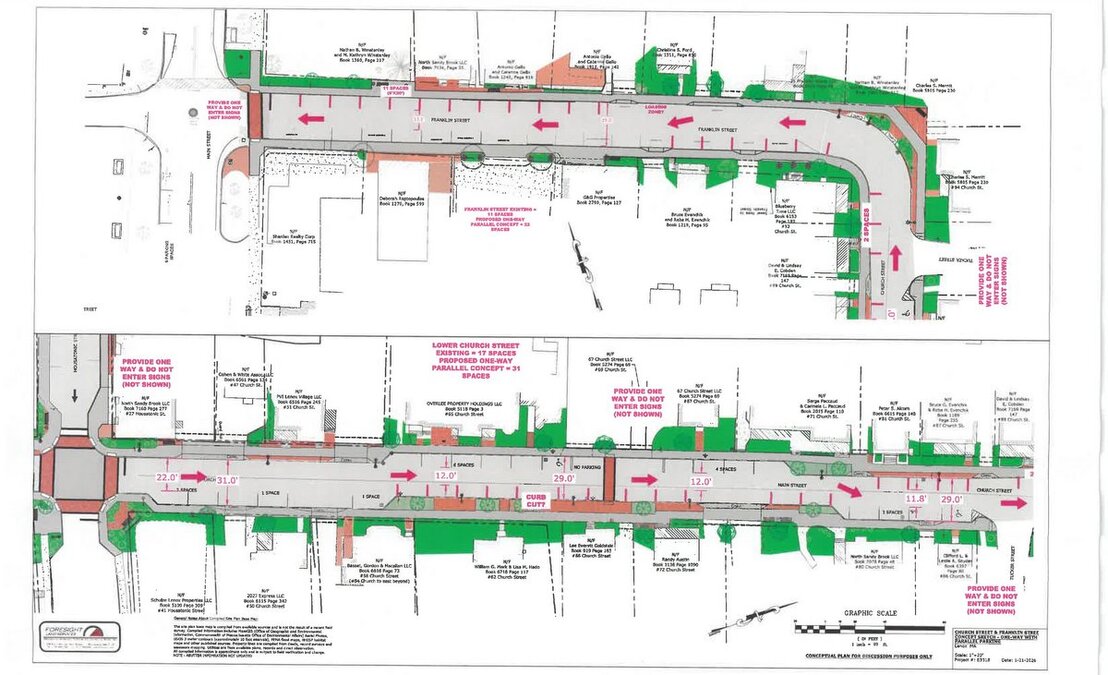
On Wednesday night, Department of Public Works Superintendent William "Billy" Gop showed a proposal of Church and Franklin Streets that would add 26 new parking spots and change them to both streets to one-ways. 
 
The proposal comes after the town was looking for a way to add more parking after losing a major parking lot last year.
 
"We had a lot of chatter over the past year about purchasing two parcels in the downtown core, and the presumption was that the town wanted to at least use one of them in order to allow for protection of the parking that we have on the dirt lot," said Town Manager Jay Green. "The dirt lot has been privately owned. It was through the graciousness of the Schultz family that allowed the town to use it as essentially municipal parking lot over the years."
 
The parking lot at 41 Housatonic St. would have cost about $1 million but a private buyer swooped in, which meant a total loss of around 20 downtown spots. 
 
"At this point, the town is out of that business looking at those parcels, as we all know, but the conversation that it started last year was essentially, what can we do to at least protect and replicate the same number of spots that we have in the dirt lot without buying property, taking it off the tax rolls, and do so in a cost-effective manner," Green said.
 
The new concept shows Church Street and Franklin Street operating as a one-way which will add more parking spots on each side The plan was questioned whether snowplows would be affected with how narrow it would become.
 
Gop said it is a worry but that it would not be hard to enforce a ban of one side during the winter. 
 
"We can change it, we can do anything. This was the idea here was to get an idea of what would happen if we did, how many parking spots we would get additionally if we did," he said. 
 
"And then we can just see what issues we have, and if we don't like it, we go scrap it, but we wanted to tweak it, and maybe in the winter months, it's no parking this side."
 
Green and Gop said they would like to see how these new spots would work for two years and that it would be easy to go back or tweak it. 
 
"The way that Bill and I would like to do this is really a two-year pilot, so we can test these concepts, particularly during the winter. We haven't really thought through that, so that was some great feedback. If it doesn't work, it's not a problem, you can go back," Green said.
 
Gop explained this would only change part of Church Street after the intersection with Housatonic.
 
"The only major change will be off of Main Street coming up to Franklin. Or if you're leaving Tucker street, you won't be able to come up Church," he said. "You'll have to take a right and go out."
 
The board was agreeable to the plan but thought there might need to be more enforcement on parking from the Police Department.
 
"This is really the cost is negligible, and it's painting, striping, signage, but the follow on things such as enforcement and being proactive and informative will be important," said Select Board member Neal Maxymillian. "So that'll be staff cost, but I mean, this is, to me, something that certainly we should go to the next step." 
 
The board voted to hold a public hearing. The change could go into effect by spring. 

Tags: parking,   
If you would like to contribute information on this article, contact us at info@iberkshires.com.

Lanesborough Property Tax Rate Up 5%

By Breanna SteeleiBerkshires Staff

LANESBOROUGH, Mass. — The Select Board on Monday approved a single tax rate that will increase the average homeowner's property bill by at least $670.

With a rate of $18.20 per $1,000 valuation, the average single-family home valued at $373,784 will see a $668 increase, and the average commercial property, estimated at a value of $577,990, will increase by $1,125 per year. This rate is 91 cents higher than last year's $17.29 per $1,000 valuation.

"Historically, as part of their annual budget policy, the Select Board and Finance Committee has endorsed a single tax rate option, providing no exemption or discount to a particular property class or group, voting a residential factor of one, which is what we'll do tonight, affirms a single tax rate and proportionate sharing of the tax levy burden between all classes of property," Principal Assessor Ross Vivori explained during the joint meeting with the Finance Committee and Board of Assessors. 

This year's levy is $11,760,845, which is a 11.28 percent increase from last year, or $1,192,521.

The town's total taxable value is $648,200,324; about $541 million in residential, almost $9 million in industrial, about $52 million in commercial, and about $44 million in personal property. It is 5.7 percent higher than the previous year.

For fiscal 2027 the max allowable levy is $12,313,803, the town is levying $11,760,845, leaving an excess levy capacity of $552,957. There was more than $6.5 million in new growth, which was described as contributing about $112,855 in tax revenue at the prior year's rate.

Finance Committee member Al Terranova suggested that the rate may change if revenues, such as from the state, changed. 
 
"I just don't want people to look at this and, 'Oh my goodness, I'm going to pay $600 more a year,'" he said. "They would  just pick out that one number, because you don't know what the actual number is."
 
Select Board Chair Deborah Maynard said all the figures are based on the tax recapitulation sheet, which includes estimated revenues and state cherry sheet numbers. 
 
"But there's no way around that, that's the number we're paying," added Select Board member Jason A. Breault. "That's the tax rate."
 
Ross said property values are rising because people are paying more for homes, but that's not driving the tax rate — town spending is.
 
"If the [property] value goes up and nothing else changes, the tax rate stays the same," he said. "What's driving the tax rate up is the budget ... everything's gone up and you've got raise the money to operate the town. It is what it is." 

In better news, the board accepted what Accountant Angela Garrity agreed was a "healthy" amount of free cash at $949,833. 

The board also heard from the public about putting a moratorium on data centers and battery storage facilities at its next meeting as well as Old State Road residents asking about the speed bump removed at the intersection of Target and Old State Road.

The residents said two years ago they had asked for the speed bump and were wondering why they were not warned it was being removed. 

The three people said they were afraid to cross the street for their mailbox or walk their dogs. They also said it is very hard for them to leave their driveway at the intersection. 

The Select Board could not respond during public comment, but at its last meeting, it decided to remove the speed bump based on information from police that it was "useless" as a deterrent and from Emergency Medical Services Director Jen Weber that it was dangerous when transporting patients.

An ad hoc committee with Weber and Police Chief Robert Derksen and board members Breault and Jeff Walters to discuss the best options on reduce speeding in some areas. Maynard reminded people that community members wanting to serve are being asked to submit citizens' interest form with the town.

Lastly, Alison Dixon from Berkshire Regional Planning Commission and Berkshire Environmental Action Team's Executive Director Brittany Ebeling presented two Municipal Vulnerability Preparedness action grant projects. 

One project is the road stream crossing prioritization and assessment program for town-owned bridges and culverts to prioritize crossing replacements. Dixon explained that undersized culverts were identified as a vulnerability in the town's MVP and hazard and mitigation plan. The project is expected to span two years and will notify nearby landowners before field crews work around culverts and bridges. Community members were also invited to share knowledge about crossings they believe have been problematic.

The second project will cover ghost dams. BEAT and BRPC will be working with watershed organizations and a youth team from Greenagers over the next two years locating and documenting unmapped, human-made dams, also called ghost dams, which may pose flood risks. The goal is to create a Berkshires-wide map and connect towns and landowners with information and resources for flood-resilience planning.

View Full Story

More Pittsfield Stories