Berkshires Getting Frozone Weekend

Staff Reports Print Story | Email Story
The groundhog saw his shadow and hunkered down for the never-ending winter as more snow and more cold hits the Berkshires this weekend. 
 
The National Weather Service in Albany, N.Y., has issued a winter weather advisory from 7 p.m. Friday to 7 p.m. Saturday for snow and gusty winds. 
 
The region could get between 3 and 6 inches of snow and wind gusts up to 35 mph, which will cause blowing and drifting of snow. This will particularly hit Northern Berkshire and western Windham County in Vermont. 
 
Plan on slippery road conditions. Areas of blowing snow could significantly reduce visibility.
 
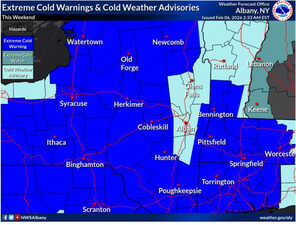
Also prepare for yet another deep freeze (even freezier than it has been) on Saturday. Albany has issued an "extreme cold" warning in from 7 a.m. Saturday through Sunday at 1. 
 
The forecast has "dangerously cold" wind chills as low as 25 to 35 below. 
 
Right now, the warning is targeted for eastern New York State and the southern Adirondacks, but the NWS map shows the frigid air covering all of Western Mass and Southern Vermont and most of Connecticut. 
 
Wind chills this low can cause frostbite on exposed skin in as little as 10 minutes. Frostbite and hypothermia will occur if unprotected skin is exposed to these temperatures.
 
If you must go outside, wear layers, a hat, a face mask and gloves. Keep pets indoors as much as possible. Two cats brought to the Mohawk Hudson Humane Society this week lost the tips of their ears to frostbite. 
 
To prevent water pipes from freezing, wrap or drain or allow them to drip slowly.
 

February 6-7th, 1978: A massive nor’easter buried the northeastern U.S. Storm totals cities, including 18 inches in New York City, 16 inches in Philadelphia, and 14 inches in Baltimore. The Boston, MA, area received 25 to 30 inches in “The Great New England Blizzard.”

[image or embed]

— Weather History (@weatherhistory.bsky.social) February 6, 2026 at 8:08 AM

Tags: cold weather,   

If you would like to contribute information on this article, contact us at info@iberkshires.com.

McCann Making Progress Toward MCAS Targets

By Jack GuerinoiBerkshires Staff

NORTH ADAMS, Mass. — McCann Tech Principal Justin Kratz told the Northern Berkshire Vocational Regional School District School Committee last week that because the school is making substantial progress toward its 2026 MCAS targets, there will be no Massachusetts Department of Elementary and Secondary Education (DESE) intervention.

"So long story short, we are not on DESE's radar for MCAS performance," he said. "At the end of the day, that is what is what we are after."

Kratz said McCann scored "a ton" of points, showing growth in most categories. He said they earned 75 percent of total possible points for all students and 83 percent of all possible points for lowest-performing students.

Kratz noted that DESE tends to change targets and formulas every year. But he drew attention to the year 2025, when a passing MCAS score was no longer a graduation requirement. In 2025, McCann received 33 percent of the possible points and 7 percent for the lowest-performing students. This equaled a score of 20 percent.

"That was the year where everything went off the cliff," he said. "We didn't do very well. This year was 79 percent, and that is knocking it out of the park. ... If we followed up with another 20, we would have been in rough water."

Kratz added this drop was typical across the state, saying he assumed students just took the test less seriously. He wanted to demonstrate how the scores and targets are "reshuffled" and gave a closer look at English scores over the years.

In 2024, the school had a target of 499.3 (average scaled score). The school scored 500.4. In 2025, McCann's new target was 502.5, but McCann scored 485.6. McCann's 2026 target was 487.7, and they scored 486.8.

Kratz said McCann is not scoring as high as they were in 2024, but they are getting more points. He said sometimes the scores needed to be taken with a "grain of salt."

He underlined that although MCAS is important in a vocational education, it only represents half of what a student does in a given school year. 

"There is no MCAS for 50 percent of their time here, which is their trade area," Kratz said. "They [DESE] don't assess that ... so this one little pocket is important, but it doesn't show the entire picture of a student."

Kratz moved from what he called the "good" section of his presentation to the "awesome." He said McCann was recognized as one of 55 schools that drastically improved chronic absenteeism by at least 5 percentage points. He said the school received a letter from DESE congratulating them that included a survey that asked how the school did it.

"It was a nice letter, but we kind of laughed and asked, 'What did we do?' " he said. "I say that sort of tongue-in-cheek because we didn't do any sort of targeted attendance improvement initiative."

He said the more he thought about it, the more he attributed the change to standardized grading and improving the school environment physically and culturally.  

"We didn't do all that wanting to improve attendance. We did it because we wanted to create more equity, and ... I think that is a byproduct of that," Kratz said. "Kids are more likely to want to go to school if that 62 they got on a test does not bury them for the rest of the year. They know they can dig their way out of it. And they are more likely to go to school if the building is a little brighter when they walk in in the morning."

Also, the importance of attendance is baked into the vocational school experience.

View Full Story

More North Adams Stories