Berkshire Museum Donates Cheshire Crown Glass to Town
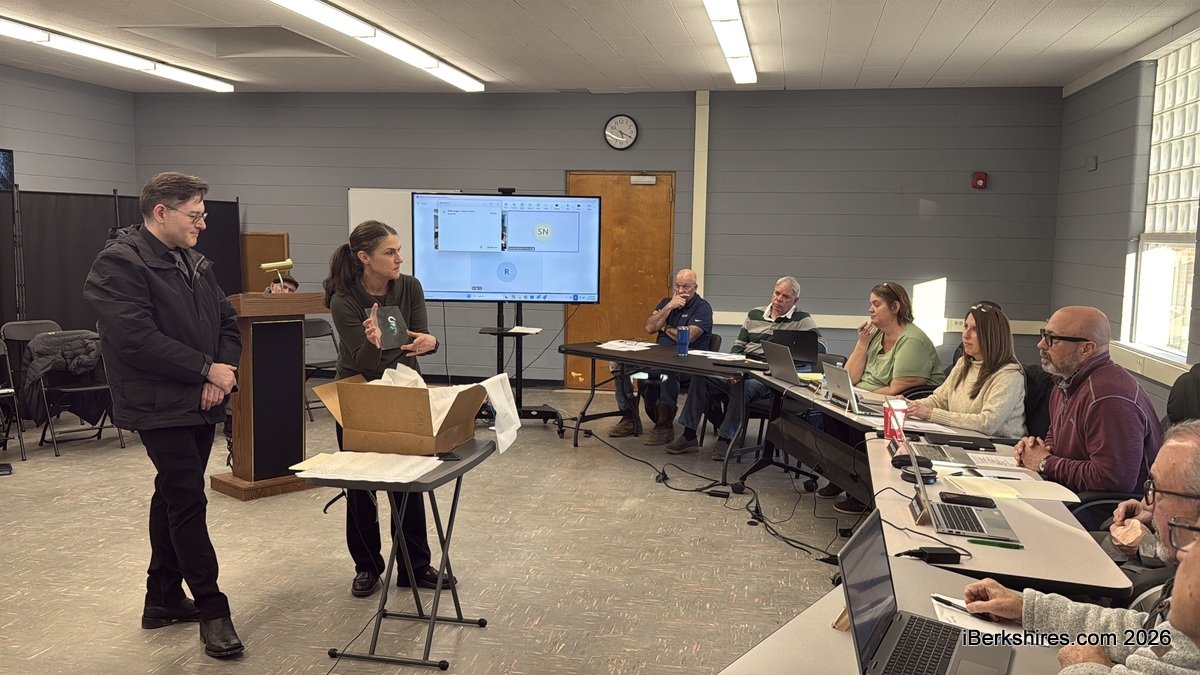
Historical Commission Chair Jennifer DeGrenier and Jason Vivori, Berkshire Museum collections manager, present the antique glass to the Select Board.
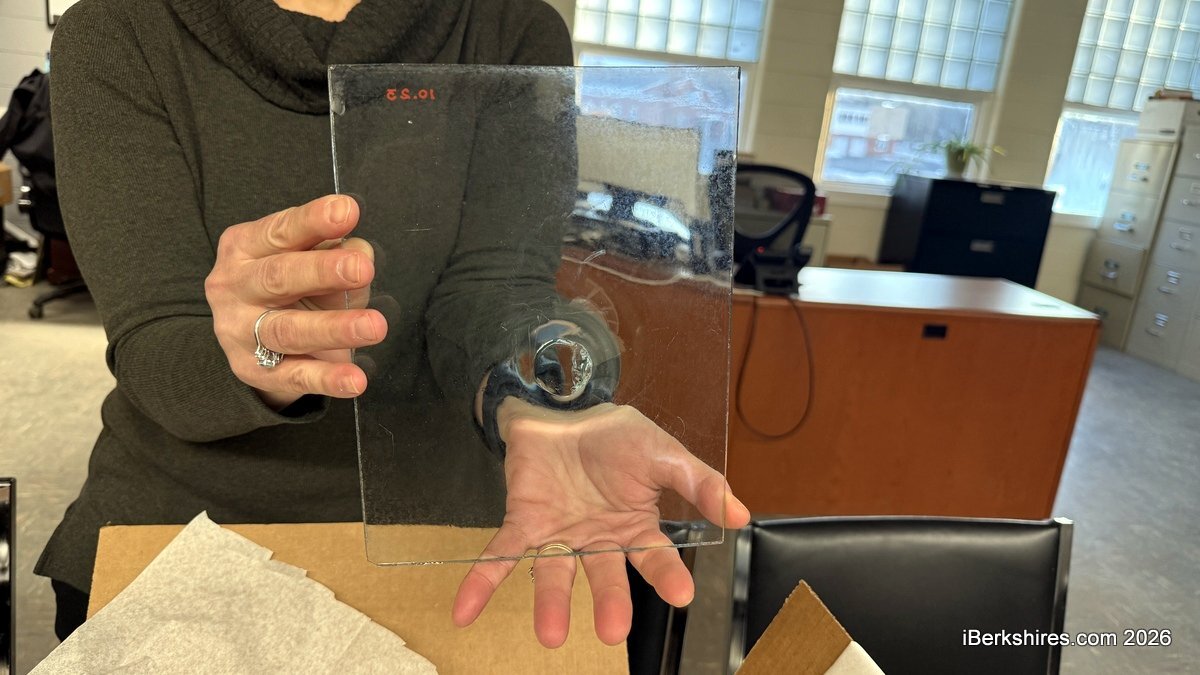
Manufactured in 1814, the artifact was donated by the Berkshire Museum, where it had been since 1910.
The glass will be on display at the town's new museum, located in the old Town Hall at the junction of Church and Depot Streets, alongside research and photographs gathered by the town's local historian Barry Emery.
Prior to being housed at the museum, the piece was at the Berkshire Athenaeum prior to the museum's founding, said Jason Vivori, the museum's collections manager.
The glass was originally used in window making. Its distinctive bull's-eye center was formed when the molten glass was spun on a long rod to form large sheets, Vivori said.
The bull's-eye rendered it unsuitable for windows today, but local historians admire the piece for its preservation, making it unique.
There is another piece of Cheshire Glass in the old Reynolds store, Historical Commission Chair Jennifer DeGrenier said.
"It wouldn't be usable as a window piece because it has this bulls-eye pattern in it where [the rod] was attached. Consequently, they weren't really kept much," Vivori said.
"It's kind of a rare piece to have. I'm not aware of any other ones from Cheshire Crown Glass that do exist besides this one."
The glass has not been exhibited for more than 20 years, so when the museum received the Historical Commission's request to have it returned to the town, the museum was happy to consider it so it could be seen by the public, he said.
"The final determination was that it would best serve the public to get it back into a place where it would be on view," DeGrenier said.
"We just didn't have a place for it in our galleries at the moment, and it really is going to be highlighted here more than it would be in our space."
In the early 1800s, there was an enormous amount of quartzite in Cheshire used for sand and other manufacturing, including a subset of glass companies in the 1812 era, all of which closed by 1900, DeGrenier said.
"I think it surprises people that this area even had any sort of manufacturing … the silica from Lanesborough was used to help make the glass, and that the actual industry it was fairly well done in this area for that time," she said.
Crown Glass was owned by a group of partners and located at was called Scrabbletown, around Wells Road and School Street. It lasted only about five years, which would make any glass it produced a rare find.
People can still find fragments of glass from those long ago companies around Furnace Hill.
"It's not uncommon that you'll hear people in town who have pieces from the companies. So, I think it's just exciting to have a piece of history from 1814 that actually was manufactured in the town and is in such good shape," DeGrenier said.
"And now we can feature that and talk about all the things that happen as a town evolves."
Tags: glass maker, historical, historical commission, industry & manufacturing,