Hoosac Valley Cuts Staffing, Taps Reserves for $24M Budget
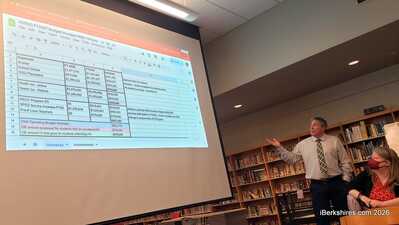 |
CHESHIRE, Mass. — The Hoosac Valley Regional School Committee on Monday approved a level-service budget for fiscal 2027 of $23,990,355 that includes staffing cuts and use of reserve funds.
Adams will see its total assessment rise by $193,745, or just under 3 percent, to $6,814,144; Cheshire's assessment is up about the same, at $196,900, or about 6 percent, to $3,402,982.
Overall, the budget is up 3.22 percent over this year, an increase of $853,719. That's about half what had been proposed in February.
To get there, the district is reducing staff by $362,000, and shifting another $514,000 in staff costs to rural aid and school choice funds.
"Any time you're talking about productions, it's a tough conversation. There are no easy decisions to make," Superintendent Aaron Dean told the School Committee. "We've really looked at how we can utilize staff we have for student support in both the middle school and high school, and kind of reallocate some of the duties similarly."
Cuts include not replacing a retiring full-time school adjustment counselor, which is opposed by the Special Education Parent Advisory Council.
"Many families have spoken up that their students feel comfortable attending school because of the support of the SAC and by spreading the remaining portion to fit, we perceive students losing their confidence to attend school, feeling that they wouldn't have the support that they need in place," a member of SEPAC read in open forum. "SEPAC respectfully urges the School Committee to carefully consider the impact that any proposed reductions they have on the district's ability to meet its legal obligations."
Dean said the district "will take that opportunity to kind of reassess duties across the district from that office" during the summer. He pointed out that there's months to go before the school year starts in the fall, and opportunities may open up.
"We could find that Rural Aid gets funded to $60 million and poof all, our problems are solved, in an ideal world," he said. "But the reality is things are going to change quite a bit."
Also among the reductions are a full-time equivalent position in media at the elementary school, a STEM position in the middle school, a SPED coordinator and a secretary. Another half million in staff costs will shift to Rural Aid and school choice funds.
The district also has to absorb half of the four preschool teacher salaries for the early child care program at about $176,000. The state grant changed the salary coverage after the district's budget was approved last year, but working with state Rep. John Barrett III, Hoosac was able to get a waiver. Dean said he is hoping for an earmark to cover those salaries after discussions with state Sen. Paul Mark.
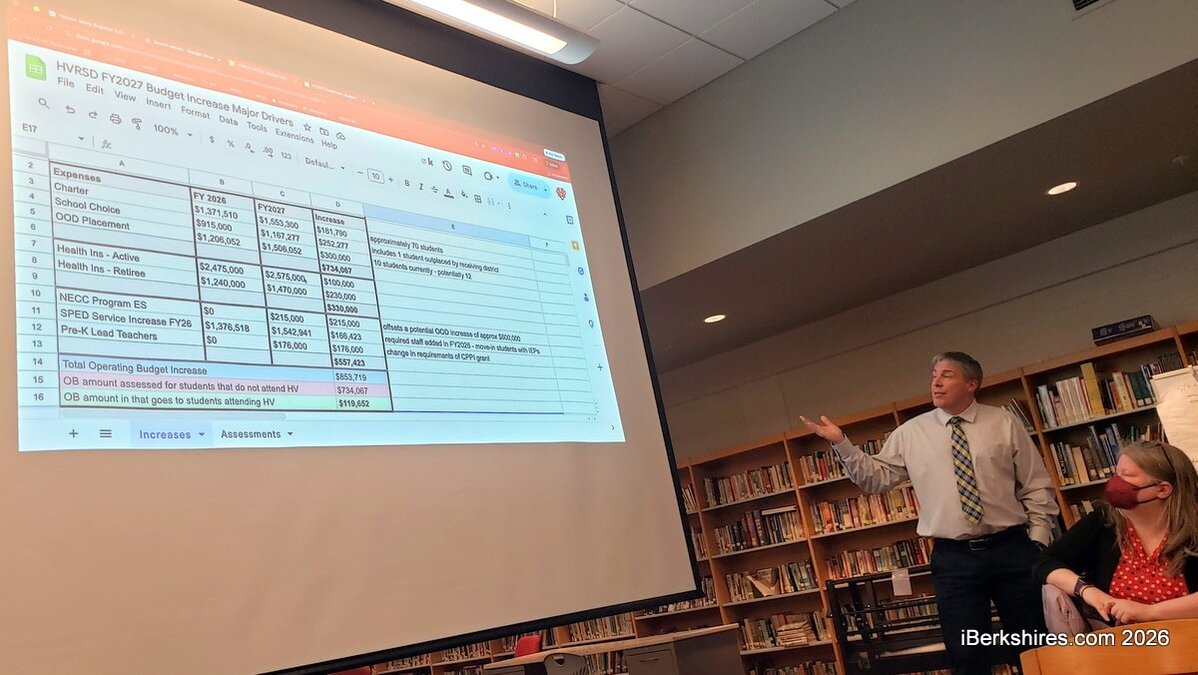
The major drivers are special education costs, including out-of-district placements, and insurance, as well as students school choicing out and charter school tuition, for about $10,012,070, or almost half the budget. That's up about $1.6 million over this year.
It's estimated close to a dozen students will be in specialized out-of-district programs for fiscal 2027.
"Many of the students that we talk about in out-of-district placements never set foot in our doors," said Dean. "Occasionally, we have a student that goes through the process with us, and we end up out-placing. But most of those students, we assume financial responsibility. We've never seen those students."
One way to cut down on those costs is to provide services in house, he said, and the budget reflects investing $215,000 in a program "that we've had tremendous success with on the middle school level and looking to replicate that work across the district, because it gives us some key ideas in terms of how to meet the needs of these students," he said.
"It gives our students what they deserve. It allows them to get educated with their peers and their community, which I think is important piece."
The superintendent estimated the district could save another $600,000 by keeping student in-district through this program.
The increase in the total operating budget is about $853,000, and the additional cost for students not attending Hoosac Valley is $734,000.
"The money that's coming out of our operating budget for our students is $119, 652," Dean said. "This is the number that's really being allocated from that budget, because we've outsourced and we've done different things with our money. So when we're asking for money, we're asking for $119,652 to service the students that walk through our doors. I think that's a pretty striking number in terms of that."
The committee first voted for salaries and insurance in the absence of members Adam Emerson and Robert Tetlow, both of whom have direct family members who would benefit. After that unanimous vote, Emerson and Tetlow returned to the table to vote the budget items of the total budget, the assessments for the towns and the transfer of $275,000 from excess and deficiency funds to reduce the budget.
In other business, the committee accepted $20,000 from the William J. and Margery S. Barrett Fund and $10,000 from Specialty Minerals toward the construction of an outdoor classroom. A groundbreaking is planned for April 15.
Tags: fiscal 2027, HVRSD_budget,