Reps. Leigh Davis, Bud Williams Filing Legislation Honoring Freeman
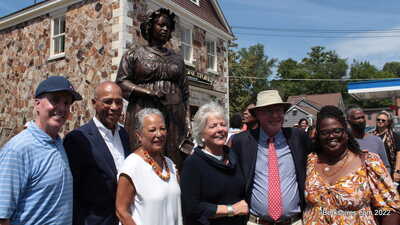 |
| Former Gov. Deval Patrick and then 3rd Berkshire Rep. Smitty Pignatelli attended the unveiling of Elizabeth Freeman's statue in 2022. |
SHEFFIELD, Mass. — State Reps. Leigh Davis of the 3rd Berkshire District and Bud L. Williams, of the 11th Hampden District, are filing legislation establishing Aug. 22 as Elizabeth Freeman Day of Equality, Healing, and Remembrance in the commonwealth.
The legislation would direct the governor to annually issue a proclamation recognizing the courageous contributions of Elizabeth Freeman, an enslaved Black woman known as Mum Bett, whose landmark freedom suit helped spark the legal end of slavery in Massachusetts.
"Elizabeth Freeman's story began here in the Berkshires, but its impact reached every corner of the commonwealth," said Davis. "More than two centuries later, her legacy continues to inspire us. Establishing Elizabeth Freeman Day will ensure that future generations learn not only about her extraordinary bravery, but also about the power of one person to change the course of history."
In 1781, Freeman, of Sheffield at the time, challenged the institution of slavery by filing suit against her enslaver, Col. John Ashley. In the landmark case Brom and Bett v. Ashley, a Berkshire County jury ruled in favor of Freeman and her fellow plaintiff, Brom, granting them their freedom. The case demonstrated the power of the Massachusetts Constitution's declaration that all people are born free and equal and helped pave the way for the Quock Walker decisions that ultimately ended slavery in the commonwealth.
"Freeman's courage changed the course of history in Massachusetts," said Williams. "At a time when the odds were stacked against her, she stood up and demanded that the promises of liberty and equality contained in our Constitution apply to her as well. She risked everything to challenge an unjust system, and her victory helped lay the foundation for the end of slavery in our commonwealth. Her legacy deserves to be recognized and remembered by every resident of Massachusetts."
Although unable to read or write, Freeman understood the meaning of freedom and equality and took extraordinary action to secure those rights for herself and others. Her story remains one of the most powerful examples of individual courage in the face of injustice.
Elizabeth Freeman Day will provide an opportunity for reflection, education, healing, and remembrance, said Williams.
"Her story reminds us that progress is often made because ordinary people perform extraordinary acts of courage. By honoring Elizabeth Freeman, we honor not only her struggle for freedom, but also the ongoing pursuit of equality and justice for all. Her example teaches us that courage is contagious," he said.
Freeman was represented by attorney Theodore Sedgwick and a bronze statue in her honor stands in front of the Old Parish Church in Sheffield, across the street from Sedgwick's home at the time. She is buried in the Sedgwick "pie" in Stockbridge Cemetery.
The proposed observance would serve as an annual opportunity for residents, schools, community organizations, and local governments to learn about Freeman's contributions to Massachusetts history and the broader struggle for civil rights and human dignity.
The legislation establishing Elizabeth Freeman Day of Equality, Healing, and Remembrance is being filed for consideration during the current legislative session.
Tags: elizabeth freeman, legislation,