Dalton Voters Nix Mobile Tiny Homes, Approve Clean Air Funds
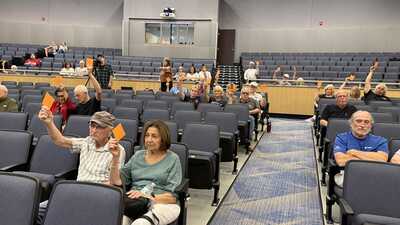 |
| Dalton voters weigh in on articles at Monday's special town meeting. |
DALTON, Mass.— The two-year-long effort to implement movable tiny homes in the town's bylaws failed during a special town meeting on Monday.
Fifty-seven voters approved only four of the six articles on the warrant during the meeting that lasted a little more than an hour.
The articles on the movable tiny houses, articles 5 and 6, failed 20-41, following an amendment and a discussion that lasted a little over half an hour. This topic was one of the most anticipated prior to the meeting.
For more than two years, Amy Turnbull has been advocating to amend the bylaw, but has met obstacles delaying the effort. She took the situation into her own hands by spearheading a citizens' petition to put it on a town meeting warrant after the discussion was tabled during multiple Planning Board meetings.
During her presentation, she reiterated arguments she made during previous meetings, specifically how moveable tiny houses are a more affordable option in addressing the housing crisis and align with the town's master plan.
Although the state has made accessory dwelling units allowed by right to help address the housing crisis, ADUs now cost more than $300,000 to build. Movable tiny homes offer a lower cost way to add a dwelling unit on a lot, she said.
"Originally, I wanted this bylaw to be an ADU bylaw, but because I felt like it was important to put a special permit into it," Turnbull told iBerkshires.
"[However,] the attorney's office confirmed that that was not possible to do because an ADU is a by-right use, so at the 11th hour we had to move the language into a different category, which is accessory use."
This "muddled" communication between Turnbull, as a citizen's petition, and the town's attorney made it challenging to develop language to accurately represent the goal of the article, she said.
In a follow-up with iBerkshires, Turnbull explained she was not surprised by the result.
"I think there's probably a history that petition articles fail, and having the support of the planning board is paramount, but when you've got people on the planning board that use their personal opinions and bias, and keep tabling meetings. It's difficult to make change," she said.
The Planning Board voted to neither recommend nor oppose the articles on movable tiny houses following a public hearing that was requested during the annual town meeting, where the topic was "tabled."
Those against the article argued that it was too vague and incomplete and lacked clear limits on the number of units, placement rules, and detailed standards for height, design, and utilities.
During her presentation, Turnbull said that tiny homes could be designed to match the architecture of the neighborhood.
Opponents of the articles said requirements to have the unit align with the neighborhood design were not delineated in the proposed bylaw, so it was not a guarantee. They also raised concerns about the neighborhood impacts and town finances, specifically how it should be taxed and the impact it may have on property values.
With the failure of the articles, Turnbull said she was not sure how to proceed, whether it's moving to Great Barrington, where movable tiny homes are permitted, advocating for state legislation, specifically Bill 1474, or looking into buying "a really big, ugly trailer" to put on her property.
In a follow-up, Town Manager Eric Anderson said that if voters choose to, they can "resurrect" the item at a future town meeting via citizens' petition, whether it's with the same or alternative language.
For over a year, the town has also been navigating how to address sand allegedly leaving Berkshire Concrete's unauthorized dig site.
During the town meeting in May, voters approved Article 9, transferring $50,000 to fund the pending litigation between the town and Berkshire Concrete.
During the special town meeting on Monday, voters also approved establishing a Clean Air Committee line item in the budget and its sister article requesting the appropriation of $20,000 to fund the Clean Air Committee's efforts in gathering data.
Prior to the annual town meeting in May, the finance committee approved a budget of $20,000 for the Clean Air Committee budget but it was never added to the budget voters approved.
The article initially requested $20,000, but was amended to $27,000 to cover the cost of two things: funding for an air monitoring report for the fall and an assessment of the town's Purple Air monitors
In January 2026, the Clean Air Committee was awarded a grant for five PurpleAir monitors and the Berkshire Regional Planning Commission.
They were placed at locations throughout town, including Town Hall, Wahconah Regional High School, Craneville Elementary School, the Senior Center, and the housing across from Pinegrove Park.
During a special town meeting in June 2025, voters approved $59,000 to fund professional and technical work to ensure the compliance of the Berkshire Concrete Corporation with town bylaws.
This funding helped fund a five-month study outlined in a report developed by Air Partners Collaborative of Needham. The town hopes to have another report published in the near future, Select Board member Antonio "Tony" Pagliarulo said.
The published report was due in the fall; however, because of the pending litigation, the town asked the air partners to submit the assessment earlier.
"That information is going to be used as data to substantiate any claim of dust being swept or blown across to neighbors' property," Pagliarulo said.
"That report again- this is my opinion- indicates correlation. We've been told by Berkshire Environmental, a group whom we employed last year, that causation has to be over a three-year period.
"So, we're looking to collect data at least for a three-year period, and that data is being used in terms of litigation. This report has been passed on to KP Law. Additional data through PurpleAir monitors will hopefully substantiate cleaner air somewhere versus air not so clean somewhere else."
Last year's appropriation also included funding for dust sample collection and analysis at Berkshire Concrete's property and neighboring properties. However, in an August meeting with Berkshire Concrete, the town was assured it would be provided samples.
"We were ready to take those samples, and we were not permitted access to the property to sample that," Pagliarulo said.
"That was our intent; however, BCC refused access and refused permission for us to enter their property and sample the sand. So, we have samples from the adjacent properties but not from BCC."
The sand collected from the adjacent properties has not yet been analyzed, he said.
All other articles on the warrant passed with no discussion or further clarification.
Tags: special town meeting,