Pittsfield's to Host Public Meeting to Present the Draft Master Plan

Print Story | Email Story

PITTSFIELD, Mass. — The City of Pittsfield's Department of Community Development, in collaboration with VHB, is hosting a public presentation and input session as part of the final steps in preparing the city's Master Plan, Pathway to 2036.

Over the past year, the Department has been engaged in a comprehensive planning process to develop a Master Plan designed to guide Pittsfield's future growth and change, while preserving its character and honoring the community's shared values. The revised Master Plan will serve as an essential policy document for the city's physical development, addressing important topics such as land use, infrastructure, and sustainability.

This meeting marks the third public gathering focused on the creation of the Master Plan for Pittsfield.

The meeting will take place on Wednesday, Sept. 2 at 6:00p.m. at City Hall, Council Chambers, located at 70 Allen Street.

During the meeting, the draft Master Plan will be presented to the public. Members of the public are encouraged to attend, review the plan, and share their feedback.

For additional details about the meeting, contact:


If you would like to contribute information on this article, contact us at info@iberkshires.com.

Pittsfield Man Creates Device to Clear Lakes of Algae Blooms

By Breanna SteeleiBerkshires Staff

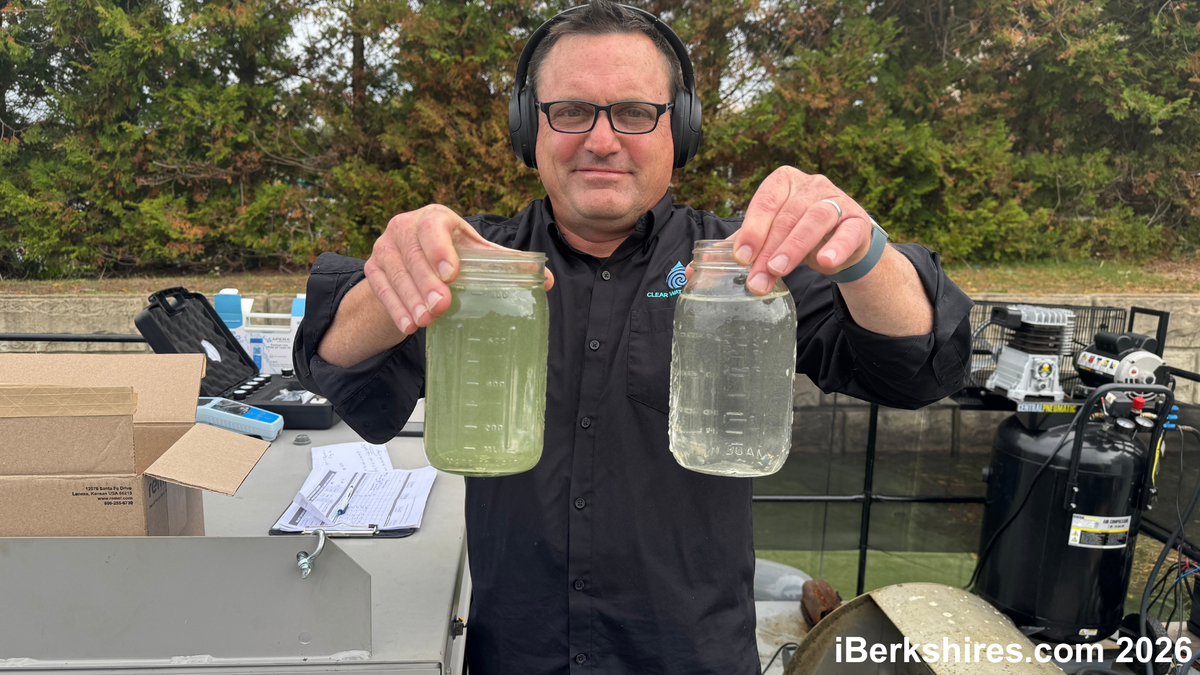
Marc Bellora holds a jar of lake water, left, to compare to water cleaned by his Aqua Clarifier Water System.

PITTSFIELD, Mass. — Marc Bellora has high hopes for a device he's created to treat lakes from harmful algae blooms.

His patented water clarifier can physically remove captured material rather than letting the nutrient-rich material settle back into the lake, which occurs when herbicides are used.

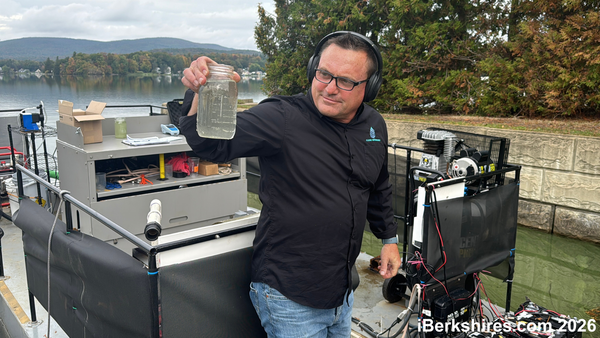
"It's a long-term lake management tool that can be used to reduce legacy nutrients in lakes and ponds over time," he explained. "We built the prototype, this is a prototype. It does approximately 65 to 70 gallons per minute. It's very environmentally friendly. Can be used with air only, or we can use a low-dose potable polyaluminum chloride (PACL) or chemical on board that can help improve results."

The water clarifier barge is based on well-proven technology for water treatment, he said. "It's a self-contained, portable, mobile unit that removes algae blooms, nitrogen, phosphorus, and the associated nitrogen and phosphorus within lakes."

Bellora founded Clear Waterways Group with business partner Mark Simon. They built a prototype mobile unit and are still working out the kinks. It's taken Bellora about five years to bring the project to fruition as he is also a full-time Realtor.

He says the repurposed barge they use has a device that uses air to filter the water to separate harmful bacteria or uses a chemical at low doses. They are testing both to see how well each does at cleaning the water.

"They would do the same thing here, except they would spray it, and it blocks all that stuff together," Bellora said of the use of herbicides. "But then it drops to the bottom. So now all the nutrients that are attached in that plot go to the bottom and contribute to the legacy nutrients only to fuel next year's bloom. Ours removes it."

He said just using air alone has removed 70 to 90 percent of harmful algae where he has been operating on the south end of Pontoosuc Lake.

"Essentially, we take in the bad stuff, we take in the lake water. We separate the good stuff from the bad stuff. Clean water goes back into the lake, and the bad stuff can either be composted, or it can be taken to the wastewater treatment plant, which is what we're doing here," he said. 

Bellora explained that tiny air bubbles attach to particles in the water, making them buoyant so they rise and can be removed. The unit can operate with air alone, or with a low dose of potable polyaluminum chloride.

PACL helps through flocculation: it gathers small particles into larger clumps that are easier for air bubbles to capture. He said this can help remove dissolved nutrients that air alone may not capture as effectively. 

Bellora said he was inspired to build something like this after noticing the lakes he enjoys being shut down because of algae blooms. 

The city issued a health advisory for Pontoosuc in August, warning residents not to swim or come in contact with the lake water because of an algae bloom. The cyanobacteria can cause skin irritations, vomiting and diarrhea and nerve or liver problems. 

Bellora previously worked for a company that used traditional dissolved air flotation (DAF) systems to treat water. In that role, he traveled around the country to work at paper mills and food-processing plants.

That experience gave him a practical understanding of DAF, and while flying between jobs, he would see green ponds and wonder whether the technology could be adapted to treat lakes. 

View Full Story

More Pittsfield Stories