MassWildLife: Unexpected river hitchhikers
Print Story | Email Story
Provided photo

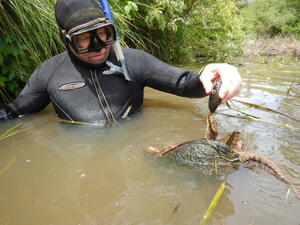
BOSTON — Freshwater mussels are not known for speed and most only move a few meters per week. But biologists from MassWildlife and collaborators in other New England states discovered some may have found a faster way to travel: hitching rides on turtles. 

While freshwater mussels are no strangers to hitchhiking, they typically travel only during their earliest life stage. Species such as the eastern elliptio (Elliptio complanata) disperse by releasing microscopic larvae into the water that temporarily attach to the gills or fins of fish. After developing, the young mussels detach—often far from where they began—and settle into the riverbed, where they spend the rest of their adult lives moving only short distances. 

But, what biologists thought they knew about adult mussels changed when they recently discovered some adult freshwater mussels traveling around by attaching to turtles. The first observation occurred in 2007, when a male wood turtle was seen walking along the river bottom with an eastern elliptio firmly attached to its right hind foot. 

Since then, researchers have documented eight observations involving three turtle species in three New England watersheds. In nearly every case, the mussels were attached to a turtle's claws or feet. Although the behavior appears to be uncommon, seeing the same pattern repeated across multiple turtle species and watersheds suggests these encounters are more than isolated accidents.

These observations are more than an unusual wildlife story—they could change how scientists understand freshwater mussel movement. Until now, biologists thought mussels mainly moved upstream as larvae attached to fish hosts and traveled downstream through flooding events. Adult mussels traveling on turtles introduces another pathway for dispersal. If turtles occasionally carry attached mussels over land between streams or watersheds, they could connect populations that were previously isolated. Even rare movements like these could have important implications for the genetic diversity of freshwater mussel populations.

This mussel behavior appears rare today—researchers documented these mussel-turtle interactions only after more than 11,000 direct observations of turtles. Yet that rarity may not reflect how often the behavior occurred in the past. Wood turtles and freshwater mussels were once far more abundant, meaning these encounters may have been a more routine part of New England’s river ecosystems. The discovery offers a glimpse into ecological connections that may have become harder to see as species have declined.

Many questions remain. Researchers still don't know how often adult mussels hitch rides on turtles or how this relationship may impact mussel and turtle populations. But each new observation adds another piece to the puzzle and reminds us that the natural world is often more connected—and more surprising—than we realize.
 

If you would like to contribute information on this article, contact us at info@iberkshires.com.

Pittsfield Man Creates Device to Clear Lakes of Algae Blooms

By Breanna SteeleiBerkshires Staff

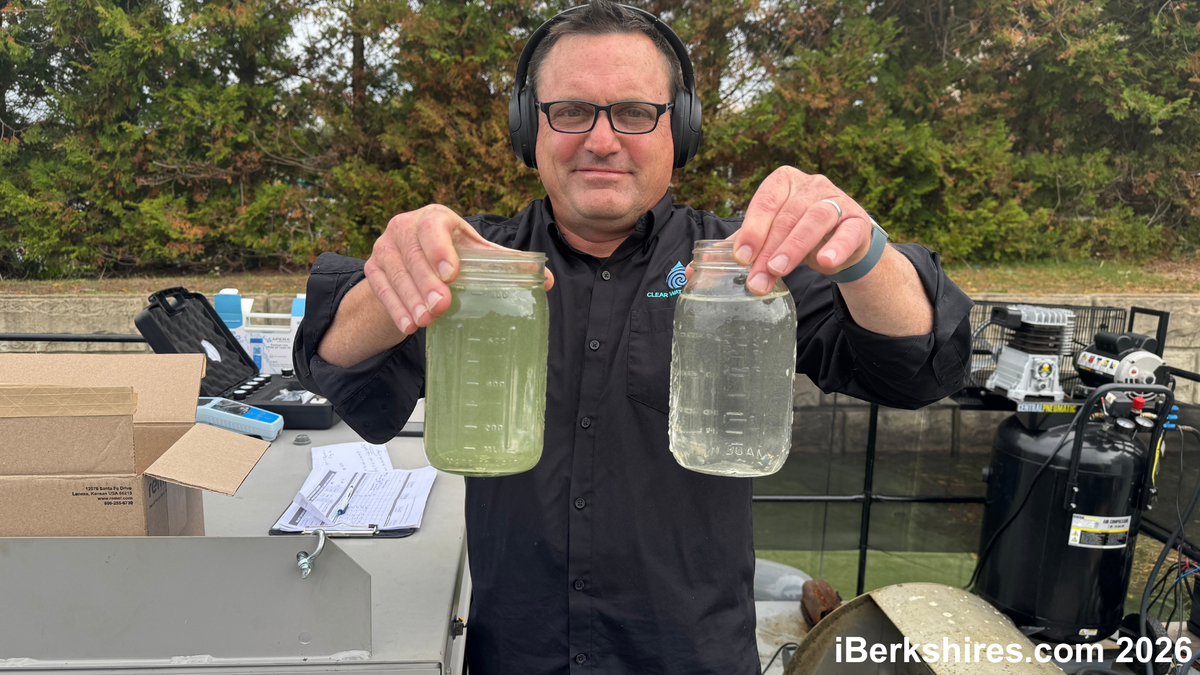
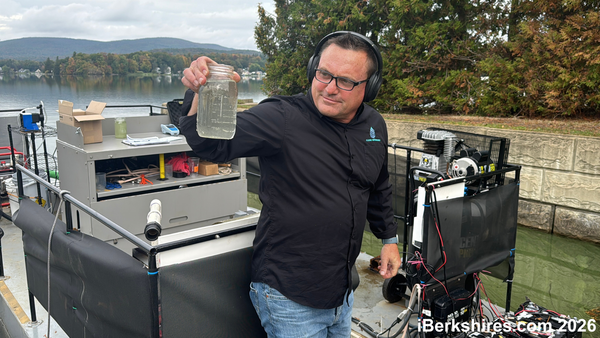
Marc Bellora holds a jar of lake water, left, to compare to water cleaned by his Aqua Clarifier Water System.

PITTSFIELD, Mass. — Marc Bellora has high hopes for a device he's created to treat lakes from harmful algae blooms.

His patented water clarifier can physically remove captured material rather than letting the nutrient-rich material settle back into the lake, which occurs when herbicides are used.

"It's a long-term lake management tool that can be used to reduce legacy nutrients in lakes and ponds over time," he explained. "We built the prototype, this is a prototype. It does approximately 65 to 70 gallons per minute. It's very environmentally friendly. Can be used with air only, or we can use a low-dose potable polyaluminum chloride (PACL) or chemical on board that can help improve results."

The water clarifier barge is based on well-proven technology for water treatment, he said. "It's a self-contained, portable, mobile unit that removes algae blooms, nitrogen, phosphorus, and the associated nitrogen and phosphorus within lakes."

Bellora founded Clear Waterways Group with business partner Mark Simon. They built a prototype mobile unit and are still working out the kinks. It's taken Bellora about five years to bring the project to fruition as he is also a full-time Realtor.

He says the repurposed barge they use has a device that uses air to filter the water to separate harmful bacteria or uses a chemical at low doses. They are testing both to see how well each does at cleaning the water.

"They would do the same thing here, except they would spray it, and it blocks all that stuff together," Bellora said of the use of herbicides. "But then it drops to the bottom. So now all the nutrients that are attached in that plot go to the bottom and contribute to the legacy nutrients only to fuel next year's bloom. Ours removes it."

He said just using air alone has removed 70 to 90 percent of harmful algae where he has been operating on the south end of Pontoosuc Lake.

"Essentially, we take in the bad stuff, we take in the lake water. We separate the good stuff from the bad stuff. Clean water goes back into the lake, and the bad stuff can either be composted, or it can be taken to the wastewater treatment plant, which is what we're doing here," he said. 

Bellora explained that tiny air bubbles attach to particles in the water, making them buoyant so they rise and can be removed. The unit can operate with air alone, or with a low dose of potable polyaluminum chloride.

PACL helps through flocculation: it gathers small particles into larger clumps that are easier for air bubbles to capture. He said this can help remove dissolved nutrients that air alone may not capture as effectively. 

Bellora said he was inspired to build something like this after noticing the lakes he enjoys being shut down because of algae blooms. 

The city issued a health advisory for Pontoosuc in August, warning residents not to swim or come in contact with the lake water because of an algae bloom. The cyanobacteria can cause skin irritations, vomiting and diarrhea and nerve or liver problems. 

Bellora previously worked for a company that used traditional dissolved air flotation (DAF) systems to treat water. In that role, he traveled around the country to work at paper mills and food-processing plants.

That experience gave him a practical understanding of DAF, and while flying between jobs, he would see green ponds and wonder whether the technology could be adapted to treat lakes. 

View Full Story

More Pittsfield Stories