Northern Berkshire United Way: 1990's Big Goals, Shifting Needs
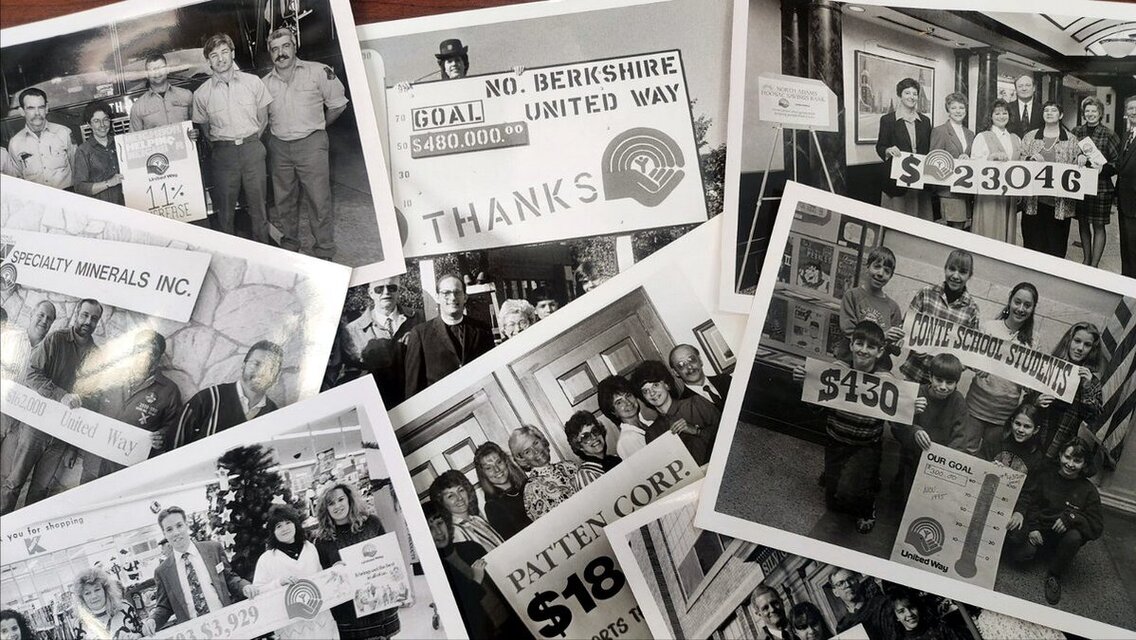
Northern Berkshire United Way is celebrating its 90th anniversary this year. Each month, we will take a look back at the agency's milestones over the decades. This part looks at the 1990s era as reported in the North Adams Transcript.
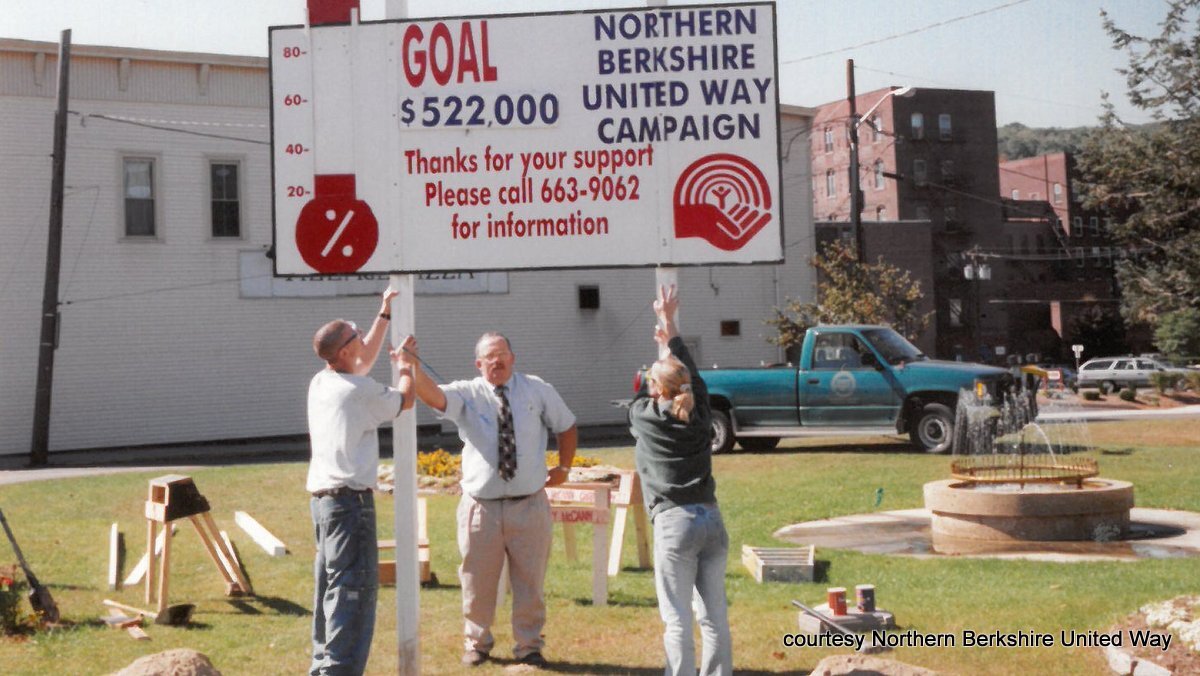
Northern Berkshire United Way saw its campaign goals rise to a half-million or more over the decade.
It wasn't easy; the area was still reeling from closures and layoffs, including from General Electric and Waverly Fabrics. The first campaign of the decade saw a historic $500,000 goal only meet 93 percent of its goal.
"We lost tens of thousands of dollars from firms and employees that contributed last year," said Daniel Bird, board vice president told the 150 gathered for the 1990 campaign conclusion, as reported by the Transcript. "There were just fewer to give because of closings and layoffs. What we did see were tens of thousands in new and increased gifts which brought us to the high percentage of goal, and we are grateful."
The agency lowered its sights to $480,000 the following year and beat that number, possibly by pulling out all the stops. The four co-chairs that year could heavily rely on prayer — the Rev. Lawrence Provenzano of St. John's, the Rev. Betty Lou Ure of First Congregational, and Lts. Cheriann and Kevin Stoops of the Salvation Army.
They even sang a rap song that year, with lyrics including "the United Way is in our town to help the people who are down / some are young, some are old, some are living, some are cold / but you are here to make this work, to raise the funds, you will not shirk!"
Mayor John Barrett III and state Rep. Daniel Bosley promised a "big splash" for the campaign with a set up photo of a "plunge" into a wading pool. (They had promised the YMCA pool but were in Boston to talk about a museum in the former Sprague complex.)
Provenzano thought the success was because "people knew how desperate the situation was."
"Even the little guys, those who didn't have a lot to give, gave," said Ure, who added that they stressed every contribution was important. "You put that together and you get a miracle."
The campaign came close the next two years with Executive Director Arlon Nelson noting the "lingering recession and stagnant economy."
As the decade wore on, employee contributions from local industries and business became of critical importance to the annual campaign. It was noted that Hoosac Bank's employee participation in 1991 was 100 percent for the 34th consecutive year, and Pfizer and its successor, Specialty Minerals Inc., made up nearly a quarter of annual contributions.
The Adams operation was so important that its President Paul R. Saueracker was the keynote speaker at the agency's 60th annual meeting.
He pledged his commitment to supporting the United Way, explaining that members of his family had to benefited from its services. The company at that time was matching employee donations dollar for dollar up to $90,000, and had been since 1979. By 1995, it had contributed $1,428,232.
The year before, Northern Berkshire United Way had exceeded its goal and only missed it once by a few hundred dollars for the rest of the 1990s.
The agency also saw three executive directors that decade. Nelson retired in 1995 after 15 years leading the organization and was awarded the United Way Medal of Service by United Ways of Massachusetts Association.
Stepping in was Janet Weyers, a North Adams native who'd been working in the nonprofit field in Maryland. She was credited with overseeing the three highest campaigns in the agency's history, developing an endowment fund and educational program, and modernizing the website and office software.
She left in 1999 to become director of the Greater Bennington Chamber of Commerce and Robert Barton, coming from administrative roles in higher education, lastly at Williams, became the latest director.
Northern Berkshire United Way's partner agencies numbered between 16 and 17 and, as in previous decades, its focus changed with social conditions.
By the '90s, more attention was being paid to homeless, substance abuse and domestic and child abuse. Louison House would come on as an affiliate along with Berkshire Council on Alcoholism and Addictions and the Women's Service Center.
But it would cut ties with Boys Scouts of America after being unable to come to a compromise over non-discrimation policies, and it would withhold dues to the national organization (along with other chapters) over questionable salaries and financial management.
United Way has always depended on its volunteers, upwards of 500 by this time, many of whom worked largely behind the scenes.
"The United Way is not a faceless charity," then President Arthur Kelly III said at one campaign conclusion. "As we look around the room, we see the faces of the service providers, the volunteer workers, and the contributors. As we look around the community we serve, we see our friends, our neighbors, our loved ones."
Marion Manion, active and an officer in NBUW since 1969, was awarded the 1989 volunteer of the year because she had moved to Cape Cod. Katherine Hadley, part-time librarian and charter member of the Red Feather Society, left more than $100,000 to NBUW, its most significant gift to date.
The community raised funds through chicken dinners at Boston Sea Foods and 25 cent burgers at McDonalds. United Way and college officials served dinner to the Massachusetts College of Liberal Arts' Multicultural Student Society after they raffled a 20-pound lobster, taken Head Start children trick-or-treating and raised money for food donations.
North Adams Regional Hospital employees held a Beanie Baby raffle; Starlight Stage, under the direction of Robert and Gail Burns, had its opening performance benefit NBUW; and the Hoosac Valley High School Student Council raised $1,200.
Despite all this, NBUW found itself with a significant funding gap of $640,000 by 1999, a result of revenues not keeping up with inflation. Ten programs had to be discontinued, only one of three new programs granted, and 18 increased funding requests denied.
John Lipa, that year's campaign chair, was looking to the "new" economy of tourism, arts and technology for donations, and asking Red Feather to consider higher levels of contribution.
The goal was an ambitious $580,000, some $50,000 above the successful 1998 target.
That goal was not only met, it was spectacularly exceeded at $659,350, a 24 percent increase over the previous year, closing the gap and setting up the organization for the next decade.
"This is a stunning accomplishment," said Lipa. "And everyone involved should take a bow."
Tags: NBUW,