Williamstown's Gas Supply Is at Capacity, and Economic Development Is at Stake
WILLIAMSTOWN, Mass. — For more than a decade, town officials have been grappling with how the Village Beautiful can spur economic development.
Last week, the Select Board heard about a major impediment the town can do nothing about.
"Berkshire Gas had reached out to me last week," Town Manager Robert Menicocci told the board during his report at the twice-monthly meeting. "I did meet with them, and they're reaching out to let us know they're out of capacity for Northern Berkshire.
"The pipeline that comes up through North Adams and feeds into us is at its maximum capacity. So there will be no additional installations for the very foreseeable and, probably, distant future."
That means that soon no more new residential or commercial hookups for natural gas will be available in town. And new development is exactly what Williamstown has been hoping to spur, particularly in its population center.
Economic development was the focus of an intensive, yearlong town study in 2015. It has been at the heart of many of the initiatives of the town's Planning Board in recent years. And it has been a rallying cry of the Finance Committee, which has consistently told residents that without "new growth" in the property tax base, the spiraling tax burden will continue to be split among existing taxpayers.
As recently as Aug. 24, during the Select Board's annual tax classification hearing, Town Assessor Christopher Lamarre told the panel why growing the tax base is the only way to avoid either cuts to town services or a Proposition 2 1/2 override vote.
"How do we determine the maximum allowable levy? It is last year's levy plus 2.5 percent plus any debt exclusions plus new growth," Lamarre said. "So that says right there how important new growth is, because if we get big numbers of new growth, it allows us some breathing room. And, of course, it expands the overall tax base for everyone to share the levy. When your tax base is constricted, the [pre-existing] taxpayers are the ones who have to eat any increase whatsoever."
Now comes word that any new projects that come to town will have to work around impending limits on access to natural gas and another common utility.
"So if someone builds a new house or new office, it will have to be electric?" board member Stephanie Boyd asked Menicocci.
"Of which we have no capacity either," the town manager replied.
"[The Berkshire Gas communication] was not good news because we're already jammed up on [electric] grid capacity where we have a megawatt or less of capacity there. I know the college had a great need for electricity and natural gas and was recently told, 'No,' by Berkshire Gas for something they're trying to do right now.
"Everything we're talking about like options and development expansion and all that, this puts the squeeze on things, for sure."
Generally speaking, developers of new projects work in advance to make agreements with utility companies before a shovel goes in the ground, Williamstown Community Development Director Andrew Groff said Tuesday in email responding to a request from iBerkshires.com.
"It's my understanding we're not yet under a [natural gas] moratorium, so this hasn't come to pass yet," Groff continued. "It could have big implications though for the ARC project the college is planning to replace all of the indoor athletic facilities."
Several municipalities in Franklin and Hampshire Counties already live with a moratorium on new gas hookups. At Monday's meeting, Select Board Chair Peter Beck asked Menicocci if he had reached out to his colleagues in those town halls.
Menicocci said he could, but, "I think it's going to turn out they're less constricted with the electrical grid," than Williamstown.
Menicocci said state officials in Boston and nearby New York State are not keen on approving expansion of infrastructure of natural gas, which the current administrations perceive as a "dirty" energy source.
Boyd said the coming natural gas moratorium for Williamstown and other Berkshire County communities could spur state officials to pressure National Grid to expand the electricity grid.
"It's the state who has to say you have to invest," Menicocci said. "But, ultimately, even if that's the case, the bad news is ratepayers have to pay for anything. We already know it's a $100 million project. That's part of why National Grid isn't too excited about doing it, because they don't want to hit everyone with ridiculous rate increases. They don't think it's marketable to increase the capacity."
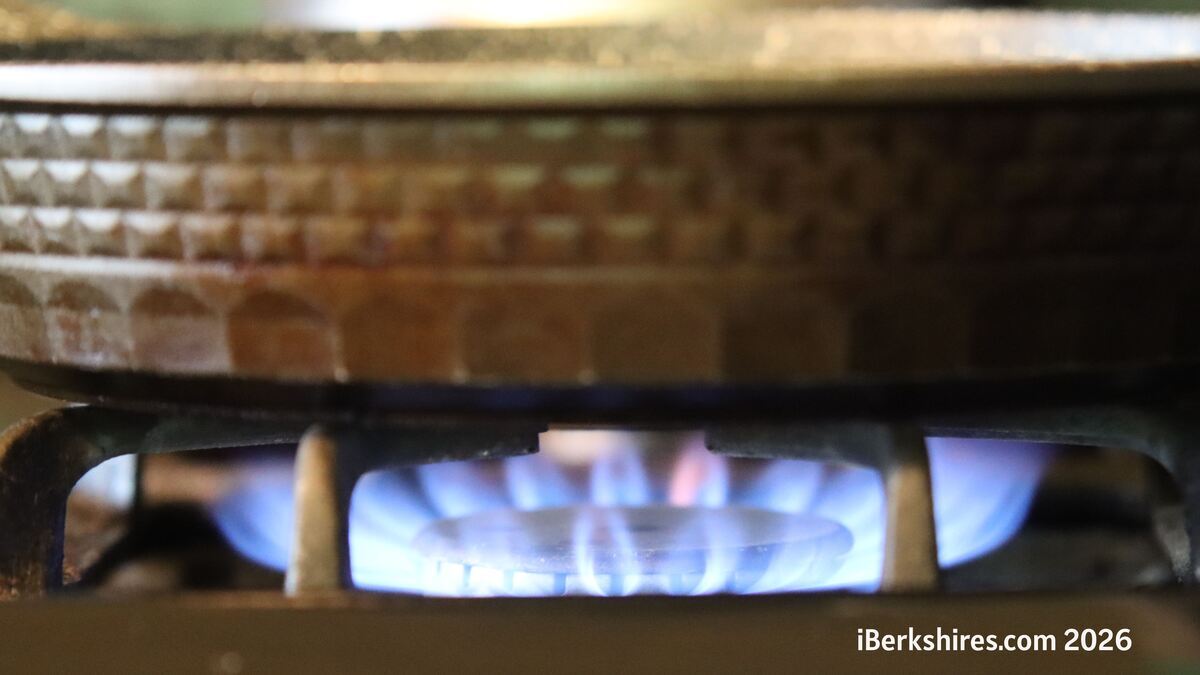
In the meantime, the natural gas moratorium, when it's official, means no more new residential hookups or even, for homes that heat with natural gas, hookups to put in a gas oven in the kitchen or run a line to an accessory dwelling unit on a residential property.
"I know you're saying the electrical grid is super tight," Select Board member Matt Neely said as the board thought through the implications of declining utility availability. "It sounds like that would be a real constraint on any new homes being built at any scale that would make a difference."
Menicocci said residential solar electric system might be an option, but it would need to be a battery-based system.
"If you were to look at battery storage, which is a whole other thing you guys want to tackle and take on as a nice hot topic, that is one of the few options," the town manager added.
In other business on Monday, the Select Board had a lengthy discussion about a proposal to hang "Hometown Heroes" banners honoring local veterans on utility poles and discussed two issues related to traffic safety in town.
Boyd raised the issue of service providers — like landscapers, for example — parking their trucks and trailers on streets in residential neighborhoods where parking is prohibited. Boyd noted that the trucks create a danger for motorists, joggers and bicyclists when vehicles are forced to drive into the oncoming lane of traffic to get around the trailers.
Speaking from the floor of the meeting, Sarah Gardner reinforced Boyd's point.
"I called the police twice about this issue because I often run or bike on Luce Road," Gardner said. "At the top of Luce Road, it takes a sharp left. It's a hill and it's blind and it's a curve. I once saw a cyclist in front of me almost get nailed by a car because there is a big trailer that always parks right there.
"I, right away, called the police because it was horrifying, and they said, 'OK, we'll come and tell them to move.' But I still bike and run on this part of Luce Road, and they're still always there."
Gardner said the police officer who responded to the incident was accommodating. But board members and Menicocci noted that the Police Department cannot catch every offender, and sometimes police get calls on trucks that have been moved before an officer gets to the scene.
The board members agreed that while enforcement is difficult, the town would reach out to known landscapers in the area to remind them that on-street parking is not allowed on most town roads. Board members also asked Menicocci to put a note in the town's new email newsletter to raise awareness among homeowners who hire the contractors.
Finally, resident Anna Moriarty Lev addressed the board during its public comment period to ask that the board — in its capacity as the town's Road Commission — consider putting a crosswalk at the intersection of Church Street and Manning Street near Williamstown Elementary School.
"Many, many families on Hall Street, Arnold Street, Mill Street, the 330 Cole Ave. development, Front Street, John Street and Manning Street all walk to school this way, and there is no crosswalk there," Moriarty Lev said. "I find that to be very troubling."
Tags: berkshire gas, economic development, natural gas,