Application Withdrawn for North Adams Homeless Shelter
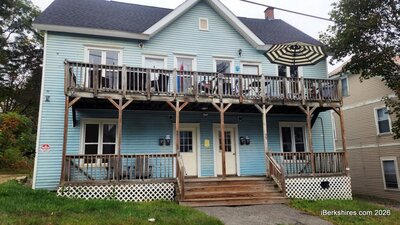 |
| An application to turn this Hall Street apartment building into a homeless shelter was been withdrawn. |
NORTH ADAMS, Mass. — A proposal to turn a Hall Street apartment house into a homeless shelter was withdrawn from consideration on Monday.
Caleb Wursten, operating as Queequeg Ventures LLC, had been scheduled to appear before the Planning Board on Monday seeking a special permit to convert the existing four-apartment residential building at 55-57 Hall St.
Louison House was listed in the application's narrative as managing the day-to-day operations, resident coordination, and house rules.
Wursten last month had been approved for a special permit for short-term rentals at the same Hall Street property.
Projects coordinator William Shanahan informed the planners that Wursten had asked for total withdrawal, not postponement. Planner Kyle Hanlon moved that the board not enter into the public hearing and the disposition of the withdrawal was moved to regular meeting.
Chair Brian Miksic said the board could decide whether to vote the withdrawal with or without prejudice; with prejudice would prevent the applicant from bringing the proposal back for two years.
"I think it should be penalized," said Planner Paul Senecal. "I mean, we had to spend $300 to $400 [for public notices]."
Miksic, a property developer, disagreed, though he said it was fine if the board wanted to vote that way.
"I know things change, personally, as far as that, so I don't see why we would penalize him for two years for $300," he said. "That doesn't make sense to me."
Hanlon made the motion to pull the proposal without prejudice; the board voted yes unanimously.
In other business, Shanahan said the codification committee had requested some information related to zoning. The committee has been reviewing the city's code for months to update its language.
Shanahan said he did not get all the questions yet, but what he did receive had to do with adult use zoning — bookstores, movie theaters, video and paraphernalia stores.
"The zoning states that it is only allowed in industrial, but within ... I believe a 500-foot buffer between any adult use store and a residential unit," he said. "With the way that our current zoning is that means that there is no actual appropriate parcel where it is allowed, and there have been several communities that have been sued across the country because it's kind of like a phantom zoning."
He'd found language from other communities, including Adams, Great Barrington and Pittsfield.
"It's kind of a large subject, but you know I had been involved in the codification review committee for those questions," he said. "My recommendations had just been based on what Adams currently does, but I also know that there are a lot of reasonable opinions both for and against looser restrictive zoning."
There are some smaller questions, like whether auto body places should be permitted in the general business zoning, Shanahan said, but "this is by far the most complex question because it's totally repealing the current language that is technically a walking lawsuit, or do we support having a entire subsection of our zoning that defines meticulously on ... what the requirements should be ...
"I don't think the codification review committee was hoping to get like a full detailed ordinance but just what the general position of the Planning Board is on this subject matter."
Senecal recommended waiting until the next meeting when Planner Lisa Blackmer was in attendance. Blackmer, also a city councilor and member of the codification committee, was at the convention of the School Committee and council to vote new committee members.
Planners also briefly brought up conditions at Nite Owl Automotive on River Street and Mohawk Auto Sales on Curran Highway. Miksic said he would speak to the building inspector.
Tags: emergency shelter, homeless,