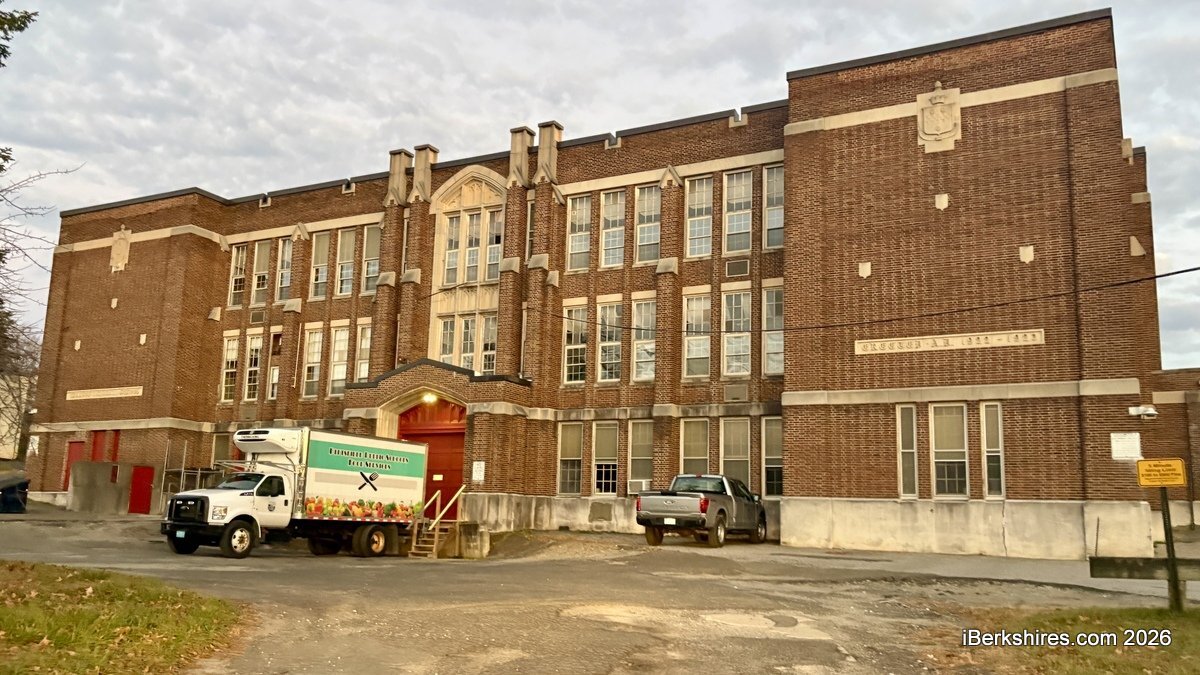
image description
The 1924 Hibbard School, closed in 2009, will be refurbished for housing in the future.

Path Paved for Housing in Pittsfield's Former Hibbard School

By Brittany PolitoiBerkshires Staff
Print Story | Email Story

PITTSFIELD, Mass. — The School Committee has voted to discontinue the former Hibbard School for educational use, paving the way for future senior housing. 

The building at 280 Newell St. has not been used as a school since 2009, and the district has been storing supplies in it. With three stories, it sits on nearly two acres and is surrounded by paved open space and a front lawn.

"The city is looking to take that beautiful building and repurpose it. Our intention would be to turn it into housing; affordable housing, particularly senior housing, for which we know we have a critical need in the city," Director of Community Development Justine Dodds explained to the committee last week. 

"And so this is the first step. We require you to determine that this is no longer being used for educational purposes, and then it would go back to the city for us to use the building for a differing purpose." 

The committee, having care and custody of the property, unanimously approved its discontinuation for educational use, determining it is no longer needed in that capacity. 

Charles E. Hibbard School opened in 1924 as an elementary school and served as such for 57 years until 1981, when it became the alternative education programs.

Pittsfield is trying to secure another storage location while simultaneously working on a conversion, which Dodds said will take some time. Alternate storage considerations include space the city already owns and rented space. 

She reported that they did some preliminary feasibility studies and know that it would make "exceptional" housing. 


The Pittsfield Public Schools store food and other supplies, such as paper, in about 13,000 square feet of the building in a corner of the first floor. 

"We need some storage space, just not that much," Dodds said. 

It was a tough night for School Committee member Katherine Yon, who went to Hibbard School, but she is glad to see the building have a new life. 

There was some lighthearted laughter throughout council chambers, and Yon said, "So if she’s gotta go, I suppose." 

Fellow committee member Daniel Elias recognized that this has been discussed for several years now. 

"So I'm glad to see that it's actually coming to fruition. I think it's long overdue. It makes sense," he said. 

"Ideally, it would be nice to be able to find storage that we currently possess without having to pay additional costs, but I think affordable housing is the way to go."


Tags: housing,   school reuse,   
If you would like to contribute information on this article, contact us at info@iberkshires.com.

BRTA Hears From New ITS System to Help With Rides

By Breanna SteeleiBerkshires Staff

PITTSFIELD, Mass. — The Berkshire Regional Transit Authority heard from an "intelligent transportation system" company on what it can bring to the bus service.

Spare Labs presented to the board last week, showcasing its platform for demand-response services, fixed-route information, service planning, and rider engagement. 

Spare representatives said the company has been working with transit authorities across the state and hope to "de-risk" the service with software changes.

"We know how tough it is to make a software change. It's no small feat. We've done it quite a few times in the states, so you're now working off of a blank piece of paper. We understand what your partners have done, positives and negatives, so you're building with that in mind," said senior growth manager Joshua Bethel.

Bethel emphasized a hands-on implementation where they will work with BRTA staff to prepare data, test the system, train dispatchers, drivers, and administrators, and help with rider communications.

"One example of how we've de-risked is the MBTA, one of the largest paratransit services [The Ride] in North America. In their switch to Spare, they saw immediate results. So our kind of implementation process is extremely white glove," he said. "We like to get in the trenches. We like to be with you on site, opening up a lot of times. We're here 4 a.m. when the days open, working with you. So look at this as an active partnership." 

Bethel gave an example on how the system helped the Massachusetts Bay Transit Authority with a training approach.

"Internally, every stakeholder will have some type of training, whether it's a dispatcher, a driver, admins. You all will have some level of training and different permissions in the system. Because of that approach, MBTA saw immediate great results," he said. "Their on-time performance pre-spare was 88 percent. Within 24 hours of launch, they were up to 95 percent, and they are continuing to grow."

Spare described several ways riders could interact with the system — a BRTA-branded smartphone app, online booking through a web portal, phone booking with a human dispatcher, text-based interactions, and an AI phone agent for routine requests, such as booking, canceling, or checking the status of a trip.

"One of the biggest differences that riders will see is everything will truly be at their fingertips, and we have multiple ways we're going to stay up to date based on what's available to them, we obviously will have a router app on the smartphone, but we offer availabilities for people who don't have that," Bethel said. "So, for someone who doesn't have a smartphone but they have access to a computer, we have a webbooker. For someone who doesn't have access to a computer but they need to call in, we also will be teaming what you have from a dispatcher standpoint. We also offer an AI call taker who can answer frequently asked questions, and when wait time is too hard, too high, automatically clicks in and says, 'Hey, this is the final wait time. You can call, you can cancel.' So effectively, with the technology, you can reduce wait times as you grow."

Their platform could also account for rider accessibility needs when matching trips to vehicles and could flag cases where a rider's booking did not reflect their usual needs. It can also have caregivers and others book on a rider's behalf if need be for medical appointments and more.

Earlier in the meeting, BRTA Deputy Manager Benjamin Hansen spoke on the ridership numbers citing inaccurate data on how many are riding because of the outdated system. Their system will be able to know in real time when a passenger boards and when one gets off. 

Spare also described tools intended to support route and demand-response planning, including; reporting by route, stop, time of day, and rider; integrations with passenger counting hardware and other systems; real-time vehicle and trip information; traffic-aware routing, which could use Google traffic data; and alerts for unusual patterns or apparent data discrepancies.

They said data could be brought into the platform from existing hardware and configured into reports for BRTA. The Spare team would work with BRTA during implementation to decide which data to import and which measures the agency needs. 

Many of the questions posed by the board were about the selling of data and how rider data is protected. Spare representatives said the company does not sell rider data and that BRTA would control the permissions as the data would belong to BRTA. As for a government agency asking for the data, they were unsure and said they would have to verify the rules for sharing information, but added they are compliant with the Americans With Disabilities Act and federal and state law. 

View Full Story

More Pittsfield Stories