Adams Community Bank and Pittsfield Cooperative Bank Officially Become Trailmark Bank

Staff ReportsPrint Story | Email Story

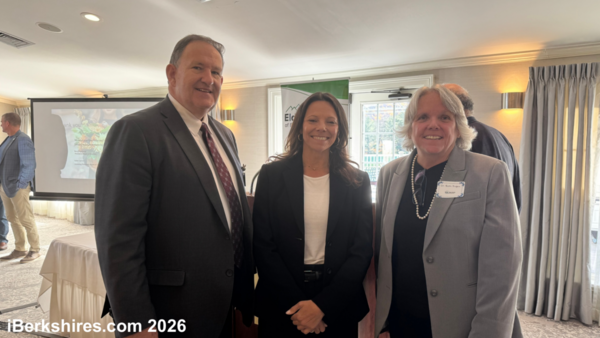
PITTSFIELD, Mass. — Adams Community Bank and Pittsfield Cooperative Bank announced the successful legal closing of their merger, marking a milestone in the formation of Trailmark Bank. 

The merger officially took effect on Nov. 1, 2026, bringing the two longstanding community banks together as one financial institution under the Trailmark Bank name.

The legal closing follows receipt of all required regulatory and governance approvals, including approvals from the Federal Deposit Insurance Corporation (FDIC) and the Massachusetts Division of Banks.

"Today marks an exciting new chapter for our employees, customers and communities," said Julie Fallon Hughes, Chief Executive Officer of Trailmark Bank. "Trailmark Bank brings together two community banks with deep roots in the Berkshires, shared values and a longstanding commitment to the people and communities we serve. We are proud of what each bank brings to this partnership and excited about what we can accomplish together."

Trailmark Bank is an independent, community-focused bank with approximately $1.5 billion in assets, nearly 200 employees and full-service banking locations across Berkshire County. The merger combines the resources, expertise, and capabilities of two established community banks while preserving the personalized service, strong relationships and local decision-making customers have long valued, stated a press release.


Beginning Nov. 1, Adams Community Bank and Pittsfield Cooperative Bank will operate as divisions of Trailmark Bank. The combined bank will officially open for business as Trailmark Bank on Monday, Dec. 7, with customers gaining access to all branch locations across Berkshire County.

Until then, customers should continue banking as usual through their existing Adams Community Bank or Pittsfield Cooperative Bank locations and systems, using their current checks, debit and ATM cards, online and mobile banking, and other banking services. Late fall, customers will receive detailed information outlining important dates, what to expect and any actions they may need to take.

"The legal merger is an important milestone, but it is also another step in a carefully planned transition," said Gregg Levante, President of Trailmark Bank. "Our focus throughout this process has been making the transition as smooth as possible for our customers while building a stronger community bank for the future. Trailmark Bank gives us greater resources and capabilities while preserving something that matters tremendously to us—the ability to make decisions locally and remain deeply connected to the Berkshires."

Trailmark Bank will be headquartered in Pittsfield, Massachusetts, reinforcing its commitment to remaining a locally headquartered community bank serving the Berkshires. Customers can continue to find transition information and updates at AdamsCommunity.com and PittsfieldCoop.com as the bank prepares for the December conversion.


Tags: adams community bank,   pittsfield cooperative bank,   
If you would like to contribute information on this article, contact us at info@iberkshires.com.

BRTA Hears From New ITS System to Help With Rides

By Breanna SteeleiBerkshires Staff

PITTSFIELD, Mass. — The Berkshire Regional Transit Authority heard from an "intelligent transportation system" company on what it can bring to the bus service.

Spare Labs presented to the board last week, showcasing its platform for demand-response services, fixed-route information, service planning, and rider engagement. 

Spare representatives said the company has been working with transit authorities across the state and hope to "de-risk" the service with software changes.

"We know how tough it is to make a software change. It's no small feat. We've done it quite a few times in the states, so you're now working off of a blank piece of paper. We understand what your partners have done, positives and negatives, so you're building with that in mind," said senior growth manager Joshua Bethel.

Bethel emphasized a hands-on implementation where they will work with BRTA staff to prepare data, test the system, train dispatchers, drivers, and administrators, and help with rider communications.

"One example of how we've de-risked is the MBTA, one of the largest paratransit services [The Ride] in North America. In their switch to Spare, they saw immediate results. So our kind of implementation process is extremely white glove," he said. "We like to get in the trenches. We like to be with you on site, opening up a lot of times. We're here 4 a.m. when the days open, working with you. So look at this as an active partnership." 

Bethel gave an example on how the system helped the Massachusetts Bay Transit Authority with a training approach.

"Internally, every stakeholder will have some type of training, whether it's a dispatcher, a driver, admins. You all will have some level of training and different permissions in the system. Because of that approach, MBTA saw immediate great results," he said. "Their on-time performance pre-spare was 88 percent. Within 24 hours of launch, they were up to 95 percent, and they are continuing to grow."

Spare described several ways riders could interact with the system — a BRTA-branded smartphone app, online booking through a web portal, phone booking with a human dispatcher, text-based interactions, and an AI phone agent for routine requests, such as booking, canceling, or checking the status of a trip.

"One of the biggest differences that riders will see is everything will truly be at their fingertips, and we have multiple ways we're going to stay up to date based on what's available to them, we obviously will have a router app on the smartphone, but we offer availabilities for people who don't have that," Bethel said. "So, for someone who doesn't have a smartphone but they have access to a computer, we have a webbooker. For someone who doesn't have access to a computer but they need to call in, we also will be teaming what you have from a dispatcher standpoint. We also offer an AI call taker who can answer frequently asked questions, and when wait time is too hard, too high, automatically clicks in and says, 'Hey, this is the final wait time. You can call, you can cancel.' So effectively, with the technology, you can reduce wait times as you grow."

Their platform could also account for rider accessibility needs when matching trips to vehicles and could flag cases where a rider's booking did not reflect their usual needs. It can also have caregivers and others book on a rider's behalf if need be for medical appointments and more.

Earlier in the meeting, BRTA Deputy Manager Benjamin Hansen spoke on the ridership numbers citing inaccurate data on how many are riding because of the outdated system. Their system will be able to know in real time when a passenger boards and when one gets off. 

Spare also described tools intended to support route and demand-response planning, including; reporting by route, stop, time of day, and rider; integrations with passenger counting hardware and other systems; real-time vehicle and trip information; traffic-aware routing, which could use Google traffic data; and alerts for unusual patterns or apparent data discrepancies.

They said data could be brought into the platform from existing hardware and configured into reports for BRTA. The Spare team would work with BRTA during implementation to decide which data to import and which measures the agency needs. 

Many of the questions posed by the board were about the selling of data and how rider data is protected. Spare representatives said the company does not sell rider data and that BRTA would control the permissions as the data would belong to BRTA. As for a government agency asking for the data, they were unsure and said they would have to verify the rules for sharing information, but added they are compliant with the Americans With Disabilities Act and federal and state law. 

View Full Story

More Pittsfield Stories