Lanesborough Hears Concerns, Support for Proposed Solar on Square Roots Farm
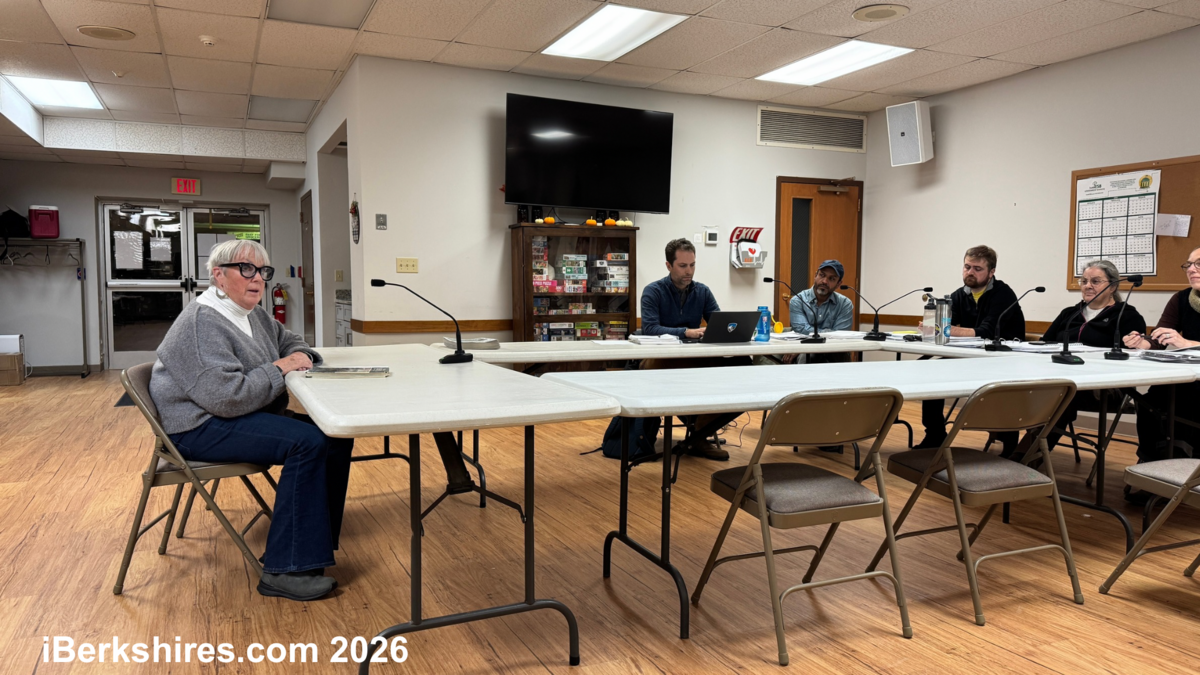
Beth Wirsul, who grew up on the farm but no longer lives in the area, objects to installing more than 6,000 solar panels on what had been her father's farm.
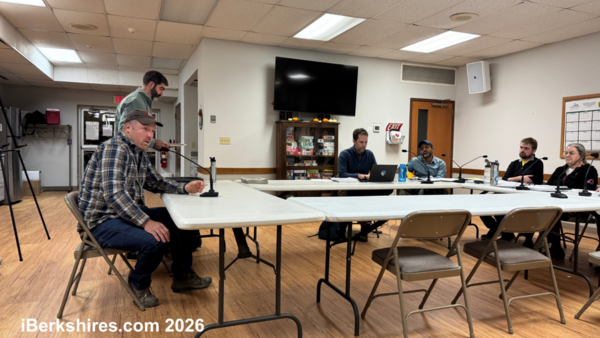
Planners continued the hearing to its next meeting to take more time to review the plans.
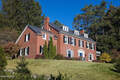
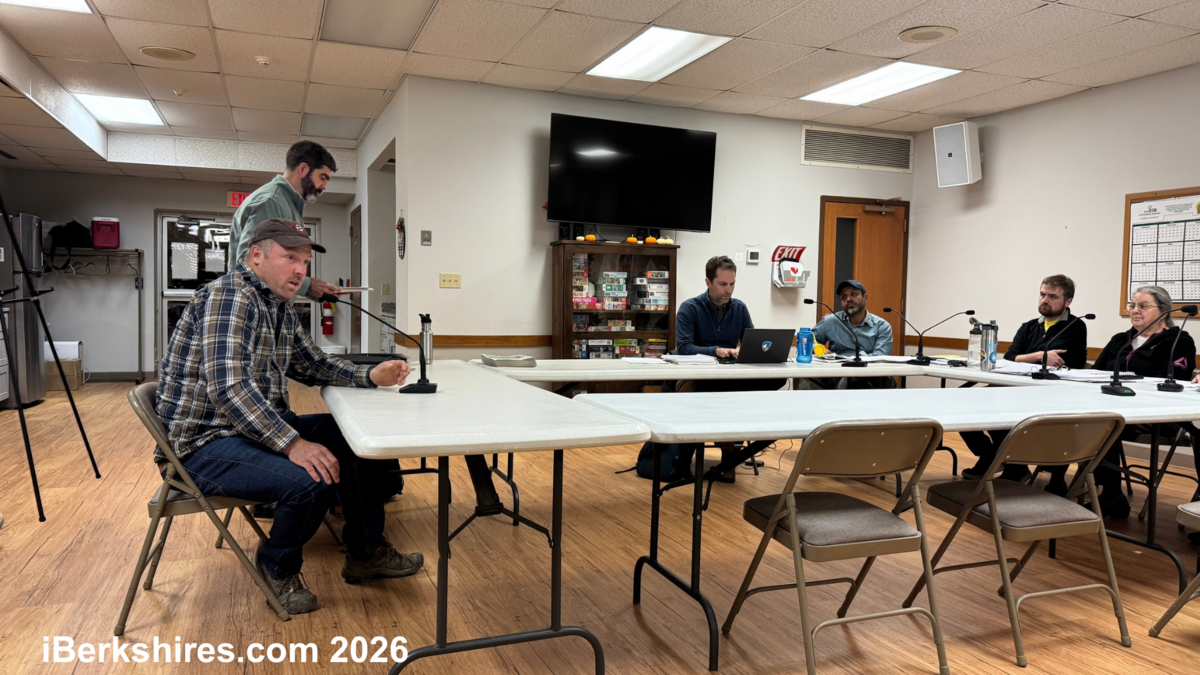
Square Roots Farm on Old Cheshire Road, owned by Michael Gallagher and Amy Amsden, is proposing to install a solar field of thousands of elevated panels. Gallagher appeared before the board for an informal conversation about the project in August.
"This is really a project for us that isn't taking farmland out of farming to build a solar project," said Gallagher at last Monday's meeting. "It's sort of stacking both of those things together so that we can get the benefits of clean energy and that we can continue to get to do the farming."
The panels will be about 10 feet off the ground and rotate based on the sun's movement. They will be 28 feet on center so that livestock will be able to move around them and the farm can continue with a rotational grazing approach.
Beth Wirsul drove two hours to oppose putting arrays on the 185-acre farm where she grew up. Her father, Earl Fletcher, operated as Jersey Acres before it was sold to Berkshire Natural Resources Council and then to the Gallaghers.
"I can say with full confidence, and I mean full confidence, that had he ever known that we were going to be sitting here tonight, 36 years later, discussing a 6,020-panel solar field in the prime fields that he worked, he would have never made the deal that was made," she said. "There is something called progress. I understand progress. I also understand historical preservation. There's a need for open land."
The beautiful fields aren't a place for solar panels, Wirsul said. "Animals thrived on that farm for 225 years, and I know that they would continue to thrive for the next 225 years without 6,000 solar panels. There is no need for this solar project in the town of Lanesborough, and particularly on the property that was once my family's livelihood."
Resident Ray Jones argued that utility-scale solar belongs on sites such as landfills or industrial property rather than farmland. He raised concerns about the project's effect on the landscape, Fire Department preparedness, and battery risks. He said the board should turn it down.
Next-door neighbor Chris Sayers said the solar panels will be right in his back yard, 150 feet away. He asked how they would be screened as the bylaws say they must, and wondered how it would affect his property value. He was also hoping the Planning Board would address how panels will be secured.
Farmer Kristen Tool, who also runs nonprofit Heart and Soil Collective, hoped the board would support the project.
"I've been working with Square Roots Farm since I started, and I want to speak in support of this solar project, because since I founded my nonprofit in 2021, two of the 12 farms that I was working with across the Berkshires have closed, and so any project that is going to increase the viability of our small farms, I think, needs to be supported," she said. "It's already hard enough to be a farmer and try to make a living, and knowing that the rate of food insecurity has increased by I believe it's 86 percent in Berkshire County from 10 years ago, we absolutely have to make sure that all of our farms are able to keep growing and producing as much food as possible."
Red Shirt Farm owner Jim Schultz also spoke in favor of the project, dwelling on the difficulty of making a living as a farmer.
"I respect everybody who spoke and all the points that were made and presuming that all the codes are met and the historical things are met, I think that this should go through," he said. "It produces power that we desperately need in a very sustainable environmental way. It promotes the welfare of the animals that are on the property. Cattle need shade, and if you know an ideal situation, they'd be raised in silviculture, which is trees on pasture, that not existing, having solar panels that provide shade to the animals, improves their welfare, improves the production of the grass on the property, and it sustains and keeps a farmer and his family in business.
"So I understand everything, the downsides to it all. But given where we are in this culture, this society, and where we're going, we need farms, we need power, and we need it to be done as sustainably as possible."
Gallagher said this project will help him continue farm work in a sustainable way.
"Shade for us is really important for the cows, especially as we're getting to a point where we're getting hotter temperatures, longer stretches of heat. We're in a situation where we're moving our cows every day to a fresh piece of pasture, so they're bunched up in a small area. They eat everything. They move," he said. "The ability to have a lot of different paddocks with shade in them is going to be really important for us going forward. Especially as we're looking at situations where it's hotter and hotter. The cows are happier, the grass grows better."
Steve McDonough of BlueWave Solar and project manager Andrew Hamel with Weston & Sampson Engineering of Albany, N.Y., explained the solar power system layout and answered questions from planners and the audience.
"We own, operate, and maintain over the lifetime of the project. Not to say projects don't get sold, but our intention with the projects that we're developing in Massachusetts is to own them over the course of the lease term and in the project lifetime," McDonough said, adding Blue Wave has four projects in the state operational and another six under construction.
He said the company specialize in dual-use projects like Gallagher's.
"This program was developed together with the Massachusetts Department of Energy Resources and the Massachusetts Department of Agricultural Resources," he said. "Hundreds of farms are no longer operational in the last 10 or 15 years. So, this is one aspect to provide revenue to farmers, while also developing clean renewable energy on these farms, so that's one of the things that that program developed with the DOER and MDAR is helping to keep these farms in business and not have them suffer the consequences of struggling financially."
The project is described as approximately 4.5 megawatts, with a proposed 3,800 kWh battery. The site has a stated 36.1-acre limit of work. Hamel said the calculated coverage was 5.36 percent of the farm, counting panels, access roads, and equipment pads.
It would include a 7-foot fence around the project and additional fencing around the equipment pad areas.
To address the impact of fire, the batteries would be lithium-ion phosphate technology, which McDonough described it as a safer battery chemistry, while noting that consultants would be involved in preparing a hazard mitigation analysis and emergency response plan with the Fire Department.
Many people also brought up the decommissioning process asking of the adequacy and form of the financial security for removing panels and infrastructure at the end of the project.
For decommissioning, McDonough cited an estimated cost of about $211,000 in present-day dollars, or approximately $338,731 after 20 years using an assumed 2.5 percent annual inflation rate.
He also addressed vegetation screening, saying it would likely be staggered trees along the boundary to minimize the view and that the panels are designed to absorb as much sunlight as possible, but, if need be, Blue Wave was willing to conduct a glare study.
The project was filed with the Massachusetts Historical Commission in June 2024 but no response had been received. Project planners said if the commission has not responded within 30 days, the plans are considered accepted.
Ashley Amsden said she and her husband are community people who care about the farm and plan to be around for a long time.
"We've been running our values-driven community-based family farm profitably for almost 17 years, we were married on that back pasture. We're raising our kids on the farm. Everett's over here doing his ELA homework, and Maggie just got back from our Girl Scout meeting. They learned to count by collecting eggs on the farm. This place is really special to us too," she said.
"I just wanted to clarify: this isn't a story of desperate farmers looking for financial rescue from a solar developer. It's the next chapter in the story of a family who's committed to doing our very best to grow high-quality food for our community in a way that enhances and regenerates the land. We believe in community, sustainability, innovation, and authenticity, and this leads us sometimes to make choices that are different from our farming peers or how things were done historically."
Tags: farming, Planning Board, solar array,