WTF’s Travesties dazzles with linguistic flair
by Ralph HammannPrint Story | Email Story
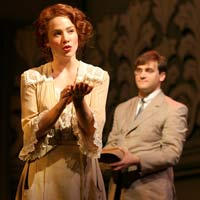
Lynn Collins and Michael Stuhlbarg in WTF's Travesties
Travesties by Tom Stoppard Thomas, directed by Gregory Boyd Williamstown Theatre Festival, through August 17 There are two types of people in this world: those who love Tom Stoppard and those who don’t. I cannot imagine having a close, meaningful relationship of significant duration with the latter. Trying to get one’s mind around this play is rather like trying to shake hands with a hyperactive, attention-starved octopus. I should think that directing it would be akin to establishing order in a roomful of Marx Brothers or, given some of the play’s wandering willow roots, a roomful of bothersome Marxists. Attending it is a grand, rattling experience that leaves one happily exhausted from laughter, thought and more laughter. Audacious, playful, anarchic, overwhelming, stimulating, over-stimulating, hilarious ˆ this is as good as theater gets. It is a travesty, or collection of travesties, of the highest order. Those parodied include: Marxist revolutionary Vladimir Lenin; revolutionary stream-of -consciousness author of “Ulysses,” James Joyce; revolting co-founder of Dadaism, Tristan Tzara; and functionary in the British consulate in Zurich, Henry Carr. All happened to be in Zurich, Switzerland in 1917 during World War I, the war that supposedly would end all wars (had Stoppard been writing then, it is probable that it might have—leaving behind a world that would forever laugh at the ravings of its would-be leaders). While Carr met Joyce when the former appeared in the latter’s production of Oscar Wilde’s The Importance of Being Earnest (also parodied), Stoppard has conflated the four lives and their particular politics into a series of imagined encounters that take on the structure of Wilde’s play about the vanities that dangerously underlie all of society. To make matters crazier, it is all filtered through the erratic memory of Carr as an old man. The result is, among other things, a provocative and consistently funny romp through the ideas and vanities of Lenin, Joyce and Tzara that helped to shape the twentieth century. More specifically, Stoppard examines the relationship between art and politics, the power of art and the role of the artist during wartime. If that weren’t enough, Stoppard is also concerned with the extraordinary difficulties inherent in communication, the hysterical failures and few stirring triumphs of language, and the foibles of pedagogues, egotists, xenophobes and leaders of movements and nations. The play could have been written yesterday. Stoppard also examines the way that our systems of communication create our behavior and seduce us into strange courtships and bizarre acts that range from senseless violence to follow-the-leader (or both). His relish of language is ever-present and so exciting that one becomes happily delirious from the constant alternation of rapt listening and explosive laughing. Ultimately, Travesties may be a thinking-person’s farce, but I can’t imagine anyone, save sacred cows (and their cowherds) and the cowed politically correct, not enjoying it. Given Stoppard’s musical use of language it likely will not appeal to the deaf, tone-deaf or rhythmically impaired. An appreciation of limericks, sonnets, Samuel Beckett, striptease, Eugene Ionesco, British music hall, Monty Python, vaudeville, and quaint musical forms will, however, be richly rewarded. A linguistic feast, word salad and vegetal verbiage spun through Stoppard’s food-for-thought processor, it is admirable that a director and company could digest it and memorize it, let alone get it staged with the limited rehearsal time afforded summer festival productions. That they could create such a finely delineated, imaginatively attacked and painstakingly mounted a production is heroic. And amazing. And, acknowledging the somewhat hyperbolic mood this play has induced, one of the best productions I have critiqued in some twenty-five years. Making a Chaplinesque entrance as Tzara, Michael Stuhlbarg proves a delightfully defiant Dadaist as he dexterously snips Shakespearean sonnets into new shapes. While we laugh at Tzara’s single-mindedness and stupidity in rejecting all traditional artistic and cultural values, Stuhlbarg rises to Tzara’s unexpected and necessary-though-fleeting intrepidness when attacking the self-serving language of politicians’ language that corrupts words like patriotism, duty, love, freedom and honor into standing for their opposites. “Wars are fought for oil wells,” he argues with stunning currency, “War is capitalism with the gloves off.” One wants to cheer a character one jeered just moments earlier. Similarly are our feelings for Lenin subverted. Seemingly valorous in one moment, he becomes a subject for ridicule in the next, and Gregor Paslawsky authoritatively plays his contradictions with appropriate high-mindedness. Words taken verbatim from Lenin’s actual speeches before and during the Russian Revolution become risible, as when he argues, with Ashcroftian horror, for a free press under party control. George Orwell would have loved this play. Stephen Spinella liltingly lights into Joyce who is arguably given the most amusing and affectionate treatment by Stoppard. Whether deftly dancing through music hall numbers or tripping through limericks, Spinella proves a consummate showman, and when the time comes for the travesty to temporarily subside, he is elegantly assertive. When asked, “And what did you do in the Great War?” he replies, “I wrote ‘Ulysses.’ What did you do?” The play’s most difficult role is Carr, the narrator, who must ramble as an old man through Beckettian memory monologues that defy even Joyce’s stream of consciousness in their complexity – call them eddies of Alzheimer’s. Having completed these navigations, which call into question the reliability of all the information we are presented (giving the play its absurdist leanings), Carr must then transform into his younger self as he wanders back in time to 1917. Additionally, he becomes increasingly dandified to the degree that he comes to resemble Algernon Moncrieff, the role he was enlisted to play in The Importance of Being Earnest. Required is an actor who can cross eras, genres, and styles with considerable energy and panache. In the role and all of its facets, David Garrison is brilliant. No exaggeration. Such delights do not cease with the major players. Lynn Collins and Kali Rocha are gracefully and libidinously hilarious as Gwendolyn and Cecily, respectively, but hardly respectably. Their custard pie fight, superbly choreographed, removes the mannered subtext from Wilde and charges it with civilized violence, humiliation and sexuality. Rocha also bares her breasts in a striptease, which may serve as a metaphor for Stoppard’s writing but has considerable attributes beyond mere literary device. In stark contrast (and cold light) to the English ladies, Candy Buckley plays Lenin’s wife, Nadya, with a commanding Russian accent and no-nonsense-Bolshevik delivery that is no less entertaining. Likewise, Herb Foster is comically straightforward as Bennett, Carr’s butler. Even the stagehands are put to inspired use as they become infected with the chaotic-but-actually-well-ordered spirit of things. Gregory Boyd has done a great service in giving form and focus to this work of genius that is, understandably, rarely performed. That his exhaustive work glides by with such seeming lack of effort is a tribute to his own genius and the talents of his flawless cast. The teasing music and sound design by John Gromada should get its own special award at year’s end. Neil Patel’s scene design creates visual background that is vibrant but also simple enough not to clash with the many word pictures Stoppard contrives. Judith Dolan’s costumes, off and on, are splendid. And, while it is getting repetitive to say so, Rui Rita’s lighting is again dazzling. With Darko Tresjnak’s wonderful production of Rosencrantz and Guildenstern are Dead several years ago and now this feat of magic, producer Michael Ritchie may be starting his own tradition at the WTF, equal to Nikos Psacharopoulos’ discovery of Chekhov. I hope so. Williamstown is the perfect location for Arcadia (the concept and the Stoppard play). Ralph Hammann is the Advocate’s chief theater critic.
If you would like to contribute information on this article, contact us at info@iberkshires.com.

Stockbridge Grange Community Dinner

STOCKBRIDGE, Mass. — The Stockbridge Grange is holding a community dinner on Sunday, Feb. 8, 2026, featuring spaghetti and meatballs, salad, and bread with dessert choices of chocolate cream or lemon meringue pie.
 
Dinner is $17.00 per person, take out only with 12-1:30 pm pick up at the Stockbridge Grange Hall at 51 Church Street, Stockbridge.  Orders may be made by calling 413-243-1298 or 413-443-4352. 
 
Inclement weather postpones the meal for a week.
View Full Story

More Stories