Switching to alternative heat sources may be easier said than done during the upcoming home heating season, with at least one alternative fuel already in short supply.
Pellet stoves and the pellets that fuel them are presently hard to come by regionally, and indications are that the shortage extends across the Northeast.
Desperately Seeking Pellets
Hoosac Valley Coal and Grain company owner Keith Hayden sells pellets at the Adams-based store; on Oct. 18, Hayden received a telephone call from a Syracuse, N.Y. man embarked on a pellet quest.
“He said that he can’t find pellets within a 100-mile radius of his home, and if I’d had pellets, he would have rented a trailer and driven over to get them,†Hayden said.
Hayden said he’s recently received a similar telephone inquiry from someone living in New Hampshire. The store is currently sold out of the pellets, and Hayden had to disappoint both callers, he said.
And not only is the store currently sold out of the pellets, the next five scheduled deliveries are already sold, Hayden said. He may be able to sell pellets to additional customers at the start of the new year, he said.
Kathy Klein of North Adams has owned a pellet stove for several years. Klein said that the stove heats her two-story home easily and comfortably and has saved money in fuel costs.
“I wouldn’t live without it,†she said. “The stove I have has six heat settings and I’m heating right now with it set on the lowest setting, otherwise it gets too hot in the house.â€
Her fuel supply is down to three bags of pellets, she said. She is having difficulty finding a store with pellets in stock. Klein said she usually purchases pellets at a North Adams-based Wal-mart store; every time she tries to buy pellets, the store is sold out.
“As fast as they get them in, out they go,†she said. “I keep calling and they keep telling me they’re sorry, they are sold out.â€
Waiting List
In Bennington, Vt., the Tractor Supply store has sold out of pellets. The store expects a delivery in November. The store has also sold out of pellet stoves, and those interested in purchasing a stove can be placed on a waiting list, said store Assistant Manager Candy Rousseau.
“As soon as the stoves come in, they go,†said Rousseau. “The demand [for stoves] has slowed down a little bit, and we are still putting people on a list. We’ve been able to take care of people who get on a list; they have to wait until we get the stoves in.â€
The wait time can be several weeks.
At the Bennington Pool and Spa store, which sells a variety of wood- and pellet-burning stoves, a few pellet stoves and bags of pellets are available for sale, said store employee Nate Rice.
“People kind of waited until fall to get into the pellet stoves, and the manufacturers can’t always keep up with the demand,†Rice said.
Renewable Energy
Increased demand for pellets among those already owning the stoves and those acquiring them for the first time has led to a dwindling supply of the fuel, he said.
“One thing that kind of hurt is people bought more pellets than normal,†he said. “It’s like when people all pile into gas stations and then the gas runs out.â€
The situation is a direct result of spikes in home heating fuel prices and any pellet stove and pellet fuel shortages are likely temporary, said Rousseau and Rice. The pellet industry is likely to increase production of both stoves and fuel to meet the rising product demand, both said.
“Pellets can be manufactured and bought year-round,†said Rice. “And it’s a renewable energy resource, which people like. Many people are using their pellet stoves as a secondary heat source but the stoves can be used as a primary heat source.â€
Rousseau said that this heating season, her family will rely on a pellet stove as the primary heat source for their two-story farmhouse.
“It’s heating the house right now, and it’s only set on “one†[low heat setting],†she said. “I love it; it’s easy to use. It has push-button on and off, and heat control settings, and is equipped with blowers. [Pellet stoves] are very nice.â€
The current cost of pellets is among the “very nice†factors; one ton of pellets costs about $200, and may last for about two months, said Rice. Pellet costs can vary from store to store.
The stoves range in price from about $1,300 to $3,000 and, if properly maintained, can be used for 20 to 30 years. Pellet-burning furnaces and boilers are also available.
Coal Comeback
Coal is experiencing a big revival as a heating fuel, said Hayden.
“We’re selling more coal now than probably any other time since I’ve owned the business,†he said, and noted that he expects to sell over 2,000 ton of coal during the upcoming heating season.
Hayden sells coal-burning stoves as well, and said the demand is up.
“Over 15 years, I’ve probably sold 700 coal stoves, so far this year, I’ve sold between 40 or 50,†he said.
Increased demand for coal stoves has customers waiting eight to 10 weeks for delivery in some cases, Hayden said. Coal itself seems to be available; Hayden said that the store is receiving delivery of 100 tons of coal per week. Acquiring a pellet supply is taking more time, he said.
“Coal [supply] has never been a problem for me,†he said. “It might get tight this year, but I bring in 100 ton of coal a week, and it takes me three weeks to get a supply of pellets.â€
Coal prices vary; one ton of bagged coal is currently priced at $240 per ton, while one ton of bulk coal, meaning not bagged and stored in indoor or outdoor “bins,†costs about $195.
Hayden said that he uses bulk coal to heat his Savoy-based, 2,500-square-foot home and burns about four tons a year. The yearly cost is about $800, he said. A large Victorian-style home would likely cost more to heat with coal, while a smaller modular style home would probably cost less to heat, he said.
As of Oct. 17, the Massachusetts average per-gallon price for home heating fuel was $2.54 per gallon, while the average per-gallon price for propane gas was listed as $2.28.
Pellets are usually made from materials such as sawdust and wood chips but fruit pits, nut hulls, and unprocessed shelled corn may be used to make pellets for specific stoves. Pellets are considered a “clean burning†fuel.
Cleaned Up
The coal industry has cleaned up its’ product considerably, Hayden said.
“You don’t have the black soot like there was in the past,†he said.
Like pellets, coal burning does not result in creosote build-up, which occurs in wood-burning stoves and is the primary cause of chimney fires. Anthracite coal is very hard, very clean and produces the most heat, Hayden said.
Nearly all the nation’s anthracite coal is mined in northeastern Pennsylvania.
Coal is not a renewable energy source. A 100-year coal outlook predicts adequate coal supplies but the supply beyond that point has not been determined, Hayden said.
“People going to pellets like it because it is a renewable energy source,†Hayden acknowledged.
But coal’s renaissance is far from over, he added.
“There’s been a lot of interest,†he said. “I’m getting calls about coal all the time. And this year, I sold my first coal boiler.â€
Susan Bush may be reached via e-mail at suebush@iberkshires.com or at 802-823-9367.
If you would like to contribute information on this article, contact us at info@iberkshires.com.
Your Comments
iBerkshires.com welcomes critical, respectful dialogue. Name-calling, personal attacks, libel, slander or foul language is not allowed. All comments are reviewed before posting and will be deleted or edited as necessary.
No Comments
Dalton Planners Hold Public Hearing on Tiny Homes Bylaw
By Breanna SteeleiBerkshires Staff
DALTON, Mass. — The Planning Board held a public hearing last week on a bylaw for mobile accessory dwelling units (ADU) that will be brought before a special town meeting.
For nearly two years, Amy Turnbull has been trying to amend the current ADU bylaws to allow mobile tiny homes.
A movable tiny home is defined as a unit under 400 square feet that meets all of someone's daily needs, including sanitation, cooking, and other facilities, and which is also mobile. Most homes considered "tiny" are built on a trailer so they can be towed.
Her proposal defines a movable tiny house as a "residential property with an existing primary house, intended for year-round living," and outlines eight conditions for approval.
Among these conditions: the unit must adhere to accessory dwelling unit regulations, undergo site plan review, be licensed and registered with the state Registry of Motor Vehicles, have approved energy, water, and wastewater systems, and comply with American National Standards Institute 119.5 and National Fire Protection Association 1192 safety requirements.
Additionally, the unit must be certified for ANSI or NFPA compliance by a manufacturer or third-party inspector, including adherence to Appendix Q and the International Residential Code's structural guidelines and energy efficiency standards. The tiny house cannot move under its own power, and its undercarriage, wheels, axles, tongue, and hitch must be concealed from view. Wheels and leveling or support jacks are required to rest on a level gravel or paved surface.
Turnbull has gotten enough signatures for her petition to amend the current bylaws to add her definition of the mobile ADUs. Last Wednesday, the board held a public hearing on the petitions, which will be voted on at a special meeting.
Turnbull says she has two reasons for wanting to add this to the town's bylaws: aging in place and affordable housing.
"We need a variety of housing types in Dalton, and that we also need to address the idea that you know nearly 30 percent of our population by 2035 is going to be over 65 years old, and it's problematic because ... there's not enough choice for these people to to age in place,"she said. "What movable tiny houses does, is it provides a less restrictive ADU. It's much cheaper to place, and it's easier to place, less time consuming. And what it offers to people is it offers people who are owners a place for their children to come and live, or a caregiver to come and live, or for the people who own their own house to come and live while they rent out their maybe their three bedroom home to a new family who wants to attend to Craneville simultaneously."
She said people need to move away from calling and treating the tiny homes as though they are trailers, as one former Planning Board member has voiced opinions on.
"That is an opinion, and I think we need to get over that, because I want to say that these are foundation homes, and that the chassis is a foundation, and it's a stick-built home on a chassis, and in very many ways it's like a modular house. I think we will not be surprised in the next 10 years if we see the market turn around and start to make smaller, tiny modular homes, but that is not the case right now, and we have a dire need for affordable housing," she said.
At a former Fire District meeting the Water Department drafted regulations for water hook-ups for these types of homes. The superintendent sent a letter to the Planning Board to be read at the meeting stating it will not be a hindrance for sewer system connection.
"The Department of Public Works does not feel that mobile ADUs will be an issue with the town sewer system. The homeowners will be responsible for any issues outside of the sewer main and connect and responsible for connecting in, so that would address any permits, fees, or anything like that would be added to that," the letter states.
"The Water Department, as we've stated previous, and as you stated, the water department has come up with their own set of SOPs, standard operating procedures, for hooking up a an adu and a mobile adu, which will then have to meet winterization and all those, but they've laid out a plan for that, that they have, so I'd like to point that out," board Chair Robert Collins said.
One concern was raised that if someone can have a mobile ADU could they also have another tiny home on their property, including the main house. That situation is not likely, said Turnbull, as it would cost a considerable amount of money. Town Manager Eric Anderson also stated that in his former community when they adopted similar laws their first one wasn’t put in until a couple years later and then maybe one a year.
Jason Codey struck out 13, walked two and allowed just an infield single as the Generals earned a 7-1 win over Wahconah to claim their third straight regional title. click for more
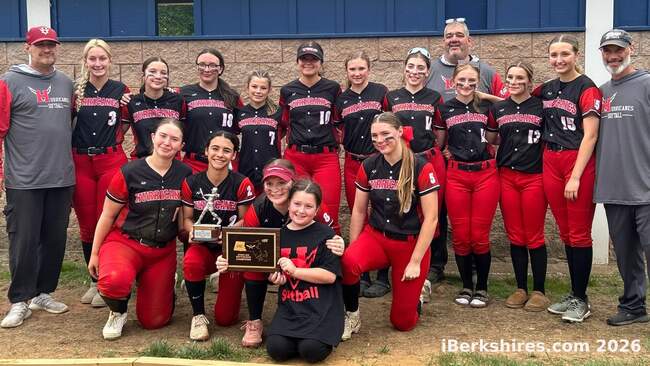
Gracelyn Wright struck out eight, and Genevieve Lagess went 3-for-5 with four runs batted in as the Hurricanes beat Monson, 17-3, to claim their first Western Mass title in four years. click for more
For the boys, Ward Bianchi helped lead the way with a win in the shot put and a second place in the javelin as the Mounties finished 16 points ahead of runner-up Pittsfield (pending the results of the pole vault, which were unavailable at 11 p.m. Friday night). click for more
Brady Auger Friday scored five goals to lead the Mount Greylock boys Lacrosse team to a 16-14 win over Hoosac Valley in the title game of the Western Massachusetts Class C Tournament. click for more
Brooke Harrington scored four goals, and Abigail Rodhouse had a hat trick as Wahconah won its second straight Western Mass title and the rubber match against the Mounties in the third one-goal game between the teams this spring. click for more