WILLIAMSTOWN - The town will have to start spelling out the projected cost of its current and future retirees - and it could be in for a shock.
That was one of two points raised in an audit management letter submitted to Selectmen on Monday by Adelson Moynihan & Kowalczyk PC, which prepared the town's annual audit with town Accountant Charles "Chuck" St. John Jr.
The letter also recommended the review of accounts or credit cards held by any boards or departments under the town's purview to ensure they were being used appropriately.
The Governmental Accounting Standards Board, commonly referred to as "Gasby 45," requires municipalities to break out retiree insurance and pension costs, which are often lumped in with current employee costs. The rule has been phased in over the past several years, with the smallest cities and towns having to comply by Dec. 15, 2008. Larger cities and states have already projected billions in retirement costs.
St. John said the town is preparing requests for proposals for a firm to do an actuarial analysis of the town's liability projected out over the next 30 years.
Selectmen Chairman David Rempell wondered how the projections could be made, considering that future contracts have not been made, and the number of future employees is unknown.
"Things don't change as much as we think they do. These are actuarial projections, these are just a range or margin," said Town Manager Peter Fohlin. The town plans its budget on revenues, he reminded the board. "We're only going to spend the money we have and no more."
Vincent T. Viscuso, of the accounting firm, told the Selectmen, "You won't be budgeting that money ... but you've made a commitment to these people so you'll have to pay it down the road."
The Gasby 45 standard was developed by the accounting profession to get a better grasp of municipalities' long-term commitments. Viscuso said there has been discussion of municipalities developing trust funds to ensure they can cover those liabilities. The size of the liabilities could also could effect bond ratings for cities and towns.
"I'm sure we're going to have a number that's going to take people's breath away," Fohlin said, estimating it would likely be well into the millions. But, he said, "Twenty-five years ago, we had retirees and we had future obligations to those retirees and we paid them. ... Today, we have retirees and we continue to meet those obligations. This has been the case and continues to be the case."
He didn't think the numbers would have much of an effect on the town's bond rating because lenders already know these obligations are out there. "It won't be news to them."
The town has taken a number of actions, such as increasing employees' health insurance co-pay and keeping the number of employees low, to mitigate future costs.
"The overall financial report is ... quite healthy in the sense that the town continues to add to its assets," said Rempell. "There is nothing in the report that is of undue concern except for the fact that we wish would had more revenue to support different town services. We're in pretty decent shape."
He was concerned over a paragraph in the audit report that noted state aid had dropped to .9 percent between fiscal 2007 and 2008 from 15.7 percent the year before, leading the town to budget for 1 percent in state aid. The state had ended its fourth year in a row with a surplus but continues to operate with a structural deficit, it stated.
"What this means, clearly, is we have some difficult financial times ahead of us, at least in terms of how much revenue we'll receive from the state," said Rempell. If state revenues are down, the burden falls more on communities, specifically through property taxes.
● Approved a request by Williams College for an above-ground 10,000 gallon diesel fuel oil tank. The tank has been in existence for 27 years but the permit to store had been lost to time. The tank was used for heating oil but has been empty for a couple years. College now wants to store road grade diesel in the tank for the operation of three backup generators. A 500-gallon tank used for the diesel will be removed.
● Approved a conservation restriction for the Finnegan property on Northwest Hill Road to be managed in part by the Williamstown Rural Lands Foundation. The board had approved the restriction two weeks but the state and the Conservation Commission requested minor changes in language, requiring the agreement to come back before the Selectmen.
● Approved a one-day, all-alcoholic beverage license for the Clark Art Institute for its Winter Gala on Feb. 16, 2008, to celebrate the opening of its newest exhibition on Frederic Remington.
● Approved an alteration of alcohol serving hours on Christmas Eve requested by Williams Inn President Carl Faulkner. He wished to close the inn after dinner or at least by 9 so employees can spend the evening at home. Selectwoman Jane Allen moved to amend the request to cover all town vendors of alcohol who might wish to close early on Christmas Eve. The motion was approved unanimously.
● Renewed the various licenses of 12 restaurants, the package-store license for the Store at Five Corners and the Class III auto sales license of Ben's Auto.
If you would like to contribute information on this article, contact us at info@iberkshires.com.
Your Comments
iBerkshires.com welcomes critical, respectful dialogue. Name-calling, personal attacks, libel, slander or foul language is not allowed. All comments are reviewed before posting and will be deleted or edited as necessary.
No Comments
Williamstown Board Opts to Negotiate with College on Water St. Lot
By Stephen DravisiBerkshires Staff
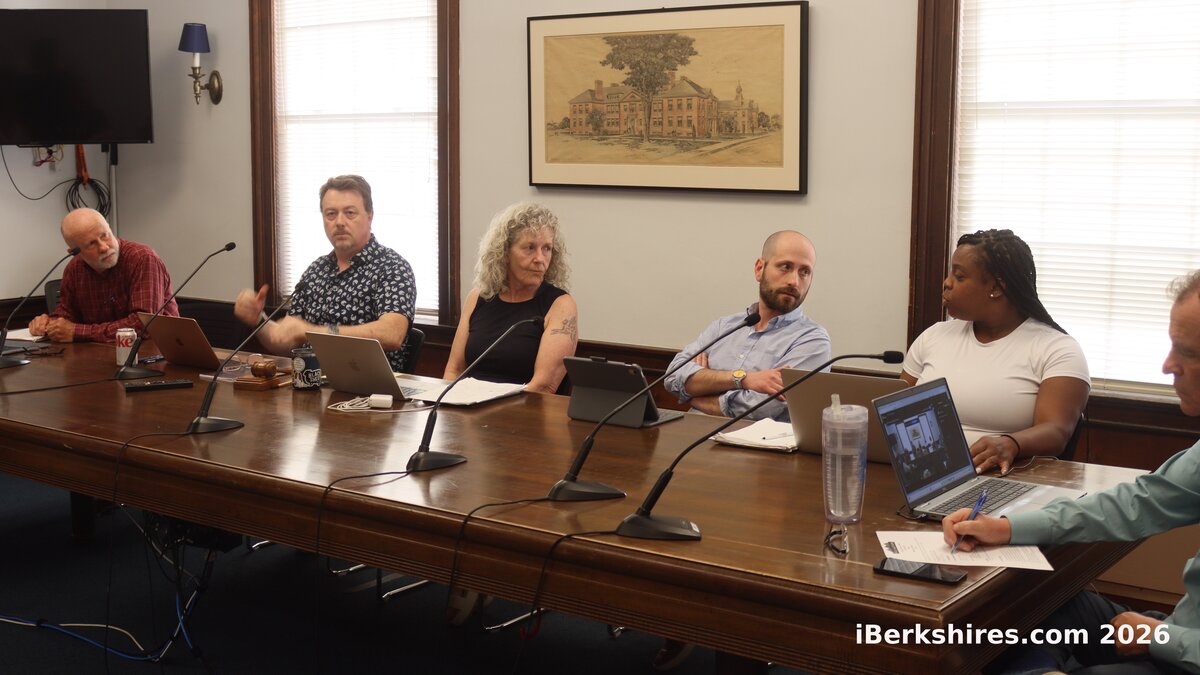
Newly elected board member Nate Budington, far left, participates in his first in-person meeting along with, from left, Matt Neely, Stephanie Boyd, Peter Beck, Shana Dixon and Town Manager Robert Menicocci.
WILLIAMSTOWN, Mass. — The Select Board on Monday decided to enter into negotiations with Williams College on the sale of the vacant town-owned lot at 59 Water St.
But the board members made it clear that the college's proposal to acquire the lot is a starting point, not a final deal that the elected officials would accept.
"For the sake of continued conversation, I'm in favor of [awarding Williams the site], but if this process wasn't continued with the opportunity for further negotiation, I wouldn't vote to continue this," Peter Beck said. "I think that next step is necessary for us to get to a yes on this."
"I think there's wide agreement on that," Matthew Neely said just before the 5-0 vote to enter talks with the college.
Williams was the sole respondent to a town-issued request for proposals to develop the former town garage site, currently a dirt lot.
The college's stated intent is to build a new Facilities office and create up to 170 parking spaces at 59 Water Street. That use will allow the college to redevelop the current Facilities building site and parking lot as part of a reconception of the school's indoor athletic and recreation facilities.
Under the terms of the RFP, the college's proposal was subjected to review by an ad hoc advisory committee to the town manager, who brought the question to the Select Board. That board will have the final say on any purchase and sales agreement.
The Select Board on Monday decided to enter into negotiations with Williams College on the sale of the vacant town-owned lot at 59 Water St.
click for more
Cassidy Flynn scattered five hits in a complete-game effort in the circle as Lenox upset top-seeded Hoosac Valley, 3-2, in the quarter-finals of the Division 5 State Tournament. click for more
Brayden Durant struck out seven and walked one in a complete-game effort on the mound Saturday to pitch the Drury baseball team to a 6-0 win over Keefe Tech in the quarter-finals of the Division 5 State Tournament at Joe Wolfe Field. click for more