Modernism Is at Home in Lenox
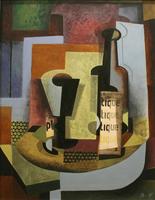 |
| 'Printemps' by Suzy Frelinghuysen, 1938 |
Just as writer Herman Melville's house, Arrowhead in Pittsfield, resonates with the history and figures of American literature during the 1800s, the home and studio of George L.K. Morris and his wife, Suzy Frelinghuysen, connects us to American efforts to engage modernism in all its forms.
That is very apparent in the museum's featured exhibition this season, "New Modern: Modern Masterpieces — Exploring the Harmony of Art and Design."
The History
Morris and Frelinghuysen were born in the early 1900s. As they developed as artists, they championed and practiced modern abstract art, helping to pave the way for its acceptance in the United States. In keeping with their efforts, Frelinghuysen left instructions in her will that their house and art collection be used for educational purposes.
 In 1929, Morris studied in Paris with Fernand Leger and, when he returned, he decided to build a studio based on Leger's (which was designed by Le Corbusier) on his parents' Berkshire estate. The resulting studio is considered the first modern structure built in New England.
After the couple married, they built their house, which is connected to the studio. Together these buildings contain works by both along with art that they collected. And so we find displayed throughout paintings by Georges Braque, Henri Matisse, Fernand Leger, Jean Arp, Ilya Bolotowsky and sculpture by David Smith and Gaston Lachaise along with many other works from their personal collection. Their house therefore became for them a test site for living modern and doing it with a lot of art and style.
The House and Art
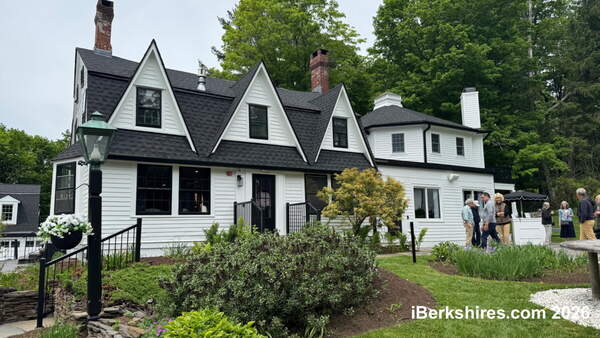
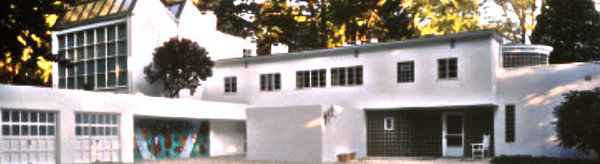
The house is white with a flat roof. The entrance foyer has a marble floor, paintings by Frelinghuysen and a sculpture and mural by Morris. After this shared effort to decorate the entrance, the couple seemed to take turns filling rooms with their art often alongside efforts by modern masters. Morris has murals, a relief and a sculpture in the living room, to which he added an early Miro painting. In the dining room, Frelinghuysen takes over with several of her abstract murals in a gray and blue palette. Each of their bedrooms (they had separate ones) also contained their own work.
Cubism and abstraction in general played a huge role in the evolution of their art. The cut and paste practices of Picasso and Braque are evident in much of their work as was the geometry of Mondrian, artists whose work they knew and/or collected.
Most surprising is a small brushy abstraction by Frelinghuysen in her bedroom. Undated, it seems to be a later work because it breaks from the formality of cubism that dominates most of her early paintings and has a fresh airiness to it.
In Morris' bedroom, he again adds a painting by Miro (a small whimsical work on sandpaper) to accompany his own paintings and studies for murals.
This is a house museum and because the original furnishings are essentially intact, one gets a real feel for how the artists lived.
There is the original furniture by Paul Frankl, Alvator Aalto, Peter Pfisterer and Donald Desky. Even the doorknobs and bathroom fixtures have the uniquely modern touch and would be of interest to design aficionados. And then there are their books.
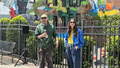
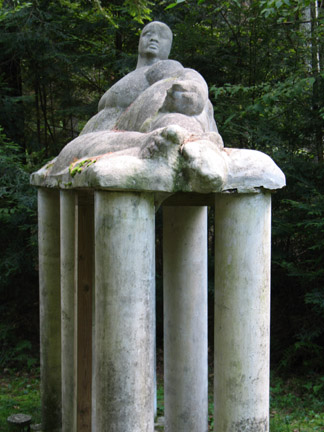
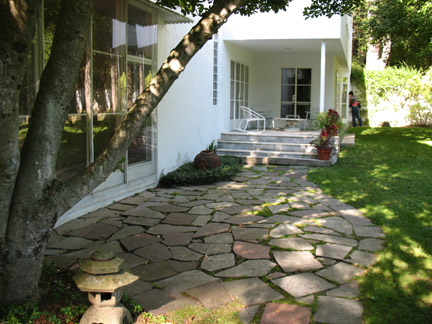
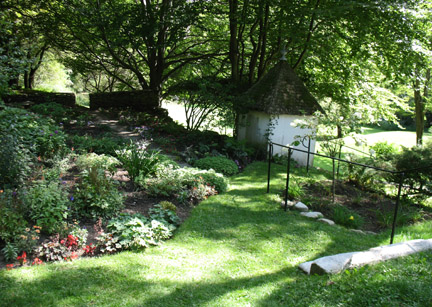 Above, the gardens; below left, the Lachaise sculpture 'The Mountain' and, right, the back of the house. The studio can be seen in the illustration above. |
|
 |
 |
The Studio and Exhibition
In the studio is "Exploring the Harmony of Art and Design." A temporary exhibition of paintings, sculpture and furniture (some by their contemporaries), it further elaborates what it meant to be modern. Clearly all the American artists assembled here owe a great deal to their fellow Europeans but they also make modernism their own.
So it is of great interest to see the luminous patchwork of a painting by Alice Trumbull-Mason near a small torn paper piece by Arp. Each work exudes a delicate personality, one of chance and randomness the other of more formal relationships. And there are paintings by artists not easily found in most museums. For example "Abstract Composition" from 1937 by Carl Holty and "Abstract in Pink" an airy pastel-colored painting by Bolotowsky. They all create an interesting dialogue with works by Picasso, Gris, Braque and Leger from the Frelinghuysen/Morris collection hanging on the north wall.
The show could be called the "Dialogue between Art and Design" since the painters and sculptors were obviously aware of their counterparts in the design world and vice versa. It is with that synchronicity that the curvy lines of the furniture echo the biomorphic shapes of the Calder sculpture. Or is it the other way around?
Same for the Naum Gabo sculpture that incorporates industrial materials furniture makers were experimenting with. Outside of the large murals painted in the living areas by the couple, all of the works present are small or modest in size and it is refreshing to see great ideas successfully played out on an intimate scale.
To visit the house, the studio and to see all the art in them, one must partake in one of the hourly tours. Which means no wandering off on one's own. And, unfortunately, not enough time to linger in front of one of the many great artworks.
However the tour is informative about the architecture and the art. And it also touches on the social life and family history of the inhabitants and the operatic singing career of Frelinghuysen. Morris, of course, wrote about art, often championing the cause of abstraction with articles like "The Quest for an Abstract Tradition" and writing the "Art Chronicle" feature for the Partisan Review during its early heady day of art and politics. A typical issue from 1938 has articles on Marxism, Soviet cinema, and the literary left, sandwiching a feature about Brancusi by Morris.
In addition to the house and studio the property has shaded gardens as well as pathways through the woods, where one can find an outdoor sculpture by Gaston Lachaise. For Berkshire residents, the museum offers a special half-price tour on Thursdays at 10 a.m. as part of the Discover the Berkshires promotion.
View Larger Map |
Bordering Tanglewood, the Frelinghuysen Morris House and Studio is accessible from Hawthorne Street. A 10-minute woodland walk from the parking area or a complimentary shuttle ride takes you to the museum.
DIRECTIONS: From Tanglewood's main gate go south on Route 183 (.3) miles to Hawthorne Road. Turn left, go (.7) miles, and turn left again on Hawthorne Street. The entrance is (.4) miles on the left. Or, from the Lenox monument, go (.3) miles on Old Stockbridge Road, turn right on Hawthorne Street. Entrance is (.8) miles on right.