Domestic violence can be one of the most difficult subjects to talk about publicly. Its very nature reaches into private homes, places often regarded as sacred or off-limits to public scrutiny or even public law. Yet confronting, and escaping, a situation of domestic violence often requires outside assistance, or at least support from another person. It requires one to take a step outside the private walls.
Victims of domestic abuse are overwhelmingly female (more than 85 percent), and they are abused by people with whom they share their life. This complicates things: if the abuser were a stranger, they would run away. But, as Jann Jackson writes in her article Understanding Survival Responses of Battered Women, “Unlike victims of other crimes, battered women are legally bound, economically dependent, and emotionally involved with their assailant. It is difficult to escape when there is no safe place to go and there are insufficient financial resources to live independently.†They want their relationships to work; they have often invested their lives in their families. They feel trapped, hoping things will work themselves out.
For a person in an abusive situation — regardless of gender, age or sexual orientation — there is a support network out there. That support network varies from an empathetic ear to a safe bed, child care support to economic assistance in a time of transition. The services are free and anonymous. They will make certain that if a person needs to leave a situation and start a new life, they can do so with the support — emotional and otherwise — of trained people who may have experienced a similar situation themselves.
October is national Domestic Violence Awareness Month. Organizations throughout the U.S. are holding performances, rallies and other special events to offer information to the public, and to remind the public, that domestic violence is a prevalent problem in any community, and a problem that, while not singling out individual victims, needs to be addressed by communities in a public way. PAVE (Project Against Violent Encounters) of Bennington, Vt. has been spending the month of October hosting a variety of events, and on Oct. 29 it will again have a bell-ringing ceremony on the Bennington Town Green to recognize and remember victims of domestic abuse.
Many people are familiar with PAVE as the organization that provides a 24-hour hotline for people in Bennington County who are victims of domestic abuse. But PAVE is in fact a varied agency that provides support services from the first call on up to housing referrals. They realize that domestic violence comes in many different forms — physical, sexual, emotional — and that while there is no one set solution to domestic violence, there are options.
“We don’t care who you are, or where you’re from,†said Andrea Patten, executive director of PAVE. “There are no huge requirements [for clients] — we serve men, women and children. A person might call the hotline because they’re concerned about their personal safety, or the personal safety of a loved one. They may just be looking for information, and we can get that to them. Or they may be calling about something that happened in the past.
“You’re never bothering us,†she added.
While the majority of callers are female, Patten noted that people are served regardless of age, gender, and sexual orientation. About 10 percent of callers are men, and ages have ranged from early teens to elders in their 80s.
PAVE’s services are free and confidential. Trained volunteers provide assistance to battered victims. The organization often receives referrals from Southwest Vermont Medical Center, the United Counseling Service, law enforcement agencies and other local organizations.
When a person calls the PAVE hotline, they will reach an answering machine, where they should leave a first name and contact phone number. Leaving one’s real name is optional, Patten said. The message is then relayed to the PAVE volunteer on call, who will call back the person within a few minutes.
Patten emphasized that PAVE volunteers are trained not to give advice, but to offer support, a series of options and resources. They are not counselors or trained psychologists, and it is not their business to give advice. If a caller is determined to stay in a difficult situation or relationship, it is his/her choice. It is not PAVE’s goal to break up families, Patten said.
She said much of PAVE’s success hinges on its ability to coordinate with other groups, as domestic violence is linked to so many other issues, such as substance abuse, sexuality, legal and economic issues. “We’re linked to all the major agencies in the area,†she said.
Activities for October
PAVE has lined up several activities that reflect its broad-based approach to both prevention and intervention during Domestic Violence Awareness Month.
The Clothesline Project invites people to design a T-shirt as their way of speaking out against violence, personal or otherwise. The colorful shirts are hung on a line to symbolize solidarity and a support network. These types of clothesline projects are done nationwide. The Clothesline Project has been on display at several locations in Bennington County, and it will be featured in the Oct. 29 ceremony.
With the violent attacks of last month, this October seems an especially appropriate time to reflect on violence that takes place in our own lives, Patten said. She pointed out that after the Sept. 11 attacks, purple ribbons were adopted as a way to support the victims of terrorism, and purple ribbons have traditionally been used to show support for victims of domestic abuse.
CAT-TV will be broadcasting some programs on the topic of domestic violence. The CAT-TV program Burning Issues will be focusing on two videos, including Hands Are Not for Hitting, a video taped several years ago at Stark Street Playground, in which parents and children worked together to decorate T-shirts. And Peer Drama is a video made by middle school students coming together to think about and express their views on domestic violence. The programs will air Thursday, Oct. 18 at 1:30 and 8 p.m.; Monday, Oct. 29 at 2:30 p.m.; and Tuesday, Oct. 30 at midnight and 7 a.m.
Another program, Love — All That and More, a combination of interviews, animation and skits about teenagers’ thoughts on love, sex and relationships, will be shown Monday, Oct. 29 at 9 p.m. on CAT-TV.
Another way to support PAVE this month is to take part in the “Clean Closets†project. When people donate their second-hand clothing to either Second Hand Rose (802-447-1563), the Second Time Around Shop (802-447-7327) or the PAVE office (802-442-2370), the purchase price is donated to PAVE’s programs.
The major event will be on Monday, Oct. 29, on the Bennington Town Green, when PAVE will hold its bell-ringing ceremony and display the Clothesline Project. This month’s event is being expanded to include all victims of terrorism.
The organization plans to launch the White Ribbon Campaign in November. Men who want to put an end to violence are encouraged to wear the white ribbon during the month to show their support.
Programs in the schools
Prevention has an important role in decreasing domestic violence, and PAVE staff spend significant time in the local schools to promote healthy relationships.
PAVE employee Steve Breakstone leads classes on prevention and awareness education at Mount Anthony Union High School, working with teens on issues of dating and relationships. Studies have indicated that violence and coercion happen frequently in teen dating relationships, especially in younger teens, and that these situations, not surprisingly, lead to higher pregnancy rates and higher dropout rates, and a pattern of abuse and dependency throughout life.
Students have been given a booklet, “Teen Dating Violence: What You Need to Know,†which asks students to define what a relationship is — what should be expected and what should not be tolerated. It talks about control — and about how healthy couples make decisions together about how far to go, and taking charge of birth control. It also helps teens find what to say if they see a friend abusing someone, or a friend being abused. With some teens, a peer can be the most trusted, most effective support system.
Like many support services, PAVE started small, as a hotline in someone’s home, almost 20 years ago. It now has six employees, receives state-administered federal funding, does heavy grant-writing for private sources, and private funding from the town, as well as fund-raising and donations from area religious groups. Also a United Way member agency, Patten said that organization provides PAVE with its largest source of unrestricted funding, which helps with things like maintenance and other unexpected costs.
In all, PAVE provides services to about 1,000 a year, a figure that includes the roughly 600 high school students who participate in the intervention/prevention program.
Volunteer opportunities
PAVE welcomes and encourages anyone interested in volunteering their time or skills to call the office for an appointment. About 35 people currently serve as volunteers, making sure that the PAVE hotline is working 24 hours a day.
Volunteers are always needed to staff the hotline. They must go through training and must be patient, supportive and willing to listen to someone. They must have their own transportation, as they may have to assist someone directly by providing a ride.
Court advocates accompany a victim to court. They will learn about the relevant legal matters and how to assist in completing necessary paperwork. They may also provide support and information to the victim’s family.
Safe-home providers are particularly needed, Patten said. These are trained volunteers who offer a place in their home for a person who needs short-term emergency shelter, usually for one or two days. PAVE coordinates with the safe-home provider to ensure that they can go to work or do other errands without leaving the guest alone. This is a service that isn’t needed regularly, but it helps to have a larger network of resources.
Volunteers are also needed to provide child care — particularly during scheduled support group meetings.
Patten noted that volunteering is easier than ever, because PAVE has adapted much of its training program into a self-study packet, decreasing the need for scheduling and waiting for group training.
PAVE’s hotline is (802) 442-2111. Other important numbers are the mental health services at United Counseling Services (802) 442-5491; the AIDS hotline: (802) 442-4481; Social and Rehabilitation Services (SRS): (802) 442-8138; and Family Emergency Services (runaway): (802) 442-1700.
If you would like to contribute information on this article, contact us at info@iberkshires.com.
Your Comments
iBerkshires.com welcomes critical, respectful dialogue. Name-calling, personal attacks, libel, slander or foul language is not allowed. All comments are reviewed before posting and will be deleted or edited as necessary.
No Comments
North Adams Water Safe to Drink
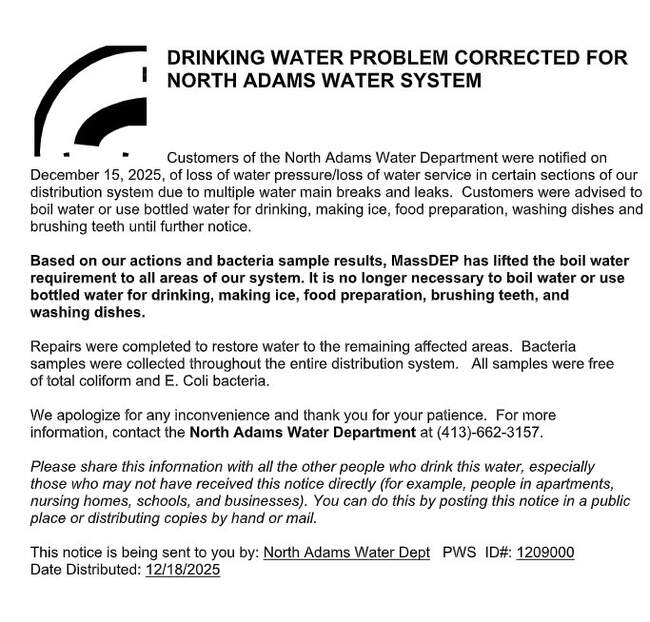
NORTH ADAMS, Mass. — The Water Department says all water line breaks have been repaired and water restored to those affected areas.
The boil water order has been lifted by the state Department of Environmental Protection. Residents no longer have to boil water or use bottled water for drinking, making ice, food preparation, brushing teeth or washing dishes.
A partial lift of the Dec. 15 order was issued on Tuesday; as of Thursday, the requirement is no longer in effect for any areas of the city.
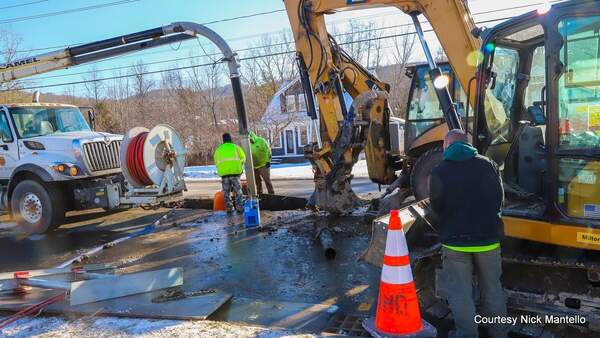
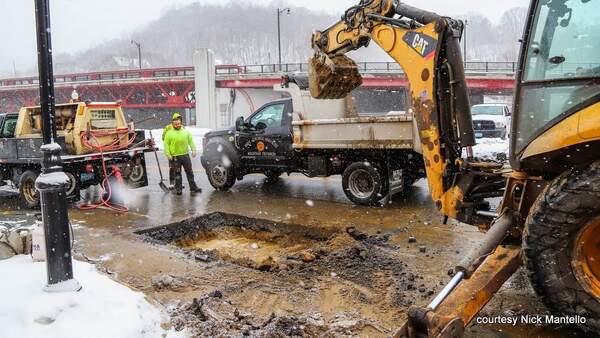
The water issues began on Friday after a water main broke in an inaccessible area behind the water treatment plant on Pattison Road. The drop in pressure and frigid temperatures led to breaks on American Legion Drive and by State Road and Biltmore Avenue.
It took all weekend to fix the main, and several more to repair the other breaks. During this time, residents experienced no water or low water pressure.
The Water Department says all repairs have been completed and that samples collected throughout the distribution system were free of total coliform and E. coli bacteria.
For more information, contact the North Adams Water Department at 413-662-3157.
The city has lifted a boil water order — with several exceptions — that was issued late Monday morning following several water line breaks over the weekend. click for more
The bridge had been closed to all vehicle traffic since March 2023 after being deemed structurally deficient by the state Department of Transportation. click for more
The Water Department has been responding to multiple water line breaks throughout the city since Friday, causing temporary loss of water in some areas. click for more