Williams Professor Wins Mellon Foundation Fellowship
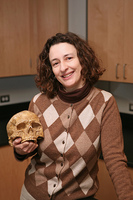 |
| Antonia Foias Photo courtesy Williams College |
The New Directions Fellowship program is designed to assist college faculty in the humanities and humanistic social sciences who are five to 15 years beyond their doctorates and who wish to acquire research training outside their academic disciplines. The fellowship provides a year’s salary as well as funds for tuition and other costs associated with research and training.
The fellowship carries with it an award of $208,000, which will support Foias' advanced training in the use of geographic information systems and geology to help her uncover the ways in which Maya civilization was tied to its ancient environment and resources.
"We need much more sophisticated theories dealing with how individuals and societies make decisions about environmental use," said Foias. "Such theories can only be created by social scientists that have training in the ecological, geological, and geographic fields."
Foias will use GIS technology, which merges cartography and database tools, to model Mayan archaeological histories in relation to regional histories, the distribution of environmental resources across the landscape, and changes through time in relation to cultural or climatic shifts. She will use her geology training to study both the clay that Mayans used in their pottery and the different soil resources available to the Mayans (who were primarily agriculturalists).
Since 1998, Foias has been directing archaeological and ecological research at the site of Motul de San Jose in the Central Peten Lakes area of northern Guatemala. She has carried out six field seasons there surveying, mapping, excavating and analyzing. Her team is finishing a book on the politics, history and economics of the Mayan society of Motul de San Jose, which will be published by University Press of Florida in 2011.
Foias received her bachelor's degree from Harvard University and her doctorate from Vanderbilt University.