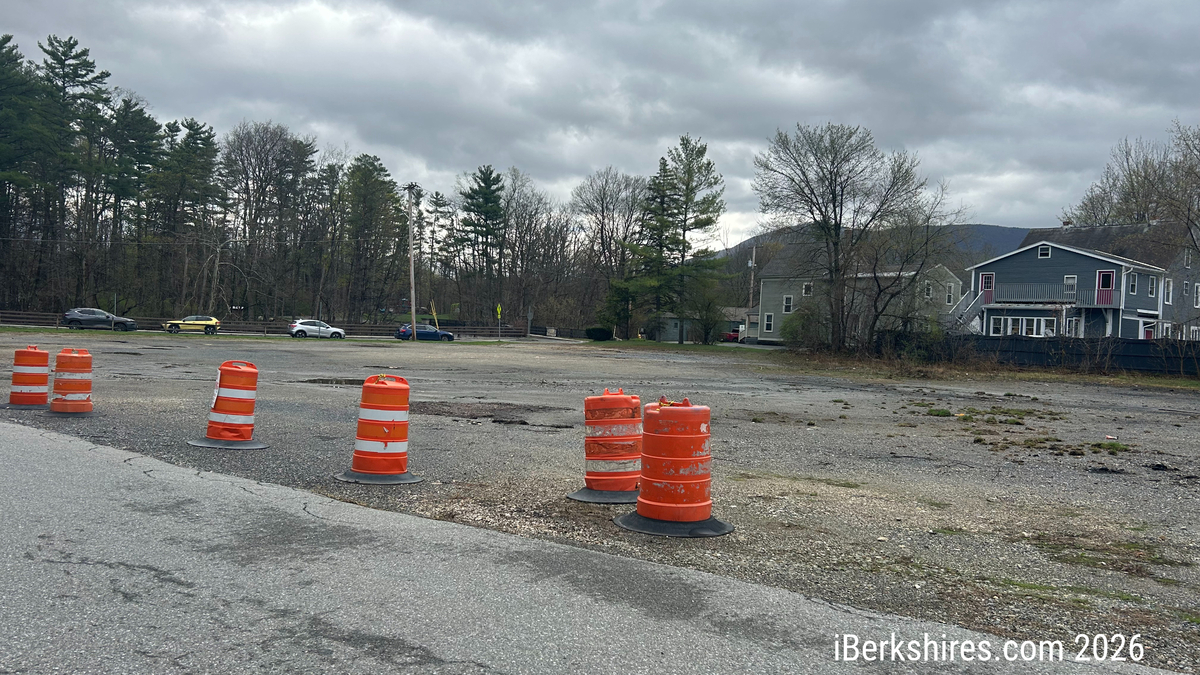
Williamstown Board Opts to Negotiate with College on Water St. Lot
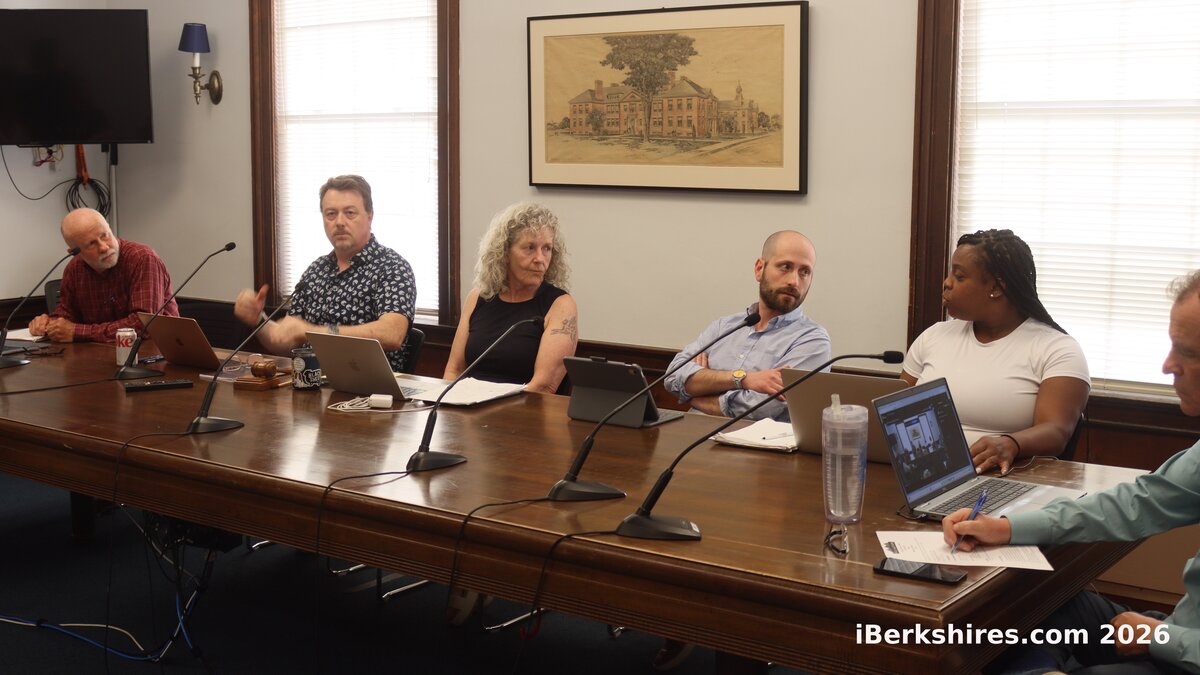
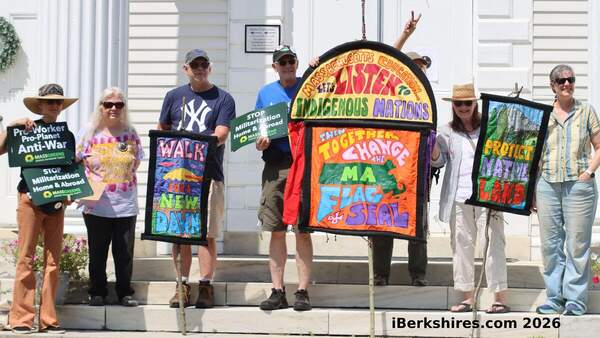
Newly elected board member Nate Budington, far left, participates in his first in-person meeting along with, from left, Matt Neely, Stephanie Boyd, Peter Beck, Shana Dixon and Town Manager Robert Menicocci.
But the board members made it clear that the college's proposal to acquire the lot is a starting point, not a final deal that the elected officials would accept.
"For the sake of continued conversation, I'm in favor of [awarding Williams the site], but if this process wasn't continued with the opportunity for further negotiation, I wouldn't vote to continue this," Peter Beck said. "I think that next step is necessary for us to get to a yes on this."
"I think there's wide agreement on that," Matthew Neely said just before the 5-0 vote to enter talks with the college.
Williams was the sole respondent to a town-issued request for proposals to develop the former town garage site, currently a dirt lot.
The college's stated intent is to build a new Facilities office and create up to 170 parking spaces at 59 Water Street. That use will allow the college to redevelop the current Facilities building site and parking lot as part of a reconception of the school's indoor athletic and recreation facilities.
Under the terms of the RFP, the college's proposal was subjected to review by an ad hoc advisory committee to the town manager, who brought the question to the Select Board. That board will have the final say on any purchase and sales agreement.
Community Development Director Andrew Groff gave a report to the Select Board from the advisory committee, which included himself, the town's assessor, the town's finance director, the chair of the Finance Committee and a member of the Planning Board.
"While our committee was split … considering how this is a linchpin of a broader project [the athletic facilities], which, if done right will benefit downtown for many years … the group determined that we think this board should award the parcel to Williams but reserve to itself in negotiations the right to push Williams harder on the first piece: the creation of tax base growth," Groff said.
The town's RFP emphasized that it would look favorably on proposals that add to the town's tax base and, "improve the vibrancy of Water Street and the Village Business District."
The planned use — a Facilities building — would be exempt from property taxes, as is the current building on Latham Street. Groff suggested that the town and the college can negotiate a path that creates property tax revenue on other properties in Williams' vast portfolio.
"The first criterion in the RFP was, 'Is the proposal going to create additional tax base in the downtown area?' and we left that language open," Groff said. "The tax growth does not have to occur on that [59 Water St.] site."
Although buildings like the Facilities building, the classroom buildings, the dormitories and the gymnasiums are tax exempt as necessary to the college's core mission, Williams still is, by far, the largest single property taxpayer in town because of its holdings, like housing it maintains for faculty, commercial property it rents to small businesses on Spring Street and the Williams Inn, to name a few examples.
Select Board member Shana Dixon asked Groff to clarify whether the proposal in front of the board checked all the boxes in the RFP.
"In terms of the tax issue, no," Groff said. "In terms of the overall impact on the downtown area, it was ranked as advantageous."
Groff told the board that the advisory committee weighed the benefits to businesses on Spring Street and Water Street from the expanded athletic events that the college hopes to hold at its updated athletic complex, including the possibility of expanded summer sports camp offerings, which used to be more robust than they are today.
"The recommendation from [the advisory committee] is: Let's move forward and negotiate to get the not-advantageous rating up," Groff said, referring to the committee's rating on the tax base aspect of the RFP.
The college's associate vice president for campus planning and operations was one of several Williams officials to field questions from the board on Monday evening.
Mina Amundsen told the Select Board that the redesign of the college's athletic facilities includes opening up acreage where Lasell Gymnasium, Samuelson-Muir Pool and Lansing Chapman Rink currently sit. Those facilities will continue to operate during construction and be razed once the new multipurpose facility is operational, she said.
"Once we build the new facility and move everyone … we'll take down the old buildings, and the idea is to have a grass recreation field," Amundsen said. "What that does is provide more recreation for students in the area … and opens up a connection to Spring Street.
"What it will do is completely open up the views."
Select Board member Shana Dixon argued that while the new facilities and recreational fields will benefit students, "I'm not sure the community feels comfortable in that space.
"I would like [59 Water St.] to be a more community-based, public area," Dixon continued. "In the [town's] comprehensive plan, it's already known there's no public space. There's nowhere people can go to have a picnic.
"I'm not sure the money is worth it."
The money in question is the effective $1 million purchase price incorporated into Williams' proposal. The college is offering to pay the town $500,000 up front — well above the dirt lot's assessed value of $254,200 — plus a $50,000 donation for the next 10 years to the Mount Greylock Regional School District.
That payment structure generated some discussion during Monday's discussion.
"If you look at the school budget we just passed, $50,000 doesn't go that far," Dixon said, referring to the town's $16.9 million share of the district's operating and capital budget.
"The $50,000 the school gets 10 years from now is not going to be worth $50,000 [in 2026 dollars]," Peter Beck said, a point later echoed by resident Kimma Stark during public comment.
"Anyone other than a non-profit would be paying in perpetuity for [property] taxes," board Chair Stephanie Boyd said.
"Every time we lose a piece of property with potential to be revenue generating, it's not good. Williams has clearly offered 10 years of something similar to tax revenue, but it's not permanent."
Groff redirected the board a couple of times to the notion that the committee thinks the town can negotiate an arrangement that augments the town's tax base with, "some holding elsewhere that becomes taxable," in Williams' real estate portfolio.
"That's why our review was conditional," Groff said.
The longest comment the board heard when it opened the floor to residents came from Roger Lawrence, who clarified he was speaking as a member of the Planning Board but not for that five-member body.
Lawrence said the town's past failed efforts to find a developer for 59 Water St., which has been vacant since 1999, and the fact that the latest RFP generated one response are arguments in favor of going with Williams' plan.
But he asked that the Select Board hold off on making that move.
"We can sell this property at any time," Lawrence said. "Once done, we can never unsell it.
"What's different now than the conditions of the last 20 to 25 years? I believe there will be opportunities coming to Water Street. The goal of activating Water Street is a uniform one. The goal of increasing pedestrian communication between Spring Street and Water Street will help with that. Activating the business climate on Water Street is something we can do."
Lawrence reminded the Select Board that the planners are working on two projects that he said could help spur commercial development of the 59 Water St. lot: making mixed-use (commercial/residential) development more attractive in town and revising the town's subdivision control bylaw, which regulates both residential and commercial subdivisions.
"The rules are changing and, hopefully, in ways that will open up opportunities for sites like the old town garage site," Lawrence said. "There may be opportunities there that haven't been there in the past."
In the end, the five Select Board members voted unanimously to enter into negotiations with Williams with the understanding that the tax-base enhancement question is very much on the table. And shortly after dispensing with the rest of the business on the agenda, the board moved into an executive session to discuss strategies for that negotiation.
In other business on Monday, Beck was elected as the board's chair starting with its next meeting. Neely was elected vice chair, and Dixon was elected secretary in the board's annual reorganization.
And Town Manager Robert Menicocci told the board that the town recently was awarded two grants: close to half a million dollars for a municipal fiber-optic initiative that will link all town buildings, the fire station and the public schools and about $100,000 for engineering work for a culvert project off Northwest Hill Road.
Tags: Williams College,