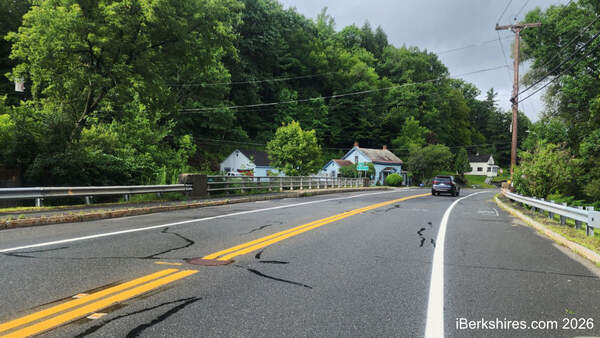
image description
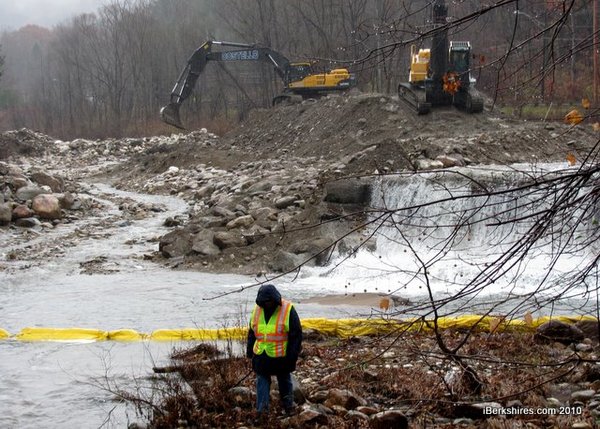
Engineer James MacBroom walks below the what's left of the Briggsville Dam.

Briggsville Dam Deconstruction at Halfway Mark
By Tammy DanielsiBerkshires Staff
Print Story | Email Story
CLARKSBURG, Mass. — By next summer, the Briggsville Dam will be a distant memory, the only record of its existence a set of rusting gears on a concrete wall.

"It's been six years coming to fruition and now that it finally has, it's a tremendous relief," said Peter Cote, president of Cascade School Supplies, on Thursday morning. "As the president of Cascade, to have this fiscal risk to our company taken care of essentially by these great partners at the private, state and federal level, we couldn't be more pleased."

Cote was standing in the cold rain with representatives from some of those partners — the town of Clarksburg, the state Division of Ecological Restoration, the U.S. Fish & Wildlife Service, Eastern Brook Trout Joint Venture, Wildlife Conservation Society, Trout Unlimited, the Hoosic River Watershed Association and American Riverways — watching two payloaders pile sediment and rocks to split the Hoosic River.

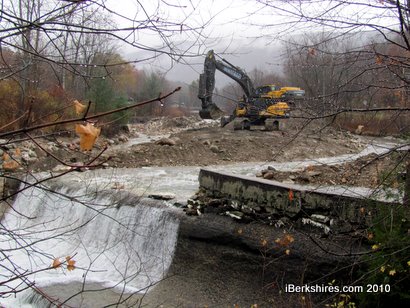
The eastern side of the 150-foot long dam is gone and the eastern side nearly so. There was an expectation of seeing a section of dam knocked out Thursday but the preparation wasn't quite ready and the heavy rain added to the difficulty.

Work started a few weeks ago but there's still several weeks of work ahead, said James G. MacBroom of Milone & MacBroom Inc. of Cheshire, Conn., the engineer of record for the project. This coming spring, the river banks will be restored and planted.

The work began more than a year ago with assessment of the structure and the development of construction plans (or really, deconstruction plans). The result, said MacBroom, was a choreographed plan for contractor Costello.

"He's always going back and forth between three different things: one is making sure there's a channel to keep the water flowing; the second part is actually moving the dam piece by piece, and the third major element, which is the biggest part of the work, is removing all the sand and gravel that's accumulated in the pool itself," he said. "People may not realize it but behind the dam, the pool was almost totally full of sand and gravel, right up to the top ... it really didn't contain water."

Once completely removed, the Hoosic River will run free for 30 miles, allowing native fish like brook trout and longnose sucker to swim and spawn along its length.

"It will create a more stable population," said Dana Ohman, an aquatic biologist with the state's Division of Fisheries and Wildlife, who's overseen the removal of fish from the work site. "We're here for the smaller ones that can't get out."

The Briggsville Dam was designated a hazard since the state did a risk assessment of its 3,000 dams six years ago, prompted by the condition of the Taunton Dam after a record October rainfall. While the Office of Dam Safety has been involved with some removals, the state's Division of Ecological Restoration has done a half-dozen or so removals in partnership with local and state river organizations.
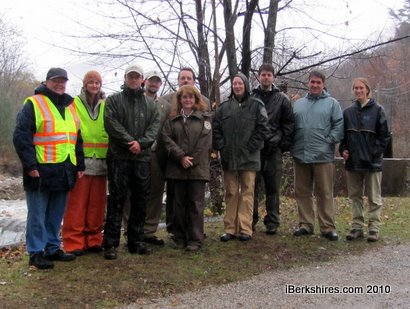

Some of those involved in the removal of the dam, including James MacBroom, Jessica Clark and Nick Wildman, at right pose at the site.
Nick Wildman, priority projects coordinator for Division of Ecological Restoration, said, based on data from Ohman's team, his agency decided it wanted to be involved in restoring that section of the river.

It's also involved in the removal of the Thunder Brook Dam in Cheshire and the Old Berkshire Mill Dam on the Housatonic River in Dalton.

Cote said he didn't realize Cascade, which occupies the old Strong Hewat Woolen Mill, owned the dam until the Office of Dam Safety contacted him about having it inspected. It was found to be in significant disrepair with a price tag of $600,000 to fix it.


"We didn't have that kind of money. This is a tremendous relief for Cascade," he said. "It takes the burden off our company and ensures our fiscal stabilitiy for years to come."

The dam once powered the woolen mill but like many old dams from the 19th and early 20th century is no longer suitable as an energy source, said MacBroom. "Today, the dams don't have an economic or commercial use; they become just a block to the flow of the water and a block to the organisms so you have to kind of balance historic value versus future value of the river."

Rather than being electrical generators, older dams spun waterwheels or turbines for mechanical power.

"It's much more efficient and much more economical to use electrical engines and so the dam doesn't really have any economic or social use anymore," he said. "While we like to encourage people to have green energy and renewable sources of energy, unfortunately, a lot of these old dams are in poor condition and are not a good candidate because of the environment and cost."

With the hazard gone, Cote's looking forward to better fishing along the river next summer. "They stock it here, you know, they fish here all summer long."

Related Stories:
Clarksburg Dam Demolished Thursday
CLARKSBURG - 11-02-2010 - The project involves removing the dam, stabilizing and vegetating banks, protecting an upstream bridge, and restoring...
Dredging Begins at Clarksburg Dam
CLARKSBURG - 10-25-2010 - Some 11,000 yards of rocks and sediment behind the dam will be excavated before the concrete structure is removed.
Clarksburg OKs Funds for Dam Removal
CLARKSBURG - 10-06-2010 - Nick Wildman, priority projects coordinator of the state's Division of Ecological Restoration, said the work could...
Clarksburg Officials Look For Voter Guidance on Dam
CLARKSBURG - 09-22-2010 - "It's your money folks. We need your vote; we need you to tell us what to do." — Selectman Carl McKinney
Clarksburg Sets Vote on Dam Spending
CLARKSBURG - 09-17-2010 - The town meeting will be held on Wednesday, Oct. 6, at 7 p.m. at the Clarksburg Elementary School.
Clarksburg Looks For Dam Removal Alternatives
CLARKSBURG - 08-25-2010 - The town may turn to the Pentagon to get rid of the deteriorating Briggsville Dam.
Clarksburg Could Vote on Dam Removal
CLARKSBURG - 08-02-2010 - "It's either going to have a lot of support and pass or it's going to go down in flames but it won't be for lack of...
Clarksburg Selectman Suggests Town Vote On Funding Dam...
CLARKSBURG - 06-24-2010 - "You can basically expect the mill to go out of business and to remain vacant and no longer pay property taxes. And...
Clarksburg School Asks Town to Help Close Shortfall
CLARKSBURG - 04-16-2010 - "You were at last year's town meeting. I really don't want to ask for more." — Chairwoman Debra Lefave.
Briggsville Dam Slated for Removal This Summer
CLARKSBURG - 02-25-2010 - "From a fish standpoint, we didn't want to come into this and pump the stream down." — Nick Wildman

If you would like to contribute information on this article, contact us at info@iberkshires.com.

Lanesborough Planners Bring STR, ADU, Signage Bylaws for Town Vote

By Breanna SteeleiBerkshires Staff

LANESBOROUGH, Mass. — The Planning Board held a public hearing on the much anticipated bylaws for short-term rentals, accessory dwelling units, and signage to be presented at the annual town meeting.

For the past few months, planners have diligently been working on wordage of the new bylaws after Second Drop Farm's short-term rental was given a cease and desist because the building inspector said town bylaws don't support them.

The draft bylaw can be found on the website.

The board voted on each of the four articles and heard public comment before moving to entertain any amendments brought forward.

A lot of discussion in the STR section was around parking. Currently the drafted bylaw for parking states short-term rentals require two parking spaces, and with three or more bedrooms, require three spaces but never more than five.

There were questions about the reasons for limiting parking and how they will regulate parking renters choose to park on the lawn or the street. Planners said it is not their call, that is up to the property owner and if it is a public street that would be up to the authorities.

Some attendees called for tighter regulation to make sure neighborhoods are protected from overflow.

Lynn Terry said she lives next to one of the rented houses on Narragansett Avenue and does not feel safe with all of the cars that are parked there. She said there can be up to 10 at a time on the narrow road, and that some people have asked to use her driveway to park. She thinks limiting to five cars based on the house, is very important.

The wordage was amended to say a parking space for each bedroom of the house.

Rich Cohen brought up how his own STR at the Old Stone School helps bring in money and helps to preserve the historic landmark. He told the board he liked what they did and wants to see it pass at town meeting, knowing it might be revised later on.

He said the bylaws now should not be a "one size fits all" but may need to be adjusted to help protect neighborhoods and also preserve places like his.

After asking the audience of fewer than 20 people, the board decided to amend the amount of time an short-term rental can be reserved to 180 days total a year in a residential zone, and 365 days a year in every other zone. This was in the hopes the bylaw will be passed and help to deter companies from buying up properties to run STRs as well as protecting the neighborhood character and stability.

They also capped the stay limit of a guest to 31 days.

Cohen also asked them to add "if applicable" to the Certificate of Inspection rule as the state's rules might change and it can help stop confusion if they have incorrect requirement that the state doesn't need.

The ADU portion did not have much public comment but there were some minor amendments because of notes from KP Law, the town counsel.

View Full Story

More Clarksburg Stories