Clarksburg School Asks Town to Help Close Shortfall
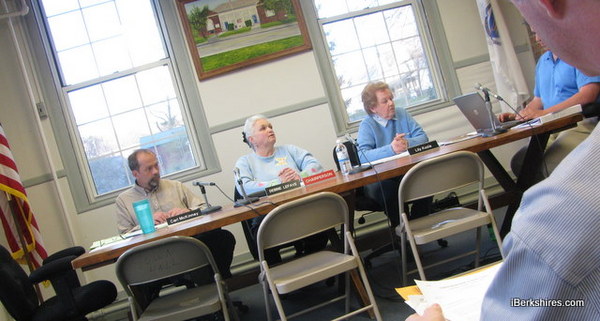
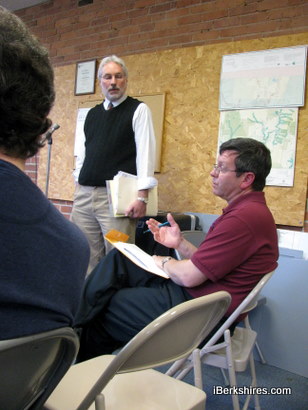 Superintendent Jonathan Lev, left, and School Committee Chairman David Berger explain the district's problem. |
"We're just being cautious in coming to you," Chairman David Berger told the Selectmen on Wednesday. "We wanted to say, we think there's going to be a shortfall."
The Selectmen said they'd be willing to meet the committee halfway but not all the way.
"If we give you $8,000, can you come up with the other $9,000? You still have $700,000 in your budget with what, two months of school left," said Chairwoman Debra Lefave.
Berger said it would be difficult to guarantee because a few line items could change costs dramatically and the school has already been trimming away at expenses. The school is currently paying for four students in residential placements, which has ballooned that budget item. It's costing $4,100 a month for one child, who is expected to be removed from the placement but only if the agencies involved can agree on it.
"We have to pay for those costs by the month, we can't pay it at once," said Berger, who suggested raising the money by placing the shortfall as an appropriation on the warrant.
The Selectmen warned that the citizenry might react negatively to that. Plus, said Lefave, it couldn't go on the town meeting warrant for next year; it would have to be presented as a special town meeting for this year.
"You were at last year's town meeting. I really don't want to ask for more," said Lefave. The town's had to cut back, too, she said. "It's no secret we don't have any money."
Selectman Carl McKinney objected to the idea of dipping into the school stabilization fund, a savings account toward the construction of a new school.
"Do you really want to touch the building account?" asked McKinney, saying he wouldn't vote for it. "It shouldn't be consumed for operating expenses."
Taking from the stabilization fund would also require a two-thirds vote to pass.
The school has seen enrollment sharply drop over the past couple years by nearly 20 students, to 171, which could open up slots for school-choice students as a way to raise revenue. But the School Committee's hesitated to do that because it's a double-edged sword.
"If we take school choice, we know they're going to come from North Adams and we also tuition our kids to Drury and they raised our tuition $1,000," said Berger. "The more we take from North Adams, the more they hurt and the more they raise our tuition."
School officials will return in two weeks with a better idea of the final weeks of their budget and in time to make the warrant, if needed. But town officials encouraged them to make cuts first and have a backup plan if voters reject their request.
"If you run out of money, you will have to shut down," Town Administrator Michael Canales told Berger. "How will we pay our bills?" responded Berger. "You can't," said Canales, because the state doesn't allow deficit spending.
In other business:
► The Selectmen, acting as the Cemetery Commission, sold two graves in Lot 70 to Marguerite Slade.
► Heard from McKinney on plans for Northern Berkshire Solid Waste paint collections, the first to be held May 1 at the Williamstown transfer station and May 22 at the Cheshire transfer station.
► Canales reported that funding for the removal of the Briggsville Dam was incomplete and could delay or stop work. Its removal is being funded by state and federal grants and private donations.