Clarksburg Selectman Suggests Town Vote On Funding Dam Removal
By Patrick RonaniBerkshires Staff
Print Story | Email Story

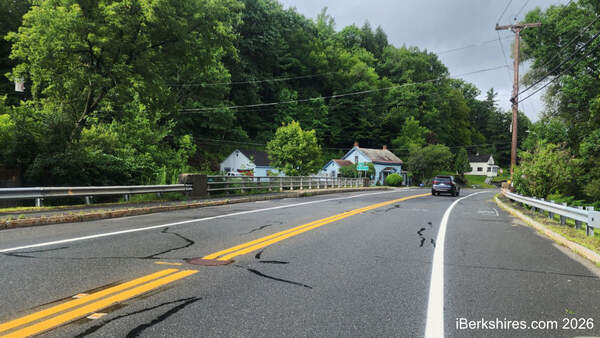
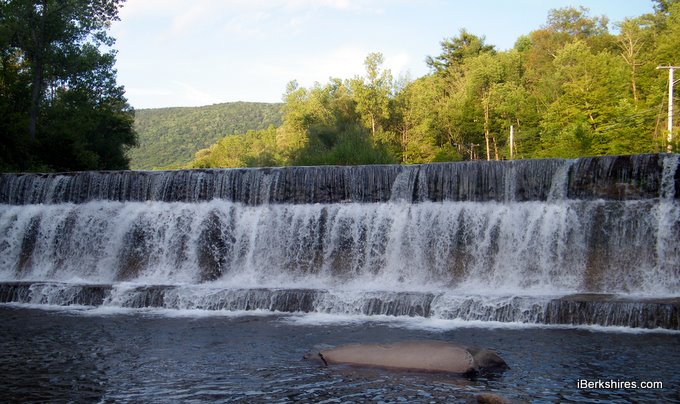
The Briggsville Dam has been designated a significant hazard by the state because one side has moved off its footings.
CLARKSBURG — Selectman Carl McKinney has proposed the idea of a special town meeting, asking voters if the town should contribute funds toward the removal of the Briggsville Dam.

During Wednesday night's Selectmen's meeting, McKinney said the current lack of funding toward the removal could have a "horrible impact on the community." The dam, which has been deemed a safety hazard by the state, was slated for removal this summer.

Because the funding is short, McKinney said the state could step in to finish the project and then stick the bill with Cascade School Supplies, the company that owns the dam. (The dam was built to power what was then the Strong-Hewat Woolen Mill.)

McKinney admitted that his stance has swung "180 degrees," referring to a meeting earlier this year when he said the town doesn't have enough money to help with the removal and, if it did, the funds would be better served in the school system.

On Wednesday, he expressed his fear that the Cascade mill could be in jeopardy if the state takes over the dam project.

"You can basically expect the mill to go out of business and to remain vacant and no longer pay property taxes," he said. "And then it's going to be a source for criminal activity and industrial decay in the center of town.

"As a community, we should discuss the ramifications of doing nothing."

Town Administrator Michael Canales stated that the current funding for the removal, which is being provided by various sources — including American Rivers, U.S. Fish and Wildlife and the federal Natural Resources Conservation Service — is short roughly $126,000. He said the town could also lose an additional $86,000 in grant money that is set to expire at the end of the summer.
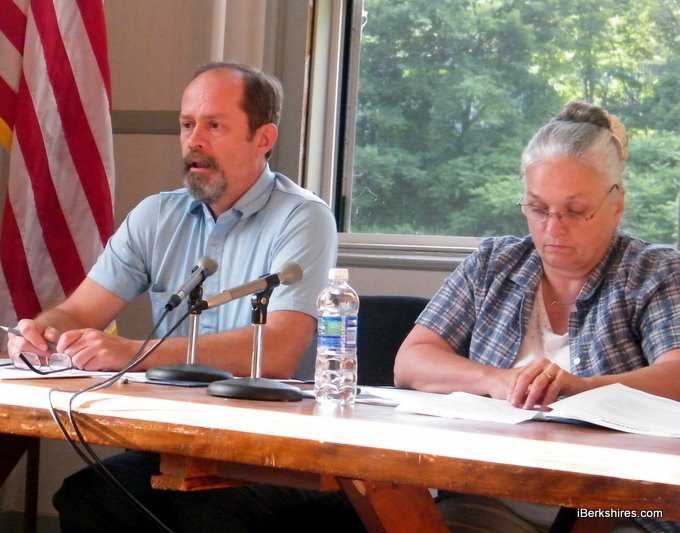


Selectman Carl McKinney, left, and Chairwoman Debra LeFave.
McKinney said he'd like to speak with the owner of Cascade School Supplies to gauge how much the company was willing to contribute, as well. He proposed that Clarksburg should consider transferring money from the stabilization fund to help expedite the removal.

To take money out of the stabilization fund requires a 2/3 vote at town meeting. Canales said there is approximately $315,000 currently in the stabilization fund.

One of the three Selectmen, Lily Kuzia, was absent, which prompted McKinney to hold off on making a motion for a town meeting. He would like to continue the discussion at the next Selectmen's meeting on Wednesday, July 28.

The town has made repeated efforts to draw in funds from other sources, according to Canales. He said it's "very unlikely" the $126,000 deficit will be filled by outside grants, at least in the near future.

"We've gone to our senators, we've gone to federal senators, we've gone to state and federal organizations, " he said. "Right now, things are tight. Things are tough."

McKinney said there isn't enough time to be inactive, and that presenting the issue to the town voters is a viable option.

"Let the people decide because it's their community," he said. "I really don't want to sit on the side and, through my office that I hold, make a decision on behalf of the people, and I question whether it's the right decision to do nothing. If nothing is done, it's going to come and bite us in the behind, and then we'll have a world of problems in the future."

If you would like to contribute information on this article, contact us at info@iberkshires.com.

Lanesborough Planners Bring STR, ADU, Signage Bylaws for Town Vote

By Breanna SteeleiBerkshires Staff

LANESBOROUGH, Mass. — The Planning Board held a public hearing on the much anticipated bylaws for short-term rentals, accessory dwelling units, and signage to be presented at the annual town meeting.

For the past few months, planners have diligently been working on wordage of the new bylaws after Second Drop Farm's short-term rental was given a cease and desist because the building inspector said town bylaws don't support them.

The draft bylaw can be found on the website.

The board voted on each of the four articles and heard public comment before moving to entertain any amendments brought forward.

A lot of discussion in the STR section was around parking. Currently the drafted bylaw for parking states short-term rentals require two parking spaces, and with three or more bedrooms, require three spaces but never more than five.

There were questions about the reasons for limiting parking and how they will regulate parking renters choose to park on the lawn or the street. Planners said it is not their call, that is up to the property owner and if it is a public street that would be up to the authorities.

Some attendees called for tighter regulation to make sure neighborhoods are protected from overflow.

Lynn Terry said she lives next to one of the rented houses on Narragansett Avenue and does not feel safe with all of the cars that are parked there. She said there can be up to 10 at a time on the narrow road, and that some people have asked to use her driveway to park. She thinks limiting to five cars based on the house, is very important.

The wordage was amended to say a parking space for each bedroom of the house.

Rich Cohen brought up how his own STR at the Old Stone School helps bring in money and helps to preserve the historic landmark. He told the board he liked what they did and wants to see it pass at town meeting, knowing it might be revised later on.

He said the bylaws now should not be a "one size fits all" but may need to be adjusted to help protect neighborhoods and also preserve places like his.

After asking the audience of fewer than 20 people, the board decided to amend the amount of time an short-term rental can be reserved to 180 days total a year in a residential zone, and 365 days a year in every other zone. This was in the hopes the bylaw will be passed and help to deter companies from buying up properties to run STRs as well as protecting the neighborhood character and stability.

They also capped the stay limit of a guest to 31 days.

Cohen also asked them to add "if applicable" to the Certificate of Inspection rule as the state's rules might change and it can help stop confusion if they have incorrect requirement that the state doesn't need.

The ADU portion did not have much public comment but there were some minor amendments because of notes from KP Law, the town counsel.

View Full Story

More Clarksburg Stories