image description
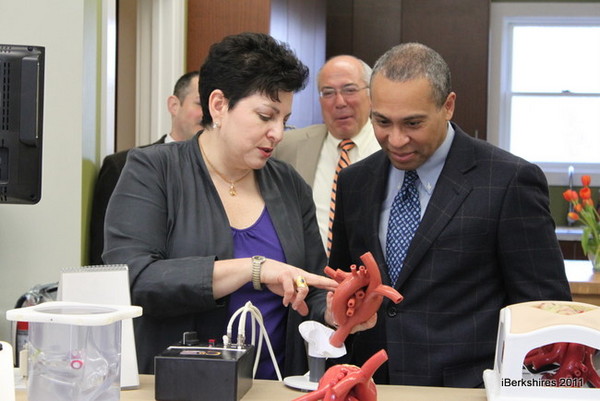
Gov. Deval Patrick and Lisa Chamberlain inspect a model heart designed and produced by the Chamberlain Group in Great Barrington.

Governor Talks Hearts, Lungs, Precision Economy in the Berkshires
By Nichole DupontiBerkshires Staff
Print Story | Email Story

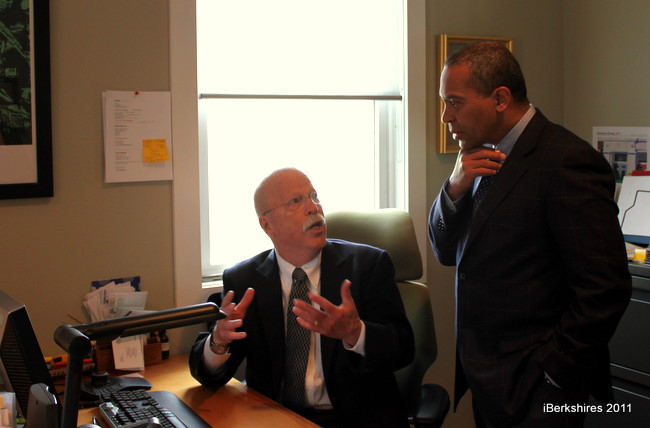
Eric Chamberlain, president of the Chamberlain Group, explains the modeling work the company does to Gov. Deval Patrick.
GREAT BARRINGTON, Mass. — Gov. Deval Patrick made a visit to the Berkshires on Thursday to highlight the region's potential for manufacturing growth in the "creative economy."

The governor's first stop (of three) was the Chamberlain Group, a studio that designs and builds mimetic organs for surgical and interventional training. The CG staff, including President Eric Chamberlain and his wife and managing partner Lisa Chamberlain, were there to greet him and give him a humorous, somewhat macabre tour of engineered hearts, hands and bladders to name a few parts on display.

Lisa Chamberlain, who began her career at the New York City-based design and effects studio R/GA, said virtual sculpture and technology was met with some skepticism at first.

"We have some surgical friends at Baystate [Medical Center] who were skeptical at first about simulation technologies," she told the governor. "We don't do this in every case. Although we're a small company we've taken high-end technology to use and it has become more affordable for hospitals and surgeons to use. We have a database for anatomy design and a training method around that anatomy."

In addition to allowing surgeons and residents to perform hands-on training with any given model, be it a bladder, heart or bowel, the lifelike models also allow training with the minimally invasive da Vinci robotic surgery, which is employed at many area medical centers including Baystate in Springfield, one of more than 60 clients that CG has around the world.

Mimetic models are essential for promoting confidence in surgical residents, said Dr. Gladys Fernandez, Baystate's assistant program director for the surgery residency program.

"As an educator at Baystate I started looking at our needs assessment," she said. "What I found is that people are getting great at doing things laparoscopically. We've revised the curriculum with the focus on reviving performance and taking more than a few steps back to teach residents old-fashioned, hands-on surgery."

Fernandez demonstrated for the governor using an uncanny model of a perforated bowel complete with "realistic" surface slime and delicate tissue. 
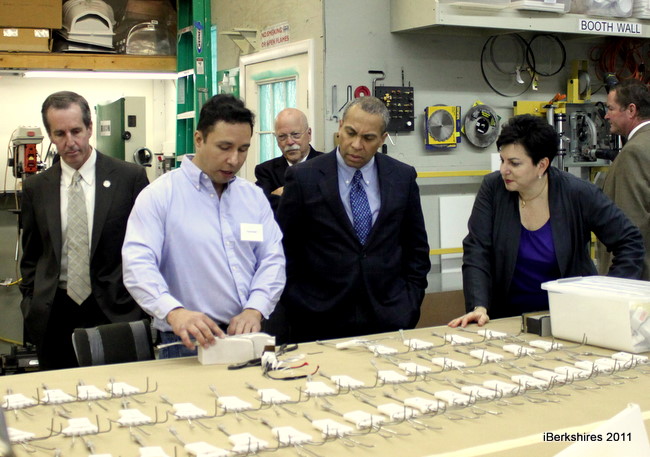
"In using this we're not only training them how to do the procedure but we're working on how does the tissue feel," she said. "It tears just like a human bowel, so they have to practice on making sure it holds sutures. Once they are proficient in this they become more confident and comfortable in the O.R. and in the clinical decision-making process."

Patrick said the Chamberlain Group and businesses like it are not only contributing to medical innovations but are also providing a business model for the manufacturing sector, which, he said, is where the future of the creative economy in the Berkshires rests.

 "The creative economy includes but isn't limited to the performing and visual arts," he said. "If we call attention to the creative economy we should also see the resurgence of manufacturing, specifically this form of precision manufacturing. It is definitely something that you have to prepare for but you don't need a fancy degree to participate in the precision economy; it's a blend of the two. Many community colleges across the state are providing this kind of education and are bridging that gap."


If you would like to contribute information on this article, contact us at info@iberkshires.com.

Social Service Organizations Highlight Challenges, Successes at Poverty Talk

By Brittany PolitoiBerkshires Staff

Dr. Jennifer Michaels of the Brien Center demonstrates how to use Narcan. Easy access to the drug has cut overdose deaths in the county by nearly half. 

PITTSFIELD, Mass. — Recent actions at the federal level are making it harder for people to climb out of poverty.

Brad Gordon, executive director of Upside413, said he felt like he was doing a disservice by not recognizing national challenges and how they draw a direct line from choices being made by the Trump administration and the challenges the United States is facing. 

"They more generally impact people's ability to work their way out of poverty, and that's really, that's really the overarching dynamic," he said. 

"Poverty is incredibly corrosive, and it impacts all the topics that we'll talk about today." 

His comments came during a conversation on poverty hosted by Berkshire Community Action Council. Eight local service agency leaders detailed how they are supporting people during the current housing and affordability crisis, and the Berkshire state delegation spoke to their own efforts.

The event held on March 27 at the Berkshire Athenaeum included a working lunch and encouraged public feedback. 

"All of this information that we're going to gather today from both you and the panelists is going to drive our next three-year strategic plan," explained Deborah Leonczyk, BCAC's executive director. 

The conversation ranged from health care and housing production to financial literacy and child care.  Participating agencies included Upside 413, The Brien Center, The Food Bank of Western Massachusetts, MassHire Berkshire Career Center, Berkshire Regional Transit Authority, Greylock Federal Credit Union, Massachusetts College of Liberal Arts, and Child Care of the Berkshires. 

The federal choices Gordon spoke about included allocating $140 billion for the U.S. Immigration and Customs Enforcement, investing $38 billion to convert warehouses into detention centers, cutting $1 trillion from Medicaid over 10 years, a proposed 50 percent increase in the defense budget, and cutting federal funding for supportive housing programs. 

Gordon pointed to past comments about how the region can't build its way out of the housing crisis because of money. He withdrew that statement, explaining, "You know what? That's bullshit, actually."

"I'm going to be honest with you, that is absolute bullshit. I have just observed over the last year or so how we're spending our money and the amount of money that we're spending on the federal side, and I'm no longer saying in good conscience that we can't build our way out of this," he said. 

Upside 413 provided a "Housing Demand in Western Massachusetts" report that was done in collaboration with the University of Massachusetts at Amherst's Donahue Institute of Economic and Public Policy Research. It states that around 23,400 units are needed to meet current housing demand in Western Mass; 1,900 in Berkshire County in 2025. 

View Full Story

More Great Barrington Stories