image description
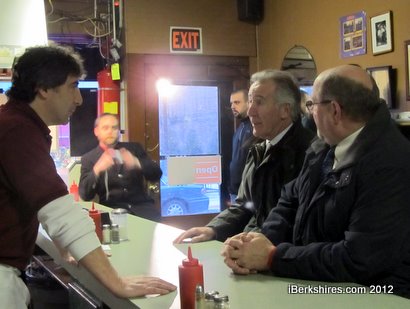
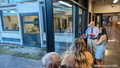
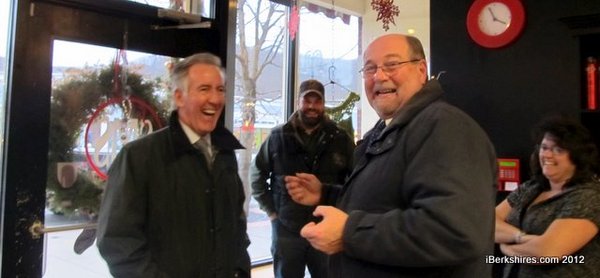
U.S. Rep. Richard Neal and Mayor Richard Alcombright stopped in Shear Madness on Main Street.

Congressman Neal Tours Main St., Mohawk Theater
By Tammy DanielsiBerkshires Staff
Print Story | Email Story


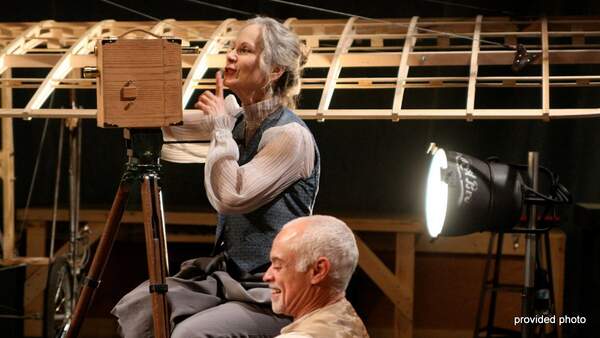
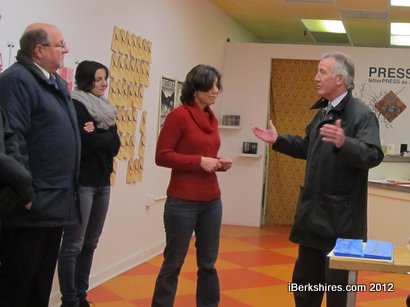
U.S. Rep. Richard Neal speaks with artist Melanie Mowinski at the Press Gallery on Main Street on Wednesday. Neal is getting acquainted with the area as he preps for a run for the redrawn 1st Mass district this year.
NORTH ADAMS, Mass. — It was a long, cold walk down Main Street for U.S. Rep. Richard Neal on Wednesday. But the frigid temperatures were offset by some warm welcomes and concluded with some hot dogs at the legendary Jack's.

The Democratic congressman has been taking some time in the Berkshires during the House recess to get to know the region that will soon include the Springfield area he's represented since 1988.

"The consolidation of Western Massachusetts is not a bad thing, it's a good thing," said Neal, who will run this year for the newly redrawn 1st Massachusetts District in hopes of replacing U.S. Rep. John W. Olver, who is retiring. "I can assure people that I will vigorously represent the interests of the Berkshires with the same enthusiasm that I represent [the 2nd District]."

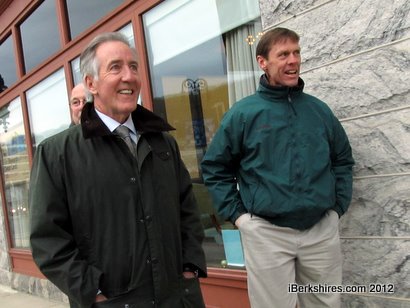
Escorted by Mayor Richard Alcombright, council President Michael Bloom and longtime friend and Fairview Hospital President Eugene Dellea, Neal was introduced to shopkeepers and artists along Main and Eagle streets and got a look at the stripped-down Mohawk Theater.

The congressman said he's been struck by the beauty of the Berkshires and the forward thinking and creativity he's found, including in North Adams.

"I think cities, throughout American history, remake themselves based upon the resources available," said the former Springfield mayor. "I've witnessed in the conversation the mayor has had with me today this whole notion we're in control of our own destiny ... at the same time acknowledging the role that the government can play and has played in terms of infrastructure."

Alcombright said he wanted the congressman to understand the city's plan for the historic theater in partnering with Massachusetts College of Liberal Arts to make it a classroom and downtown destination.

"We really wanted you to see this to get a picture in your mind of what we're trying to do and how maybe we find support at other levels other than where we're looking," he said, as the group stood in the empty theater with MCLA Vice President James Stakenas and Jonathan Secor of the college's Berkshire Cultural Resource Center.
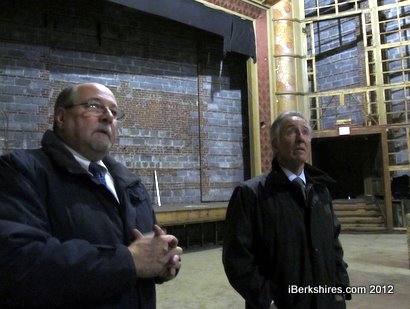
Secor and Alcombright promoted the sustainability of the idea since the theater would not be dependent on a constant stream of theatergoers for revenue, like the Colonial in Pittsfield. "It's something that doesn't
need 1,100 people four times a week coming to it," said Secor. "Because in a town of 13,000, the numbers just don't work."

MCLA already has a fine and performing arts department in place, said the mayor. "They have the arts management program, they have a marketing program; all the things are in place that would certainly make this viable."

Neal pointed to the New Market Tax Credits program he authored a decade ago that was used by the Colonial Theater to the tune of $17.5 million.

"They have created $50 billion in investment across the country and that revenue is recaptured because the owner starts paying property taxes, paying utility bills ... so the money comes back to the federal Treasury," he said, describing the program he's working to get reauthorized as a "handsome tool" for projects that spurs ancillary benefits.

The congressman said he was cognizant of the difficulties faced by small and mid-sized cities and in the potential of the arts. MCLA instructor Melanie Mowinski at the Press Gallery on Main Street told Neal how her gallery filled empty space on Main Street and brought arts lovers and students alike to the downtown.

Neal agreed that the creative economy can be valuable resource for driving pedestrian traffic.

"What the arts have done for Northampton over the last 30 years is wild," he said, "This not only great artwork and expression but he number of people it attracts."

Neal also visited a Berkshire Community College site in downtown Pittsfield in the morning and was headed for a meeting with MCLA's Mary Grant. He was to attend a dinner with local Democrats at the Williams Inn on Wednesday evening.

Tags: 1st Mass,   creative economy,   Neal,   representative,   
If you would like to contribute information on this article, contact us at info@iberkshires.com.

Why the Massachusetts Art Community Is Worth Continued Investment

By James BirgeGuest Column
How do we quantify the value of art on society and culture? Even eye-popping figures, like the $100 million estimate for the jewels stolen from the Louvre, or the record auction last fall that saw a piece by Gustav Klimt sell for more than $236 million can't fully account for the value of the history, stories, and emotions behind the creations themselves. But beyond that, there is a measurable financial, cultural and social benefit of the arts that is often taken for granted. 

Closer to home, arts and cultural production in the Commonwealth of Massachusetts totals nearly $30 billion annually, representing more than 4 percent of the state's economic output, according to the Mass Cultural Council. All told, more than 130,000 jobs are spread across the commonwealth creating a vibrant and thriving artistic community for us all to enjoy. 

Despite the obvious impact, these figures are under threat. A recent survey by MassCreative compiled recent federal cuts to the National Endowment for the Arts, the National Endowment for the Humanities and the Institute of Museum and Library Services and identified 63 grants canceled and $4.2 million in grant funding rescinded across New England so far this year. 

The dollars, of course, are important. But they also only scratch the surface on what they bring to the community. Today, we risk losing part of the culture and identity many now take for granted. 

While others choose to look past these less tangible, but just as vital benefits, we're doing the opposite. Massachusetts College of Liberal Arts is all in to ensure the next generation retains their access to works of art, while also being empowered to create themselves. 

Last fall, MCLA officially broke ground on the new Campagna Kleefeld Center for Creativity in the Arts, which will serve as a new hub for the campus and the local community for arts programming. When complete in fall of 2027, our students will benefit, but so will all of Berkshire County and artists in the surrounding area. 

This exciting new facility is just one of the many forthcomings our region can enjoy in the coming years. Just a few miles away, anticipation builds for the Fall 2027 anticipated opening for the Williams College Museum of Art. Years in the making, the museum likewise grows from an enduring commitment to the arts, both in curriculum and in practice. Exciting times are also underway for the Clark Art Institute with the construction of a new facility to house a collection of 331 works of art, including paintings, sculptures, drawings and other works. Their wing is scheduled for completion in 2028. And listeners will no doubt enjoy the sounds and melodies from Mass MoCA Records, the latest endeavor to foster creativity and artistic pursuits through music launched in October as well. Of course, many are also awaiting the reopening of the Berkshire Museum anticipated this summer, after a tremendous renovation process to rejuvenate the experience for visitors. 

So much time, energy, and yes, dollars, have already been invested in taking these facilities from ideas and sketches and making them reality. But they represent much more than new buildings. They represent new opportunities to cultivate and accelerate the thriving arts community in Massachusetts and the northern Berkshires. 

Art, regardless of the medium, is a reflection of who we are, where we've been, and what we aspire to be. It can be inspired by hopes or fears and chronicle collective triumphs as well as tribulations. The goal of art is not only to document history, but to inspire those positioned to change it and to feel something new or even to provoke us to revisit our own assumptions or misconceptions. 

As unfathomable of a number as $30 billion can seem, boiling down the impact to any number inherently discounts the unknowable downstream effects our graduates will bring to the community and the broader world after they leave our institutions. Likewise, rescinding $4.2 million now removes a huge chunk of that growth potential.  

Justification for making these investments today when simply boiled down to dollars and cents still places us on solid ground strictly from a financial perspective that forgoes all of the intangible, but no less valuable, benefits as well.  

The arts are still worth our support. And our community will be richer for it. 

James Birge, PhD, is president of Massachusetts College of Liberal Arts in North Adams.  


View Full Story

More North Adams Stories