Citizen Scientists Needed To Monitor Turtle Crossings
Print Story | Email Story
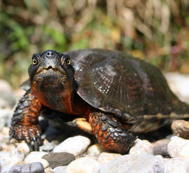
LENOX, Mass. — Turtles have existed for millions of years, but roadways are threatening the survival of local populations. A state coalition is seeking volunteers to help monitor the turtle vs. motor vehicle action.

Turtles often cross roadways from late spring to early fall and are vulnerable to car collisions. Ambitious citizen scientists, turtle enthusiasts, and conservation organizations are encouraged to join state wildlife and transportation personnel in collecting data for the Turtle Roadway Mortality Monitoring Program.

The state is especially looking for crossing "hot spots" at which multiple turtles are killed.

Linking Landscapes for Massachusetts Wildlife, a recent partnership between the Division of Fisheries and Wildlife, Department of Transportation Highway Division and the University of Massachusetts at Amherst, trained volunteers to collect data in 2010. It is expanding its volunteer program this year by offering two citizen scientist information and training sessions in Amherst and Westborough.


These sessions are designed to train new volunteers, acknowledge current volunteer efforts, and share results from the first year of data collection. The information gathered through this volunteer effort will be used to coordinate local turtle conservation efforts.

There will also be an information and training session on Wednesday, May 16, at United Methodist Church, 6 Holmes Road, starting at 6:30 p.m. The event will be co-sponsored by Berkshire Environmental Action Team and Project Native. The sessions are free, but advance registration is required. Interested volunteers can register with Dave Paulson at David.Paulson@state.ma.us or call him at 508-389-6366.

Tags: monitoring,   turtles,   wild animals,   
If you would like to contribute information on this article, contact us at info@iberkshires.com.

Elevated Mercury Level Found in Center Pond Fish

BECKET, Mass. — The state Department of Public Health has issued an advisory after a mercury-contaminated fish was found in Center Pond. 
 
According to a letter sent to the local Board of Health from the Division of Environmental Toxicology, Hazard Assessment and Prevention, elevated levels of mercury were measured in the sample taken from the pond. 
 
The concentration in the fish exceeded DPH's action level of 0.5 milligrams per kilogram, or parts per million. 
 
"This indicates that daily consumption of fish from the waterbody may pose a health concern. Therefore, DPH has issued a FCA for Center Pond recommending that sensitive populations should not eat chain pickerel and all other people should limit consumption of chain pickerel to 2 meals/month," the letter states.
 
The letter specifically points to chain pickerel, but the 60-acre pond also has largemouth and smallmouth bass and yellow perch.
 
The "sensitive populations" include children younger than 12, those who are nursing, pregnant, or who may become pregnant.
 
The Toxicology Division recommends reducing intake of "large, predatory fish" or fish that feed on the bottoms of waterbodies, such as largemouth bass and carp. More information on safely eating fish can be found here
View Full Story

More South Berkshire Stories