'Cassandra Speaks': Randolph Shines as WWII Journalist
LENOX, Mass.
You have to see this wonderful play, it's as simple as that. Actor Tod Randolph and writer Norman Plotkin have plucked Dorothy Thompson from the dust of history and underserved obscurity and brought her amazingly, even brilliantly, to life again.Dorothy Thompson, was a pioneer and a professional. She wrote a widely syndicated newspaper column for 22 years that was read by millions. She was, in many ways, the Oprah of her day. And it wasn't easy being her. I can imagine how many times men would be heard to say stupid things like: "She writes just like a man," as if digging for facts and finding news stories was just for little boys.
 An important voice in the years leading up to World War II, she accurately saw the coming conflict and horrific genocide of the Jews, yet few listened to her warnings. She had learned German and actually read "Mein Kampf." She interviewed Hitler. She knew what was going on having trailed him into the beer halls and rallies of the haters, those who were looking for a scapegoat for their own failed hubris.
She was a friend of – and almost as well known as – Eleanor Roosevelt. She was, for many years, married to – and outshone – the notorious drunk Sinclair Lewis.
In fact, up until the time that Thompson began to cover the politics of war and hatred, women tended to get their political opinions from their husbands.
As someone who always thought for herself, Thompson was a handful growing up in the miserable snowy environs of Buffalo, N.Y. In her 20s, she worked to advance the women's suffrage movement. Back in the days when getting posted to a foreign capital was considered either a hardship or a punishment, male reporters shunned the assignments. They didn't pay much either. But Thompson saw this as an opportunity to write about more than women's fashions, food and family life, a role that automatically went to women in the day, and sadly, is often still the case.
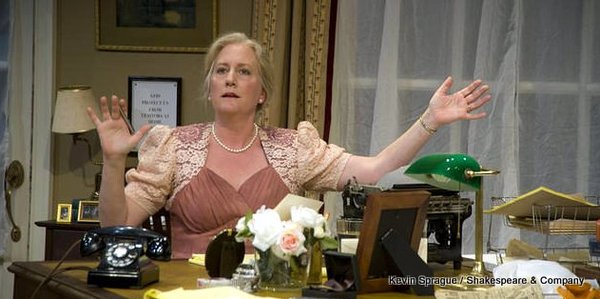
In "Cassandra Speaks," Tod Randolph slips into the character of Dorothy Thompson as if it were her own life being portrayed on stage. Norman Plotkin's play is part biography, part re-imagining what Thompson's life must have been like, writing, lecturing, organizing and getting married three times, raising a son and giving advice to politicians and political movements. She was – and on stage still is – a wonder to behold. The thought kept going through my head that people like her are rare as gold.
As I wrote in an earlier preview in Berkshire on Stage, Thompson really pissed off Adolf Hitler when she was in Germany. She told it like it is, and das fuehrer, not liking the truth to get around, expelled her, the first American correspondent he personally ordered out. Still she managed to interview the "little man" as she called him, and to read "Mein Kampf," which few Germans actually did. It was an anti-Semitic polemic that she found a handy guide to WWII. "He told us what he was about to do, and he did it," she says in the play.
That's how she earned the title of the "First Lady of American Journalism." Time magazine named her the most influential woman in the country, second only to Eleanor Roosevelt, and she was Michael Kanin's inspiration for the 1942 comedy "Woman of the Year."
|
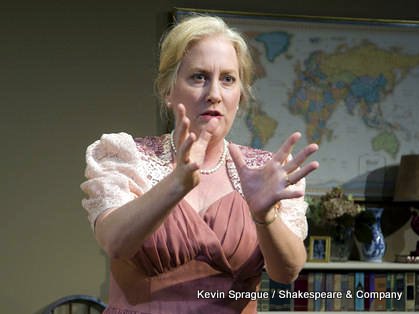
Randolph does more than just act out her part, she glides into it, virtually donning Thompson in one of the most complex performances I have seen in years. It is an astonishing tour de force, and immediately puts her at the top of the list as the best actor of the year.
But even in a performance of near-perfection, sometimes there are small fault lines.
"Cassandra Speaks" is set on a very hot June day on which she is about to marry for the third time. In a bizarre coincidence, the audience was fanning itself throughout the play, the Elayne P.Bernstein Theatre's air conditioning not being in use. The unfortunate result is that the audience left talking more about the heat and oppressive stuffiness than the play.
The set by Patrick Brennan was lovely and functional, centered around Thompson's desk and typewriter, with sitting areas to entertain guests and conduct interviews. There was only one dress worn during the show, which you can see in the photos, designed, according to the program, by Kara D. Midlam. It was an inexplicable choice, but what do I know from fashion in 1943 when the play was set. As Thompson said in the play: "I don't get to go shopping very often, and it was rather expensive." That may explain it all.
Happily, "Cassandra Speaks" runs all summer at Shakespeare & Company giving you ample opportunity to meet this reporter and journalistic pioneer. She shaped the way international news is covered by combining daring reportage with both diligent research and observable fact.
Dorothy Thompson, Sigrid Schultz, and Helen Kirkpatrick were the first women reporters to cover the volatile political climate of central Europe in the 1920s and '30s. They became the reigning Grande Dames of foreign reporting before the Second World War broke out. While derided by men as the "Cassandra's of the Coming Storm" it is Dorothy Thompson's prescience that is still with us today.
Some truths never change.
Tags: Shakespeare & Company,