Senate Candidate Lynch Getting to Know Berkshires
|
U.S. Rep. Stephen F. Lynch at the WBEC/WUPE radio station in Pittsfield. The Senate candidate was interviewed for 'Up Front,' which will be rebroadcast on Sunday. |
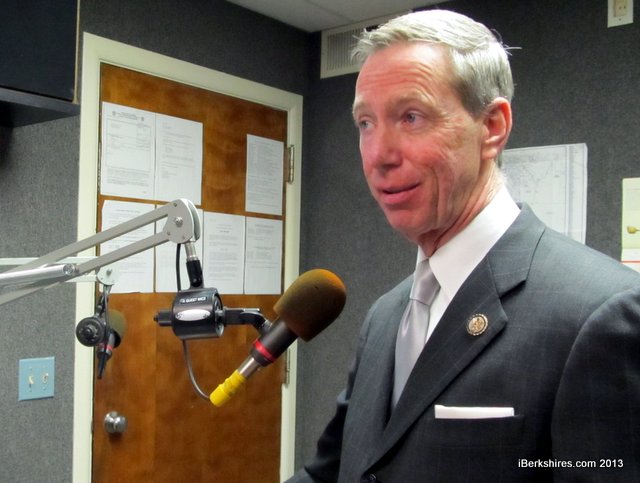
PITTSFIELD, Mass. — Stephen F. Lynch is hoping to bring what he says is a different perspective to the U.S. Senate.
"You really have to have somebody who has their sympathies with regular families," said the representative for the 8th Mass District on Monday morning during a swing through the region.
Lynch spoke of his "humble beginnings" and his working-class experience in the Quincy shipyards and mills and construction sites around the country, sometimes working from paycheck to paycheck.
"I think I bring a perspective to the United States Senate that is not there right now," he said, noting he'd been "strapping on work boots" for longer than he'd been a lawmaker. "I think we have multimillionaires and career politicians that never ever worked in the private sector."
The ironworker-turned-congressman from South Boston is running for the Democratic nomination to fill the seat left by John F. Kerry, who is now secretary of state.
Lynch had dropped in for breakfast in Dalton before appearing on WBEC's "Up Front" on 1420-AM and then heading east for lunch with the mayor of Springfield.
He spoke of his strong support for unions (he was the youngest president of Iron Workers Local 7) and the social support system, including unemployment insurance and the Social Security and Medicare programs on which his elderly parents rely.
"I grew up in public housing, that's not a program that's my home," said Lynch. "I know what public education offers people, I wouldn't be sitting here as a United States congressman if it wasn't for a good solid public school education."
But he voted against the Affordable Care Act because he said it did not address the issue of cost.
"I'm hearing from a lot of unions who originally supported the Affordable Care Act but are now asking me to implement changes, and asking the administration to implement changes, because they will no no longer be able to provide health care," he said. "That's not the way this thing was supposed to work."
More small and medium-sized businesses are dropping their workers into the health exchanges created for the uninsured, and cutting off a prime benefit of union organization, he said, and that's hurting both business and labor.
|
Lynch spoke of his working-class background and support for labor. |
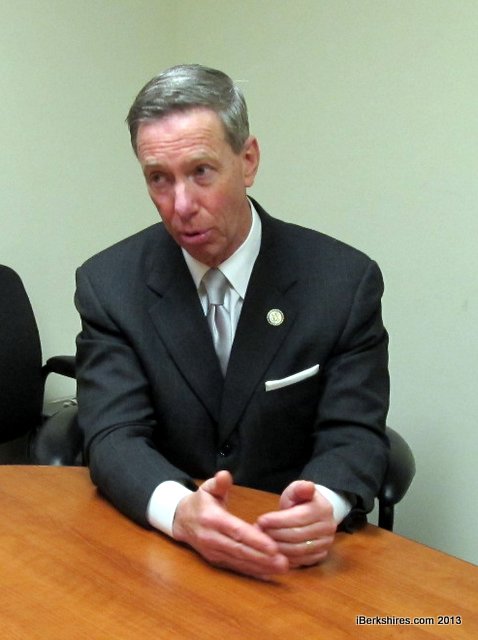
He followed his father into iron working, only to see the shipyards and automobile plants close as employers pushed jobs overseas. In between, he graduated from Wentworth Institute of Technology and later from Boston College Law School. He served in the state Legislature before being elected in what was then the 9th Mass. District in 2001.
"I think because of my experience, I'll look at trade agreements a heck of a lot differently, they're not just policy, they're somebody's jobs, they're my job," he said. Rather than incentivizing corporations to ship jobs out, the tax code needs to be reformed to grow the job base here, he said. "We need to re-engineer our economy."
Lynch says the Berkshire expansion in hospitality and culture is a winning way to play to the region's strengths while also providing "fertile ground" for the life sciences field. especially as companies begin looking outside the high-cost urban areas.
Commuter rail (which is also being expanded in Western Mass.) is both propelling companies into smaller towns and providing more moderately-priced real estate for workers.
"I see the same dynamic happening around the state and I see Western Mass. fitting in very well," he said.
On the partisanship in Congress, the self-described moderate Democrat said the center where the discussions took place has been decimated. The tea party members, particularly in the House, had exacerbated the polarization.
"They have a different ideology ... God bless them, but they don't think sitting down and talking and compromises is necessary; they don't encourage it, they don't try it, they don't work at it."
But he believed he had the ability to work across the aisle and build relationships in the Senate to get things done.
"My style is not to run over and kick the Republicans in the shins just to make myself feel good ... I do believe in compromise, I don't believe in surrender."
It was was not his first trip to the Berkshires and he vowed it wouldn't be his last as he gears up for a primary battle against U.S. Rep. Edward Markey on April 30.
But this will be the state's third Senate election in barely three years, a factor of which Lynch is well aware.
|
Lynch met with diners at the Dalton Restaurant for breakfast. |
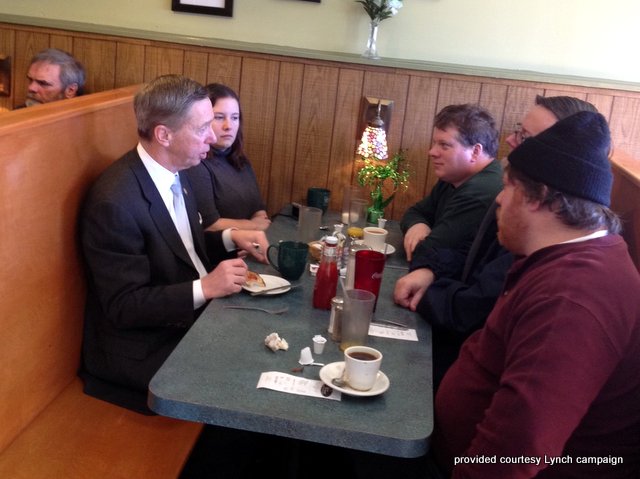
"There's fatigue out there," he acknowledged. "I met with unions who put their heart, souls and treasure into the Warren-Brown race ... They're like, 'your kidding ... .'"
The Democratic establishment did try to sidestep the issue by quickly backing Markey, the state's senior congressman, when he announced last month. (Markey's making an appearance Tuesday night at a reception hosted by the local Democratic organization).
"Unfortunately, I gummed that up a little," grinned Lynch. The short time span for the special election may help the fatigue factor but it will be hard to get out the vote. "A very small number of people are going to decide this race."
He vowed to be the region's champion in the same way he's represented his congressional district.
"I know there are folks who get elected and go to Congress and are never seen again in Massachusetts," said Lynch, which might have been a jab at Markey, who's had to fend off questions of residency. "When the gavel drops I'm back here. I am very much engaged in the areas I represent ... .
"My most important relationship is not with Nancy Pelosi. It's with the folks I represent."
Tags: election 2013, primary, special election, U.S. Senate,