Williamstown Finance Committee Reviews Town Meeting Warrants
|
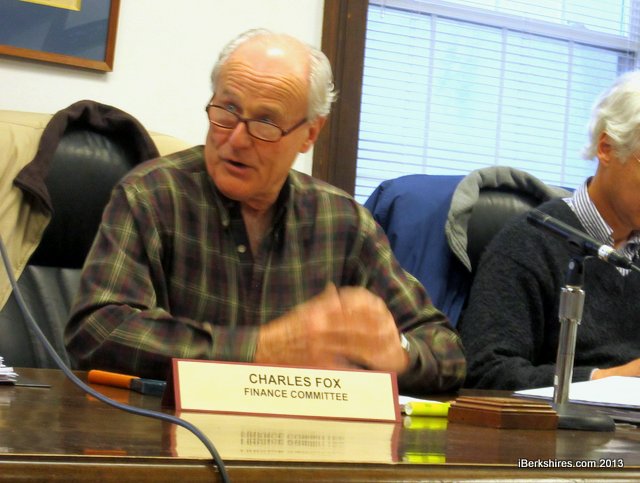
Chairman Charles Fox argued that the Finance Committee should take a stand on warrant articles addressing housing, saying they had a financial impact on the town. His colleagues disagreed. |
WILLIAMSTOWN, Mass. — It took a while, but the Finance Committee on Thursday became the latest town board to address the affordable housing issue — but only at the margins.
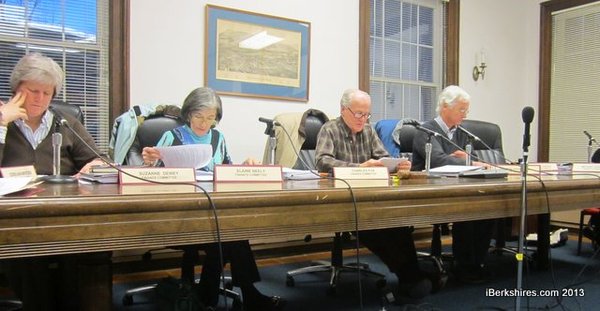
The Fin Comm met to make its final recommendations on selected warrant articles for the May 21 annual town meeting.
In fact, the panel ends up making recommendations on the majority of the articles because most of the town meeting's business is related to town finances.
But on Thursday, the Fin Comm also was faced with the decision of whether to make recommendations on three housing-related articles that made their way onto the warrant by way of citizens petitions.
At issue were Articles 37 through 39. The first is the article authored by Kenneth Swiatek seeking $365,000 from the town coffers to fund efforts by residents at the Spruces Mobile Home Park to purchase the property.
The second two relate to transfers of town land for the purpose of affordable housing.
Article 38 is a second try at an article that was rejected by the Selectmen for inclusion on the April 24 special town meeting; it seeks to adopt a provision in Massachusetts General Law that allows for transfers of land for the purpose of affordable housing to take place by a simple majority instead of a two-thirds vote.
Article 39 is a restatement of Article 2 on the special town meeting warrant, and asks the voters to allow the transfer of 10.5 acres of the so-called Lowry property to the Board of Selectmen for the purpose of developing affordable housing.
In the end, the Finance Committee opted to recommend against the $365,000 expenditure and make no recommendation on the other two articles.
"The source of funds doesn't really work," committee member K. Elaine Neely noted. "They can't take $300,000 from community preservation."
Neely referred to $100,000 in CPA money the town voted into the Affordable Housing Trust at the 2012 annual town meeting, and another $200,000 town meeting will be asked to approve in Article 28 at this year's meeting - some time before Swiatek's petition will be addressed.
"No CPA funds can be appropriated without going through the Community Preservation Committee," Town Manager Peter Fohlin noted. "The $200,000 part is a non-starter from the beginning. There wouldn't be any way for town meeting to take the money away from the Affordable Housing Trust."
Although the full committee did not address the merits of Swiatek's proposal, at least two members indicated they felt that even if Article 37 could be funded, it should not be funded.
"I think it would be a horrible investment based on the information from Public Works and Peter Fohlin," Paula Consolini said.
"And the Army Corps of Engineers," Neely noted, referring to this week's news that the Corps declined to study the feasability of a flood mitigation project at the mobile home park.
Fox asked Fohlin whether the fact that the specific funding mechanisms in the article are impossible makes the article itself null and void, but the town manager indicated that regardless of the practical consideration, the question still can go before the meeting.
"The article could pass, but it would have no effect," he said. "Town meeting can pass an article that doesn't have any
The committee voted 7-0 to recommend town meeting not approve the expenditure to the "Save The Spruces" group.
On the other hand, the committee was split on whether it should take a position on the last two articles on the town meeting warrant.
Chairman Charles Fox argued that it was appropriate for the panel to take a stand on how land transfers are decided (Article 38) and whether the Lowry property should be transferred (Article 39).
"I think this has immense financial implications," Fox said. "I would support our voting a recommendation on this article."
Committee member Andrew Hogeland disagreed.
"I think this is a purely political question that will have a financial impact down the road, but we can't predict that," he said during the discussion of Article 38. "We just passed on (making recommendations on) a bunch of zoning bylaws that also have a financial impact."
Neely sided with Fox on Article 38 after observing that the Finance Committee makes recommendations on warrant articles that dispense hundreds of thousands of CPA funds for the purpose of developing affordable housing, so other questions on the topic are in the committee's purview.
After the committee voted 5-2 not to take a stand on Article 38, Neely joined the majority in deciding not to take a stand on Article 39. Fox was the lone holdout, maintaining again that the committee should take a stand one way or the other on the article.
Most of the warrant articles on the Fin Comm's plate were approved unanimously. One exception was Article 15. The panel deferred a decision on the proposal, which would adopt a provision under Massachusetts General Law providing a real estate reduction for small businesses.
Unlike most of the fiscal items on the warrant, this proposal was coming before the committee for the first time, and it decided it needed to explore the topic further. But the committee will announce its recommendation on the question at the May 21 Town Meeting before the question is put to the voters.
The annual town meeting warrant will be discussed again at Monday's Selectmen's meeting. The last day to register to vote in the April 24 special town meeting is April 12.
Note: Reference to Article 15 rewritten at 10:55 a.m., April 5, for clarity.
Tags: affordable housing, Finance Committee,