Environmental Officials Hope to Contain Ash Borer
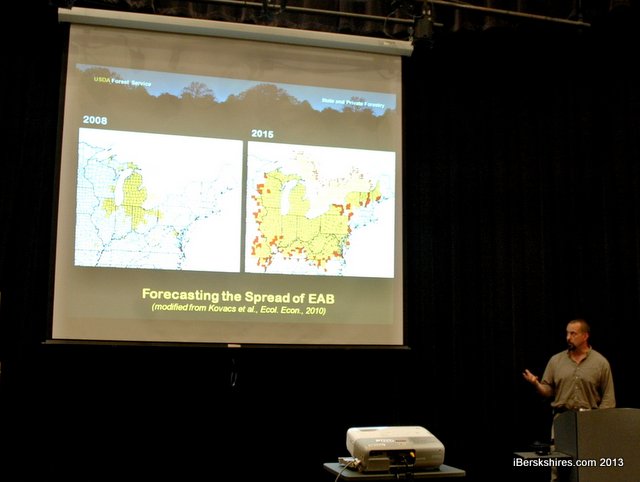 State and federal environmental officials reviewed some of the options for containing the emerald ash borer, which has caused nearly $11 billion in damage across the country. State and federal environmental officials reviewed some of the options for containing the emerald ash borer, which has caused nearly $11 billion in damage across the country. |
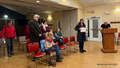
That was the message of state and federal forestry officials this week, addressing area residents at the first public forum on the subject since the county was placed under a firewood quarantine in March.
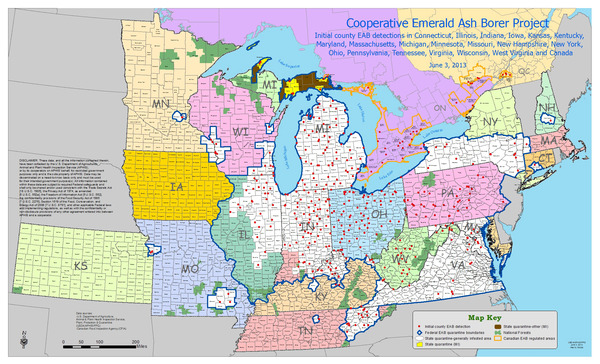
Specialists have begun implementing measures to counteract the bug where it's been found, while monitoring and trying to slow further spread. Because the insect generally spreads over distances through either commercial firewood transport or to get to ash trees, their plan is to quarantine the infestations, then concentrate the borers through select deforestation, girdled trees, and other trapping measures. Once so confined, those populations can then be targeted through "biological controls," such as natural predators like woodpeckers and wasps, to reduce their numbers.
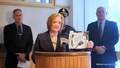
"It can be cost effective to spend money to try to slow advancement of existing populations, as well to spend money to try and prevent the establishment of new satellite infestations," said Siegert.
Ash makes up about 4 percent of the state's trees, but 64 percent of that is in Berkshire County alone. Once infected, an ash tree will be dead within three to four years. The estimated economic impact to Massachusetts if all of the species succumbs rapidly has previously been estimated by the DCR to be up to $500 million.
"This is a small population we've found so far, a very, very small, isolated population, which is good for us," explained Ken Gooch, forest health program director. "Our hope is to keep it contained right there as long as we can by using some of these methods."
The current quarantine prohibits transporting ash lumber or firewood of any species cut in pieces shorter than 48 inches to any place outside of Berkshire County. The exception is to bordering counties of New York, as they are also quarantined, but shipments further east are banned.
But not everyone is content with the current handling of the beetle problem in Massachusetts.
Neil Toomey, who owns a tree farm in Becket, complained that the nature of the DCR's quarantine unfairly penalizes Berkshire area businesses that are willingly complying while losing clients to those who are not.
"Wood is being moved illegally as we speak by others who realize DCR's inability to enforce the quarantine," said Toomey, "I'm volunteering compliance, and I'm being punished."
Toomey said he's lobbied the DCR to either allow him to segregate all ash from his stock and move the other types of firewood, or make the quarantine statewide so that export is not cut off at the county line.
Toomey's concerns were echoed by state Rep. William "Smitty" Pignatelli, D-Lenox, who previously commended the department on being proactive in enacting the quarantine earlier this spring.
"I would encourage you to think about a statewide ban or quarantine of a statewide issue on the emerald ash borer," Pignatelli told them, "I think we're putting some people at a very serious financial hardship for one or two bugs that were found in Dalton."
Pignatelli questioned the fairness of the current unenforced restrictions on local business people like the Toomey family, whose business will simply pass to other noncompliant operations.
"I don't want to be the state representative to have to say 'the state of Massachusetts put somebody out of business,' " said Pignatelli, "and I would like to know what we're going to do about this to either get them into compliance, or let's do a statewide quarantine on the emerald ash borer so that people can make a living and cross county lines.
"If there's one business that goes out of business in this economy because of the emerald ash borer that was found in Dalton, I've got a problem with that," concluded the representative.
Tags: DCR, emerald ash borer, forestry, Forestry Service, quarantine, state officials,