State Looking to 'Scale Up' Manufacturing Industry
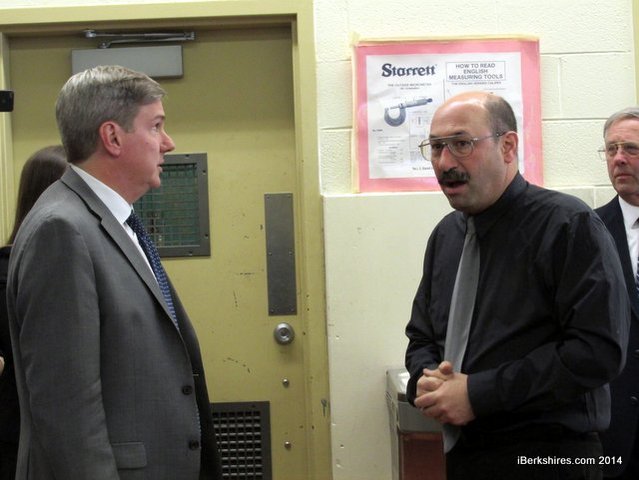
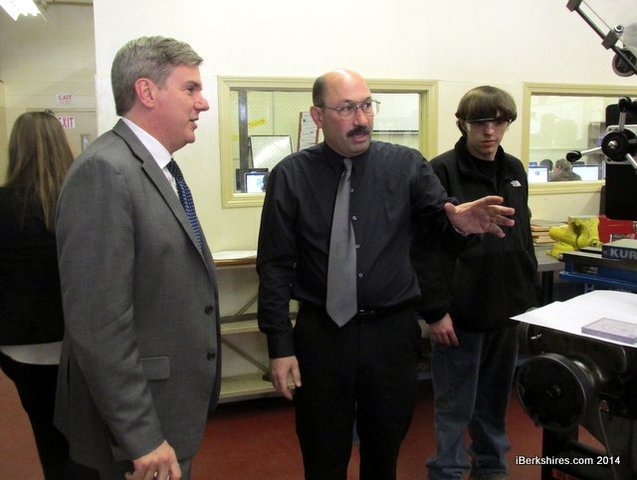
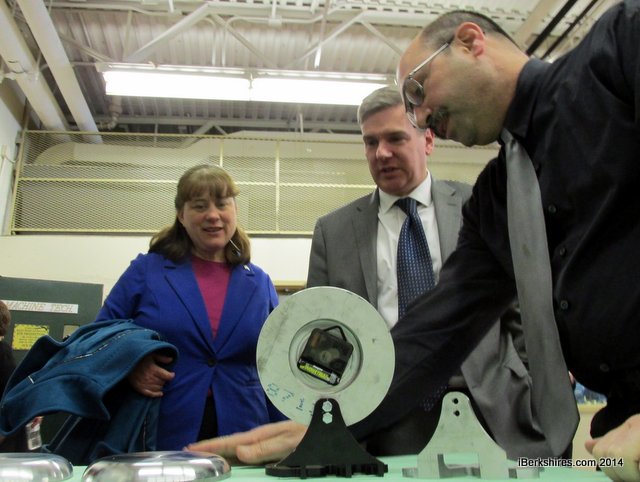 Mark Lausier shows Housing and Economic Development Secretary Greg Bialecki some of the equipment at Taconic High School. Mark Lausier shows Housing and Economic Development Secretary Greg Bialecki some of the equipment at Taconic High School. |
PITTSFIELD, Mass. — There are parents who walk down the Taconic High School hallways with their children. They look into the various vocational programs as the student tries to figure what trade he or she wants to learn.
But when students poke their heads into the manufacturing rooms, parents quickly pull them away.
They remember General Electric gave their generation thousands of jobs in manufacturing.
But more importantly, they remember the closure that sent the city into a downward economic spiral and polluted the environment. They shudder and say those days are gone. They tell their children not to even think about going into manufacturing.
The school's manufacturing technology instructor Mark Lausier has seen that unfold in front of his eyes, he told the state secretary of housing and economic development on Thursday. But, he says, he is also the one who fields phones calls on a weekly basis from employers looking for qualified manufacturing students to fill jobs.
"The mentality is that there is nothing in Berkshire County left, so get them into college and out of here," said Bill Knowles of Cavallero Plastics. "It is public awareness that needs a spark."
Taconic High School's manufacturing program has been trying to tell people that the profession isn't what it used to be and that it does have a future. Secretary of Housing and Economic Development Greg Bialecki said the country has weathered the storm of globalization that led to massive declines in manufacturing jobs and that a new type of industry has emerged.
Advanced manufacturing is taking hold now because it requires skills that can't be outsourced, he said.
"Massachusetts manufacturing not only has a great history but also a great future," Bialecki said Thursday as he met with employers and educators at Taconic High School. "A career in manufacturing is one of the very best ways to get a good job that doesn't require a four-year degree."
In the next decade, there will be 100,000 manufacturing jobs opening up in the state, Bialecki said. The state is prepared to invest the money into programs that will help not only fill those jobs but also grow more and already has invested in multiple manufacturing programs through equipment grants. But it isn't enough.
Bialecki said the state is looking for a way to "amp up" the number of qualified employees the state has to offer through a systematic way. But to put systems in place, the state needs to know what employers and schools need and find a way to ensure quality in the workers they produce.
"We really have to amp it up in a very dramatic way," he said. "We are prepared to put our money where our mouth is."
How to increase that business sector is what he hoped get input on from local officials. The consistent theme is that there needs to be a way to show people that the job isn't the same as it once was.
"I think we're missing the common folk," said Assistant Superintendent Frank Cote.
Pat Bergrowicz, of Onyx Paper, said employees in the industry are often unaware at how successful manufacturing companies are becoming. And she is finding it difficult to find qualified replacements for retirees because "the next generation" is avoiding the field.
William Mulholland, director of economic development at Berkshire Community College, said when General Electric closed, the county's manufacturing employment dropped 45 percent compared to 29 nationally.
"We got hammered in this end of the state," he said.
But it is coming back. Manufacturing is still 7.7 percent of the county's employment and 9 percent in the Pittsfield area. That sector is growing along with the rest of the state, Mulholland said, and because of an aging population heading toward retirement, even more jobs are available. And the jobs in the industry are well paying, he said.
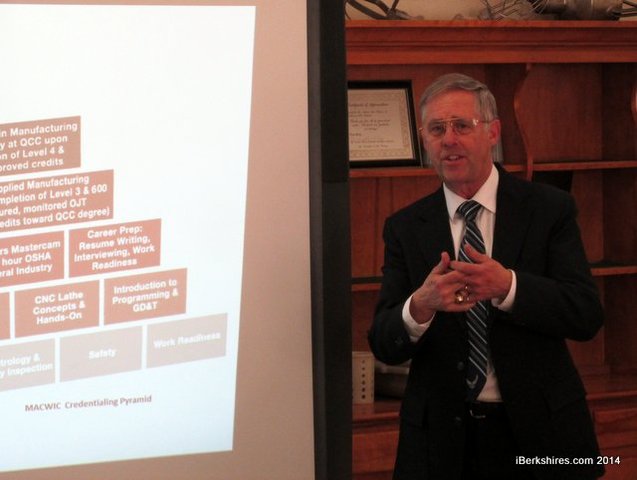
For the last six years, Mulholland said, BCC and Taconic High School have teamed up to invest more than $1 million in upgrading the equipment and creating a pipeline of students going through the system and matching up with jobs. Bialecki said the Berkshires are ahead of the rest of the state in those types of collaborations. Pittsfield Economic Development Authority Executive Director Cory Thurston said that partnership is citing the packages his organization gives to prospective companies because they can "customize" the job training programs.
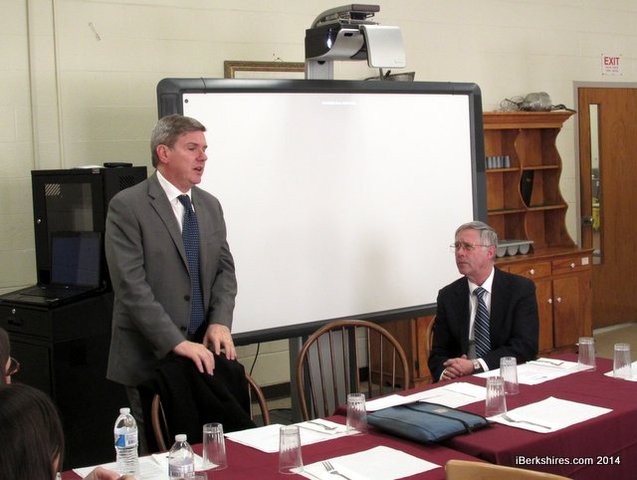
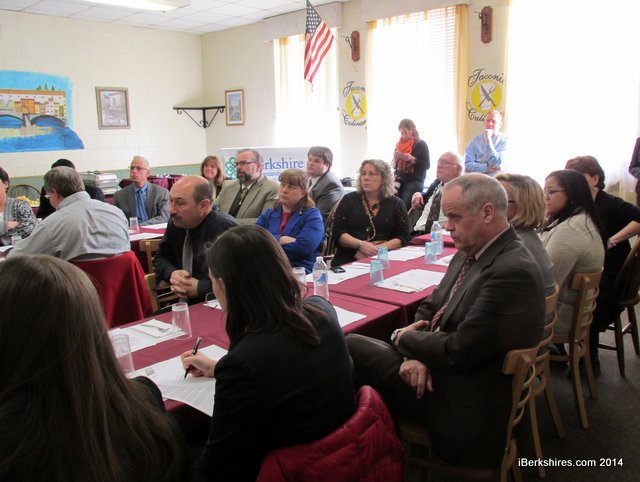 Bialecki addressed a roundtable of local manufacturing interests. Bialecki addressed a roundtable of local manufacturing interests. |
But it isn't as easy as just filling job vacancies, Bialecki said, because there needs to be accountability in the quality of workers going through the system.
The state needs to build "credibility" with employers by providing the highest quality workers they can. Any investment the state makes must also include measures to show the results, he said.
"We have great regional partnerships," he said, citing BCC and Taconic as being ahead of the game. "We are pushing to see how we can scale things up."
State Rep. Tricia Farley-Bouvier, D-Pittsfield, said one way is for the state School Building Authority to let the city build a slightly bigger high school than enrollment numbers show.
She said with a new high school there is an untapped market of manufacturing students in South County. With a larger and more sophisticated lab, Taconic will be able to send even more through the programs, which connects to Berkshire Community College's programs.
"I do believe we're in a unique situation here," she said, adding that expanding the school district to accommodate that wouldn't be an option.
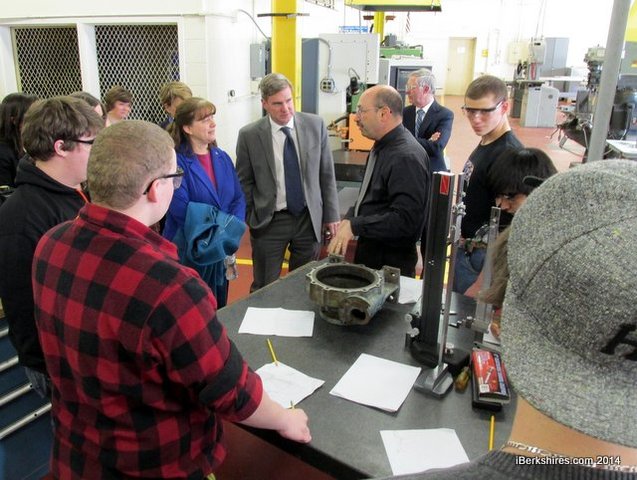
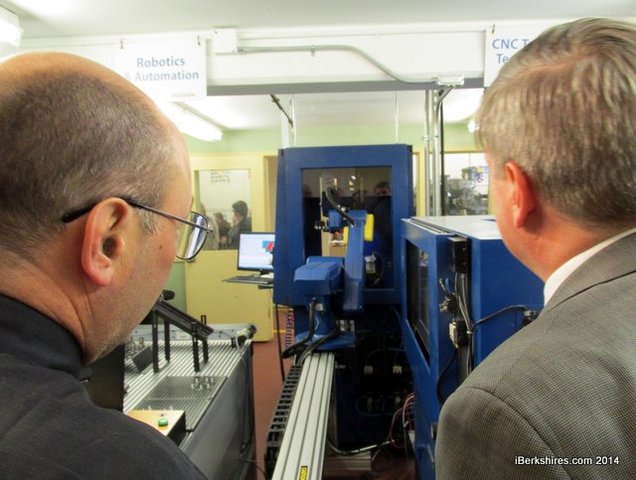
After a roundtable discussion, Bialecki then toured the advanced manufacturing lab that was recently upgraded through the BCC and Taconic partnership.
Tags: BCC, employment, industry & manufacturing, Taconic High,