Pittsfield: Once Blighted Lake Ready for Recreation
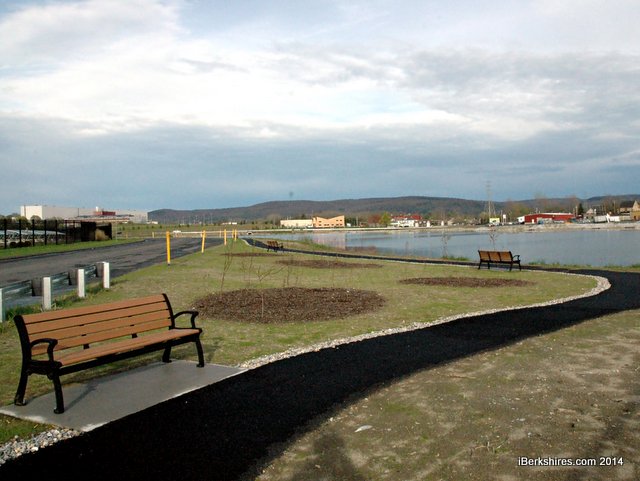 The once polluted Silver Lake is now a prime recreation area. The once polluted Silver Lake is now a prime recreation area. |
Even swimming is now permitted, though it's not encouraged, and it's highly recommended that any fishing be on a "catch and release" basis.
"It's a great pond in very urban location," said James McGrath, the city's parks, open spaces and natural resources manager. "It can be a recreational asset to the city."
The Pittsfield Economic Development Authority will host an official ribbon cutting for the walking trail on Friday, May 23, at 10 a.m.
At its April 16 meeting, PEDA voted to approve a resolution allowing it to take ownership of the final parcel of Silver Lake land from General Electric. The quasi-public agency also oversees all of the surrounding former General Electric property on the northeast side of the pond, now known as William Stanley Business Park, to which the renovated Silver Lake is considered an aesthetic asset.
This is the most recent in a long process of legal transfers and easements needed to complete the remediation and reopening of the pond for public purposes. Recently this also included an amendment to the Definitive Economic Development Agreement between Pittsfield and GE, first by PEDA in February 2012, then by the City Council in September 2013, allowing the walk way to be constructed.
"Silver Lake has been remediated. I won't get into whether the remediation was the appropriate remediation, but per the Consent Decree, the lake has been remediated and a walk way has been put in," said McGrath, offering a requested update on the lake to the Commission on Disabilities.
Under conditions established in the Consent Decree and in the 2011 Final Removal Design & Action Plan, GE was required to finance the dredging of hundreds of cubic yards of "hot spot" sediment and additional shoreline sediment contaminated with polychlorinated biphenyls (PCBs) and other contaminants. This dredging was followed by restoration of the shoreline with clean fill and installing a sand-based cap along the entire lake bottom. This work was undertaken over the course of 2012 to 2013 by Sevensen Environmental Services.
The capping, which consists of 14 individually stacked layers of mixed sand and topsoil over a one acre area of the lake's most contaminated bottom sediment, has drawn consistent criticism from local environmental organizations, including those that make up the Citizens Coordinating Council, which meets with the EPA and G.E. throughout the year to monitor remediation planning and progress along the Housatonic River watershed area.
"There are no restrictions on swimming. If you'd like to swim there, you can swim there," explained McGrath. "We don't encourage swimming there, but no one's going to tell you that you can't."
Canoes, kayaks and other small boats are also acceptable, though the pond has no real access for large craft. Fishing is allowed, but signs will be posted warning that consumption of Silver Lake fish is not recommended.
All aquatic life previously in the lake was killed when the entire lake was electrocuted during the clean up, but new fish have entered the lake through access points and established some repopulation of the pond.
"Even the state is surprised that there's an established fish population," said McGrath, "This is an ecological community that is on the rebound, as much as you can rebound given what it's history is."
It is a history that has been troubled for more than a century, even before the introduction of pollution by PCBs. Known to early settlers as the smaller Ensign's Pond, it was artificially expanded in 1843 as one of the reservoir's of the Pittsfield Cotton Factory. Later a hat factory was erected on its north shore, and it was known for a time as Hatter's Pond.
In a 1911 address to the City Council, then Mayor Kelton Miller spoke of the need for Silver Lake to be "redeemed."
"Silver Lake is still waiting to be an ornament instead of a reproach," said Miller. "There is many a city that would give thousands of dollars for a lake of pure spring water within its residential sector and within 10 minutes walk of its business center. We have such a lake, but instead of being a thing of value to the community, it almost the opposite."
In December of 1923, a gas fire broke out on the surface of the pond, one which in legend has become associated with PCBs, which in fact were introduced at the adjacent Pittsfield plants in 1933 for their more fire resistant qualities.
Though early evidence of high health risks began emerging in the late 1930s, the materials were used in Pittsfield until banned in 1977, resulting in several decades of the contaminants being released into Silver Lake and the Housatonic River watershed by the General Electric facility. Such dumping was not considered a serious concern at earlier times in city history, though occasional mild rebukes were made, such as one 1945 request by the City Council that the company "see what can be done about the removing the offensive odor of the refuse from the plant before it enters the lake."
Wrapped closely as it is by heavily trafficked East Street, Fourth Street and Silver Lake Boulevard, it has also been the site of many crashed, lost and dumped vehicles, many of which resided there for years prior to removal in 2013.
Other sporadic incidents of note have occurred there. In 1899, two horses owned by ice dealer Charles Conklin fell through the ice. Rossani Rubbo, a well known local chef, drowned in the lake in May of 1959.
Some historic footnotes of the urban pond are lighter in nature, such as an elaborate prank orchestrated by organizers of the 1975 Halloween parade. Dismayed by attempts to vandalize a popular "Jaws" float created for the Egremont Elementary School, members of the parade committee decided to get a few more days life out of the float, setting it adrift on Silver Lake buoyed underneath by two barrels. While done under cover of darkness, parade committee culprits were sure to obtain permission from the state's Office of Environmental Affairs who held jurisdiction over the pond.
In recent years, it has become the focal point of several viral internet memes related to its polluted reputation.
"A lot of people are looking at Silver Lake and sort of giggling about it," acknowledged McGrath, "It is what it is. It's a recreational resource that can be used to some extent, and we'll make certain that we give some guidance on how best to use it and enjoy it."
Tags: parks & rec, public parks,