The Decline of Loyalist Opposition in the Berkshires
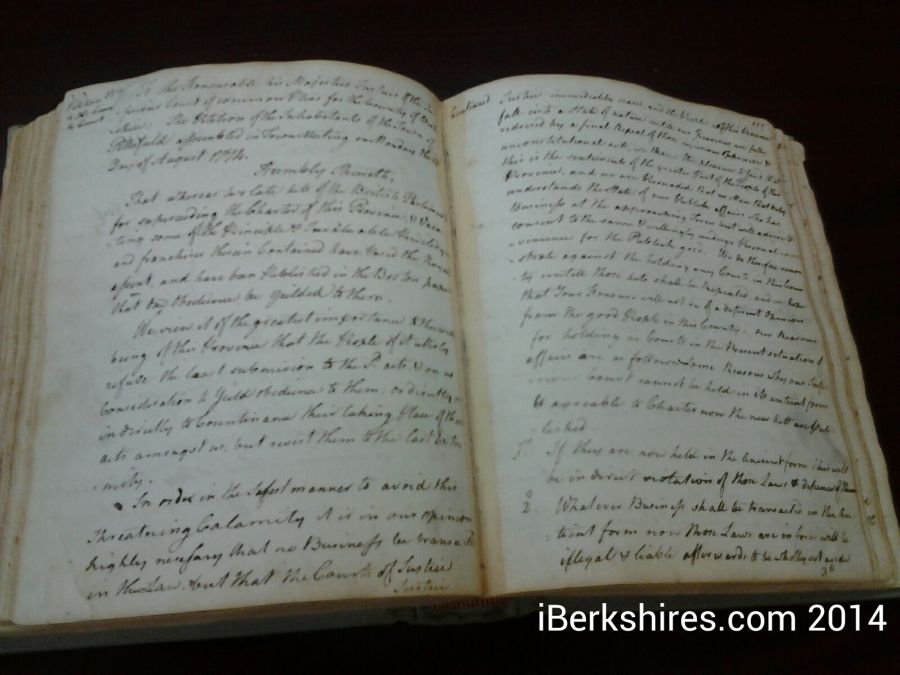 The City Clerk's vault at Pittsfield City Hall contains a hand written copy of Pittsfield's 1774 resolution to the king. The City Clerk's vault at Pittsfield City Hall contains a hand written copy of Pittsfield's 1774 resolution to the king. |
In the transitional climate of gradually increasing anti-government sentiment throughout Massachusetts between 1770's Boston Massacre and the later armed skirmishes in 1775, many Berkshire towns were ahead of the curve in the emerging political sentiment. More than three years before the Declaration of Independence, a famed petition against British tyranny, the Sheffield Declaration, a had already come out of the Berkshires.
“Mankind in a state of nature are equal, free, and independent of each other, and have a right to the undisturbed enjoyment of their lives, their liberty and property,” reads its first resolution, conceptual language later enshrined in John Hancock's document version.
On July 6, 1774, 60 delegates met at a convention in Stockbridge and endorsed a "league and covenant" to boycott all British goods and merchants who sold them. These resolutions were clear to enunciate their loyalty to the sovereignty of the king, but firmly insisted that "the inhabitants of his Majesty's colonies in America are justly entitled to all of the rights and liberties that the inhabitants of Great Britain are entitled to," and pledged to face existing abrogations of these rights through economic action.
A month later, the court at Great Barrington was shut down forcibly by Patriot insurgents, in what is considered one of the first acts of organized open resistance and a pre-cursor to the coming war.
Less well known is Pittsfield's role in the rising anti-British tide in the Massachusetts colony, but original copies of town records kept in a vault of City Hall prove revealing.
In August of that year, Pittsfield voters at a town meeting approved a petition to the king protesting the "injurious acts" that year against the colonies and demanding the cessation of all local court activities until they were removed.
"That whereas two late acts of the British Parliament for superseding the charter of this Province, and vacating some of the principles and invaluable privileges and franchises therein contained, have passed the royal assent, and have been published in the Boston paper, that our obedience be yielded to them," the Aug. 15, 1774 petition read. "We view it of the greatest importance to the well-being of this Province, that the people of it utterly refuse the least submission to the said acts, and on no consideration to yield obedience to them; or directly or indirectly to countenance the taking place of those acts amongst us, but resist them to the last extremity."
"In order in the safest manner to avoid this threatening calamity," it continues, "it is, in our opinion, highly necessary that no business be transacted in the law, but that the courts of justice immediately cease, and the people of this Province fall into a state of nature until our grievances are fully redressed by a final repeal of these injurious, oppressive, and unconstitutional acts."
The growing appetite for revolutionary action spurred an upheaval in the local political structure in Pittsfield, where Tory leanings were found predominantly among the families of its earliest settlers and included some of its prominent leaders, men like Woodbridge Little, Israel Stoddard, Elisha Jones and the influential Colonel William Williams.
For logical reasons, those wealthy in land and property tended to fear the outcome of agitation against the crown more than did the majority of families in the town at the time. In fact, it was through the political orchestrations of one local attorney, Woodbridge Little, that Pittsfield earlier, in January of that year, had passed a resolution chiding the illegal actions taken by parties involved in the Boston Tea Party.
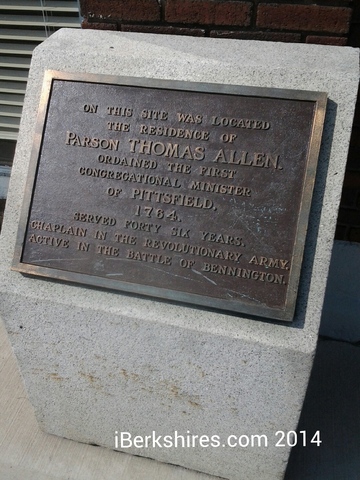
It was he along with Williams and Stoddard who first leveled charges of sedition against Parson Thomas Allen, the city's first and most rabidly opinionated instigators against British rule. These were thrown out of court, and by early 1775, the popularity of those against Britain had edged out and ostracized any more moderate position as potential traitors to the now-accepted cause of Colonial liberty.
In 1775, Pittsfield pushed further in its remonstration, putting forth a resolution asking for "the previlege of electing our own Civil and military officers."
For "if the right of nominating to office is not invested to the people," the petitioners insisted, "we are indifferent who assumes it whether any particular persons on this or other side of the water."
Also in '75, as in other towns, a Committee of Inspection was organized to monitor and censure active British sympathizers, an estimated 15 to 20 remaining families, mostly those linked to the Williams and Stoddard families.
Stoddard, along with Woodbridge Little, ultimately fled their homes for fear of reprisal. Little for some time resided in a cave in Lanesborough, and eventually made his way to Albany, N.Y., while Stoddard sought reprieve in Kinderhook, until both were eventually sent back.
A notice was taken out in the nearest paper, the Hartford (Conn.) Courant from prominent patriot Col. John Brown on behalf of the Committee of Inspection:
"Whereas Major Israel Stoddard and Woodbridge Little Esq., both of Pittsfield in the County of Berkshire, have fled from their respective homes and are justly esteemed the common pests of society and incurable enemies of their country and are supposed to be somewhere in New York Government moving sedition and rebellion against their country, it is hereby recommended to all friends of American liberty and to all who do not delight in the innocent blood of their countrymen, to exert themselves that they may be taken into custody and committed to some of his Majesty's jails till the civil war which has broken out in this Province shall be ended."
On May 9, 1776, the state House of Representatives asked towns for a determination on the independence issue, and Pittsfield was among the first in the colony to respond, with a resolution on May 29. Sheffield followed on June 18 with its own resolution in favor of an anticipated declaration by the Continental Congress.
While Pittsfield was a hub of what little Tory resistance continued to dare voice itself in the Berkshires, other towns dealt with various incidences in their own way. On the day of the signing of the Declaration of Independence, a "liberty tree" was planted in Sheffield, where Patriot fervor was near-unanimous, but the tree was cut down that night. The culprit was revealed to be a prominent local merchant, Dan Raymond, whose house later became home to the town's historical society. Raymond was forced to walk a gauntlet through the other men of the town, apologizing. His servant was covered in tar and feathers and sent from house to house to complete the process of apology.
In Lenox, Gideon Smith fled to a cave on October Mountain, which ever after became known as Tory's Cave until it was lost to geography. He was eventually put in a noose and mock-hanged three times by his neighbors, until he renounced opposition to the rebellion.
"The tories of the town were subjected to many petty annoyances, and the mischevious and fun loving youth played on them many pranks," according to the J.B. Beers' 1885 "History of the Berkshires," "Overt acts of treason were punished more severely, and confiscation and banishment were in several instances inflicted, especially on those who had joined the King's forces."
By 1777, which saw the victories over General Burgoyne's forces in Bennington and Saratoga, in which Berkshire men participated heavily, most of the prominent Loyalist minority in the region had been "convinced," by one means or another, to join the side of rebellion, and men like Little, Stoddard, Raymond and many other Tories ultimately became officers or active recruiters for the Continental Congress.
.
"The great bulk of the country is undoubtedly with the Congress," the "Fighting Parson" Thomas Allen is reported to have said, en route back from victory at Bennington.
Tags: 4th of July, historical, revolution,