Q&A: Ali Benjamin and the Thing About Award-Winning Fiction
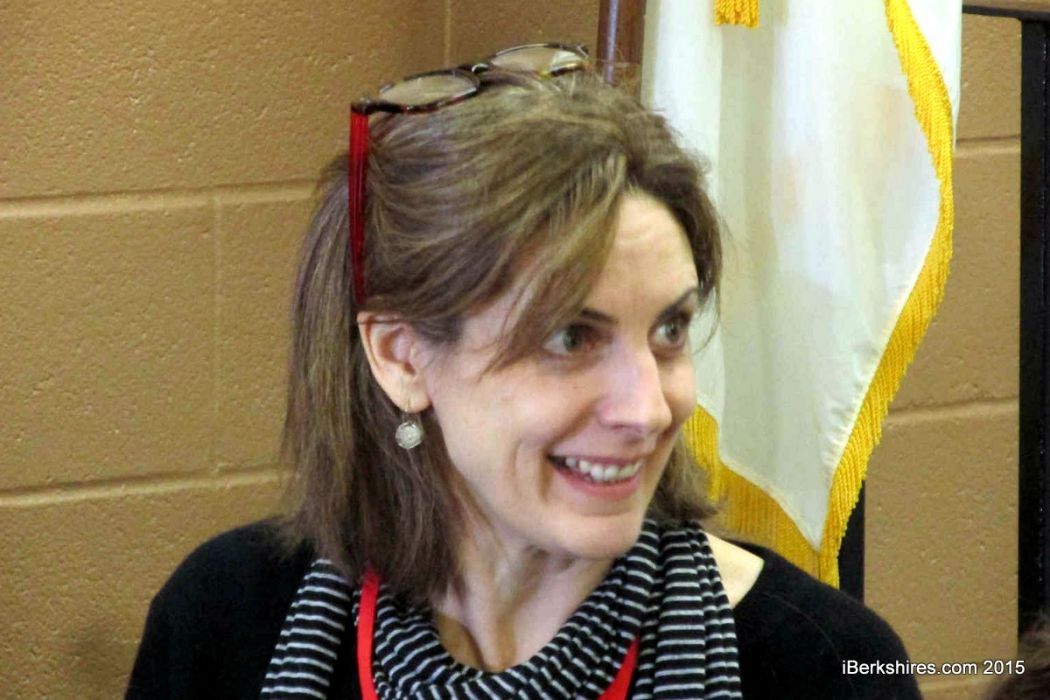 Williamstown's Ali Benjamin is on the short list for a National Book Award. Williamstown's Ali Benjamin is on the short list for a National Book Award. |
OK, maybe that is overstating things. But it is fair to say that she is ambivalent about being on the short list for the honor, which will be awarded on Nov. 18 in New York City.
"There are so many good books in the running," Benjamin said this week. "One is 'Challenger Deep,' about a 15-year-old boy who has a schizophrenic breakdown.
"It's such a wonderful story, an entertaining story. It was so well done. If this guy gets it, I'm going to be so happy.
"I'm happy to be in the running. I'm glad to be there and be part of it."
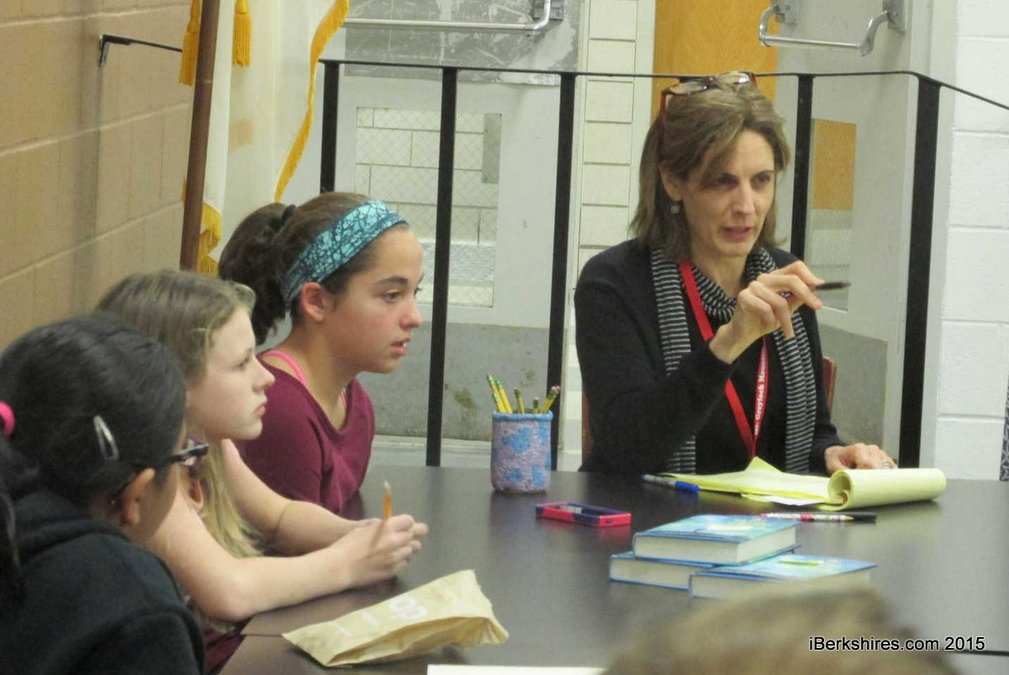
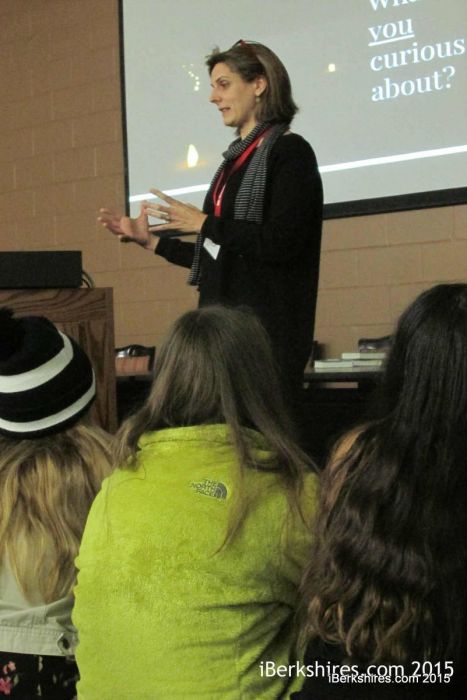
On Monday, Benjamin, a Williamstown resident, spent the better part of the day at Mount Greylock Regional School, holding two writing workshops with groups of a dozen or so students and addressing the entire seventh-grade for about an hour just after noon.
Benjamin shared insights into the process that led her from a successful career as a non-fiction writer to the publication of her debut novel, "The Thing About Jellyfish," which earlier this month was announced as a finalist for the National Book Award.
"Jellyfish," tells the story of Suzy, who both retreats within herself and learns about the world as she copes with the tragic death of her former best friend. Suzy is convinced that her friend, an apparent drowning victim, died as the result of a freak jellyfish sting and sets about to learn all that she can about the creatures.
Benjamin told the students that her interest in jellyfish as piqued not by tragedy but by a visit to the New England Aquarium. And she encouraged them to hold onto and nurture their own curiosity about the world — even to the point of obsession.
Benjamin came complete with a Power Point presentation and prepared remarks, but she needn't have bothered. The seventh-graders, most of whom had read the novel, had plenty of curiosity about her and her work. Below are a sample of their questions and her answers:
Question: How did you come up with the idea of the friend drowning?
Benjamin: I was writing what I thought was non-fiction and occasionally in the back of my mind there was a story about a girl and her older brother. The girl was 12 and thinking about the world and learning how sometimes stories don't have happy endings. She was thinking about environmental stuff and climate change.
And I had this weird light bulb moment. ... I was sitting on my couch. I may have been doing nothing, just thinking. And I said: This is the same story and somehow this girl is learning about jellyfiish.
Q: How long did the book take?
Benjamin: I don't know because I wasn't working on it straight through. It was a little bit at a time over maybe two years, but it wasn't two years worth of writing. The book sold a year and a half ago. It takes that long for a publisher to get a book out into the world.
Q: Could the characters in the book have been switched? Could you have killed the quiet one and told the story from the perspective of the popular one?
Benjamin: Yes, and I never thought about it. ... To some degree, when you're writing fiction, you have to let your unconsciousness take over, and the voice that was coming out was the one who would never be popular. The narrator is very alone and doesn't speak. If she was surrounded by friends, it would have been a very different book.
Q: How would you start a book or a novel?
Benjamin: There are so many different ways of doing it. I was talking with another author who said he plots out everything and it's very planned and linear. I said, 'You map out everything?' And he looked at me like I was crazy, as if to say 'Of course.'
My method is very different. I'll write down words and phrases when the come to me. I'll often have words writen on my arm ... I'll write on whatever I have because I don't want to forget it. I write these weird scenes that aren't connected to anything and then have to figure out how they fit together.
Q: How did you get to do the book with Tim Howard ["The Keeper: The Unguarded Story of Tim Howard"]?
 |
(After a telephone meeting with the soccer star, Benjamin was selected to write his autobiography, in both regular and young readers' editions.)
The publisher wanted the book out before Christmas to make it the big gift book because he had this great World Cup game in July. We had a very, very limited time to write it, which made it really exciting and really unpleasant. In two months, we were doing both the adult and kids book.
He's great. He's wonderful. I went to England and sat with him for a couple of hours. I recorded every conversation we had. It's just really hard to write under that kind of deadline.
Q: Would you change anything in [The Thing About Jellyfish]?
Benjamin: One of the hardest things in writing a book is deciding when you're done. ... I've had moments when I thought of something I wish a character had said. I don't think there are really big things that are out there, just tiny tweaks.
Q: Did you want to finish everything in the book or leave things unresolved?
Benjamin: Which do you think it was?
Q: I think it was kind of in-between.
Benjamin: There was more at the end of the book than what you guys saw. ... The editor said you've got to cut that off. She was very nice about it. She just thought it would be better if it ended sooner.
The more I looked at it, the more, in the end, I think she was right. It ends with almost a sense of openness and expansiveness. She was right. It would have been flatter if we saw everything.
It's really hard to have someone say something, and you don't want it to be true.
Q: Do you like to read a lot?
Benjamin: When I was a kid, I was not a great reader. I did not read widely. If I found a book I liked, I'd return to it again and again. i read more now and read more different things now.
Q: Why did you focus on jellyfish?
Benjamin: No. 1, I though they were beautiful. No. 2, they are so alian looking, and yet they're part of our world. They also affect our world so much. And I feel like jellyfish, as different as they are from humans, tell us things about humans and what we're doing to the planet.
Q: Are you less obsessed with jellyfish now after having written the book?
Benjamin: I am. I sort of feel like I did that.
Every time jellyfish are in the news, 20 different people will send me articles. And I have a different feeling about that now. I feel like I've closed the book on it.
Tags: authors, awards, books, MGRHS, Q&A,