Changes Pondered For Pittsfield's Demolition Delay Ordinance
PITTSFIELD, Mass. — The city's ordinance governing delays of demolitions for historically significant buildings is nearly a decade old, and members of the Historical Commission feel it may be time to refine the regulation.
Pittsfield's is the only example of a demolition delay ordinance in the commonwealth that requires an additional vote by the Community Development Board to enact the delay after the Historical Commission has voted on it.
The additional layer of approval was initially seen as a check against the potential for the commission to enact delays too lightly without sufficient justification, but the commissioners suggested that this may be unnecessary given the few occasions that a delay has been called for.
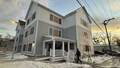
Out of dozens of demolition requests put before the commission in recent years, only three structures have raised concerns leading it to recommend a delay: the former Plunkett School building, a mothballed Crane & Co storage facility, and most recently the abandoned convent building at St. Joseph's.
City Planner Cornelius Hoss said he will raise the question with the Community Development Board.
"If they support it, that will pave the way for the City Council to take up the issue," said Hoss, noting the general protocol would be for the council to first refer it to the Committee on Ordinances & Rules.
Another piece of the ordinance the commissioners felt may bear reconsideration is the time period of the delay; while a majority of municipalities in the commonwealth reserve the right to enact a delay up to one year if deemed optimal, Pittsfield's allows only for one six-month delay.
"There's definitely an argument for that as well," Hoss indicated.
"It's kind of difficult to make anything significant happen to preserve buildings in six months," said commission member Kathleen Reilly.
In other business, the Historical Commission approved a demolition application for a dilapidated 19th-century barn associated with the Pontoosuc Woolen Mill operations. The "lesser" of two extant barns situated on the 1304 North St. parcel historically belonging to the Francis family, it is considered a safety risk by its current owner, St. Nicholas Orthodox Church
"It's in pretty rough shape, especially the foundation," said Bob Fornier of SK Design, representing the church in the demolition application process.
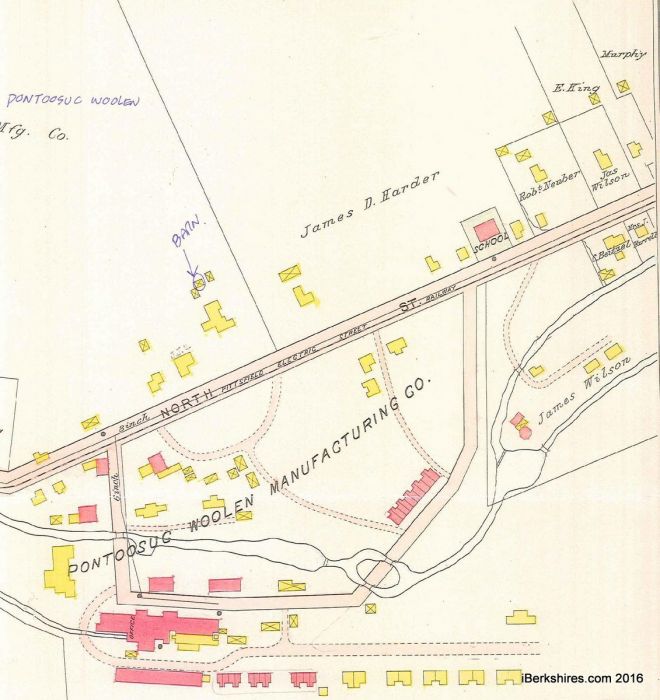
A map of the former Pontoosuc Woolen Manufacturing that existed off North Street.
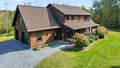
The house on the property dates back to 1910, and was occupied by the last family to own the mill, the Francis family. Most notably, it belonged for a time to James Dwight Francis, grandson of Civil War hero General William Bartlett. In 1922, Francis married Kay Gibbs, after known as famed 1930s film starlet Kay Francis.
Only 17 at the time of their nuptials, Kay Francis abhorred both Pittsfield and the marriage, according to biographers.
In 1945, the Francis family sold the property to the Deluwski family, a member of which later sold the property in 2010 to St. Nicholas, which constructed its current sanctuary the following year. The 10-room house, along with one barn on the property, is still in use by the church, but the second is crumbling and has had to be fenced off.
"I can assure that right now this poses a safety threat to the parishioners," Fornier told the commission, adding, "It's unlikely in my opinion that it was used for anything of historic interest."
Commission member Thomas Martin said the barn being preserved by the church is by far the more architecturally worthwhile of the two.
"It seems like the safety issues outweigh any historical issues," agreed Maxine Bookless.
1304 North Street- Application for Demolition
Tags: demolition, historical commission,