Williamstown Conservation Commission Reviews Culvert Project
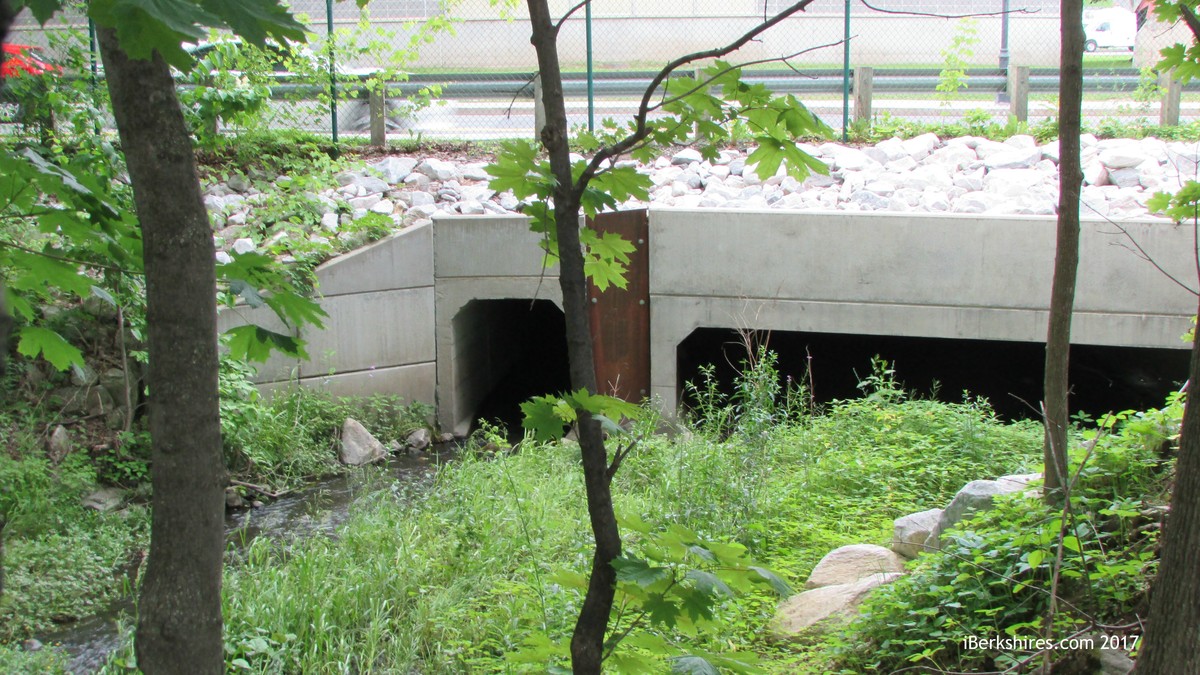
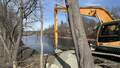
Christmas Brook enters the current undersized culvert below Latham Street across from Williams College's Towne Field House.
Williams College is proposing to replace the existing, undersized culvert with a precast box culvert that is at least 5 feet by 12 feet, the top of which will sit 5 to 7 feet below grade.
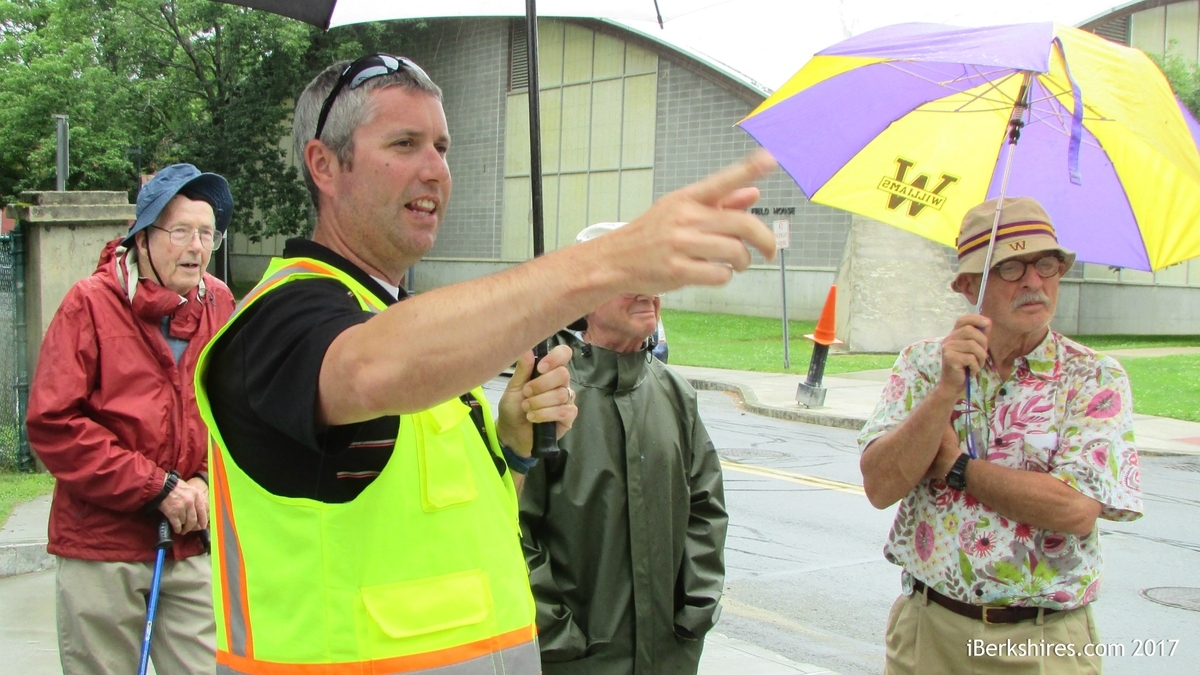
Representatives from the college and Manchester, Conn.,-based engineering firm Fuss & O'Neill laid out the project and took questions from the commission which the applicant will address when the hearing is continued in August.
College attorney Jamie Art laid out the reasons for the project.
"The culvert project … is part of the college's commitment to invest in town capital projects to the mutual benefit of the town and the college," he said. "We have an over 800-acre watershed that all funnels down to undersized pipes that run under Latham Street, across the Facilities parking lot, under the Facilities building and down across Meacham Street to Water Street and discharges into the Green River.
"It's gotten to the point where every couple of years now, we have some significant flooding in the area from Walden Street south down to Spring Street, Meacham Street, Latham Street and Water Street. …. The culvert project, which is a big project, emerged as the number one priority to be the most effective means to alleviate the flooding and have a long-standing, long-term fix to the problem."
Although much of the proposed culvert — like the existing conduit — will be under college land, the project will require significant digging along Latham and Meacham Streets, through the town-owned property at 59 Water St., and across Water Street for the discharge into the Green River.
If approved, the project likely will start at the east end, where the new culvert will terminate below Water Street. That way, the subsurface work can be completed before the Massachusetts Department of Transportation rebuilds that stretch of Route 43 next year.
The new culvert will measure at least 5-by-12 (60 square feet) and replace a conduit that at some points is about a third that size, 4-by-5 (20 square feet). The length of the new culvert will be 1,312 feet; the last 350 feet will measure 6-by-12 (72 square feet).
The culvert replacement is just one of several infrastructure projects the college has in the works for downtown Williamstown.
"This project is one the commission has been looking forward to for many years," Commissioner Philip McKnight said, referring to the fix for a persistent flooding problem. "But it's also a project that is one of four other projects. The overall view would be helpful to the commission. You have the municipal parking lot, the hotel, the invasive species and the now-delayed ecological restoration project. At some point, maybe you can talk about how it ties in."
Jason Moran from the college said there is one more project that McKnight did not mention, a pipe to carry discharge from the stormwater detention system planned to go below the Spring Street parking lot down Latham Street and into Christmas Brook.
Originally, the Notice of Intent for the culvert project included ecological restoration of Christmas Brook to the south and west downtown, where it enters the culvert at Latham Street. But after consultation with the commonwealth's Department of Environmental Protection and the Army Corps of Engineers, the college decided to drop that work for now and focus on the culvert.
The invasive species removal McKnight mentioned is covered by a separate application already before the commission.
The plans for the new Williams Inn, which is planned to go before the commission later this summer, do not really impact the volume of runoff into Christmas Brook, the applicant explained.
"The inn itself is not tied to the stormwater study in that the inn could happen without any of this work, and it wouldn't make the problem worse because the inn is handling its own stormwater on the site itself," Williams Senior Project Manager Jason Moran told the commission.
Eric Bernardin of Fuss & O'Neill elaborated on the point, explaining that although the planned inn will increase impervious surface area, it will not contribute to flooding in the area.
"The water from that site, the existing flows, go into the culvert," Bernardin said. "But they are taking care of the differential between the existing and proposed [with on-site stormwater management]."
Art said the proposed inn will be analogous to the new unified science center in that respect.
"They capture the rainwater and reuse that for things like flushing toilets and battery cooling," Art said. "There actually is stormwater management on site that further reduces flows from the redevelopment, and the inn is going to do the same thing.
"If anything, their [stormwater] projections are conservative for the inn project."
The applicant promised to discuss more how the culvert project fits in with the rest of the work planned for downtown at the hearing's continuation. By then, the Con Comm also will have the results of a peer review of Fuss & O'Neill's project design by Marlborough's Comprehensive Environmental Inc.
One part of that design raised a concern with the commission's newest member on Thursday evening. Lauren Stevens asked why the project did not include daylighting Christmas Brook west of Water Street instead of continuing the underground culvert beneath the former Town Garage site.
Bernardin said that daylighting the stream at the project's east end was one of the options studied. But given the depth of the culvert by the time it enters the 59 Water St. property at its west end, the daylighting would cut a 105-foot swath through the site, currently an unimproved parking lot.
Such a change would eliminate most of the lot's current use, as a parking lot, and forestall any future development for a site that has been eyed in the past as a possible home for affordable housing, market rate housing and a new fire station, among other things. The widest part of the 59 Water St. lot, its street frontage, is 200 feet. At the rear, it's about 130 feet wide.
Bernadin also noted that, at best, 200 or 300 feet of the brook could be daylighted at the project's east end, the majority would still be underground, and the increase in habitat would not be worth the impact of exposing the brook.
Stevens pressed the college to reconsider.
"This is a once, I hope, in a lifetime opportunity," Stevens said. "Once that pipe is in the ground and working, nobody is going to want to dig it up. Maybe it's worth looking a little closer at that opportunity."
Tags: conservation commission, culvert, flood control, Williams College,