Attorney Urges City and Town Planners to Get Ahead of 5G Tech
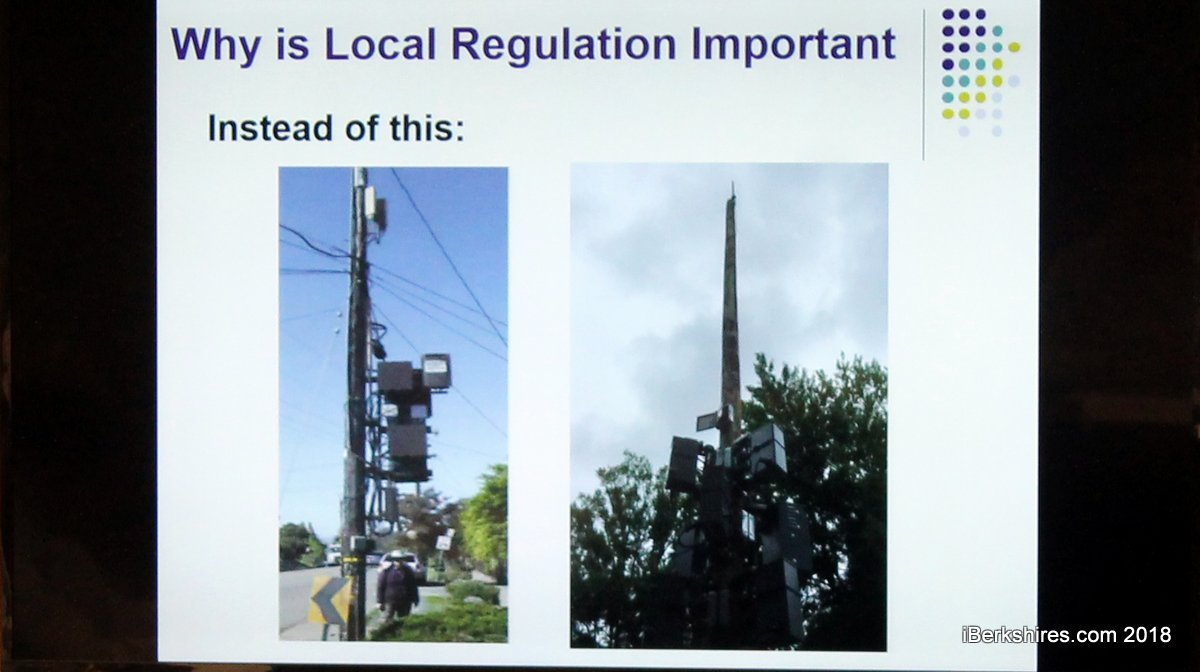
Lapore said the technology can be designed to look like street lights. But, often it just looks like utility boxes hanging from the poles.
Lepore said states have been passing legislation that effectively removes a local municipality's say in wireless infrastructure placed in a right of way.
In one case, he said the equipment was placed just a few feet outside of a resident's bedroom window and there was nothing the city could do.
"Once that law is passed, local government literally has no control over their rights of way anymore," Lepore, director of government regulations with Cityscape Consultants, said.
The industry is moving toward 5G technology to provide faster internet streaming, communication, entertainment, and eventually control driverless automobiles. The technology operates with much more bandwidth, which means the signal travels a shorter distance. Lepore said companies will be looking to install equipment on utility poles every seven to 12 homes.
"It is a big pipe, but it is a very short pipe," Lepore characterized the way the system works.
He is telling cities and towns to get ahead of the curve and start passing local bylaws to have some say over the aesthetics of the equipment. He said the laws in other states have not allowed much local control. That battle has played out throughout the country and into courtrooms.
But a bill hasn't come before the Massachusetts Legislature just yet.
"The window of opportunity for you is because there hasn't been a bill introduced in the commonwealth," Lepore said.
The technology now being rolled out is small cells, which include an equipment box and antennae attached to a typical utility pole; microcells, which are smaller and hung from wires; base stations, which are typically installed on top of a building; and "DAS installations," which are similar to the small cell with an antennae on a pole but the equipment box is located elsewhere.
Lepore said the infrastructure can be built in a very aesthetic fashion, but that costs more.
"The industry is going to do it as cheaply as possible. It is up to you to force them to spend a little more money," Lepore said.
Permitting of telecommunication infrastructure took its first major step in 1996 with the passage of a federal law. That said local zoning boards could have the authority over installations of things such as cell phone towers, but that a city or town couldn't discriminate against a particular company and couldn't prohibit wireless service altogether. That also included a process in which the city or town would have to provide "substantial evidence" as to why any siting of any telecommunication equipment was denied.
The wireless industry loved it at first. But by 2009, those companies started to feel like the local governments were taking too long to process an application. That's when the federal government passed the so-called the "shot clock" law that required municipalities to act within 90 days on a co-location application and 150 days for new structures or towers.
Three years later, Congress added a line in the Middle Class Tax Relief and Job Creation Act of 2012 that said local governments "may not deny and shall approve any eligible facility." The Federal Communications Commission followed up with some 150 pages of definitions. That had also changed the timeline, bringing the co-location applications down to 60 days with automatic approval if a town doesn't act within that period.
Now, the industry is looking to expand wireless connectivity and has been pushing legislation throughout the country to help speed up the permitting process for broadband technology. Lepore said particularly concerning about the law is that towns "must not deny and shall approve" eligible facilities in the right of way -- mostly the side of roadways. Fairly decent sized and ugly pieces of equipment are popping up in front of homes and there isn't anything a town can do, Lepore said.
Similar laws have been passed in places like Texas, Arizona and Ohio. The state of California passed it but the governor there vetoed it.
"They are trying for 13 more states this year. Massachusetts is not part of it," Lepore said.
But, one day the industry will be on Beacon Hill looking to hasten the rollout of higher speed internet. Lepore is already working with cities and towns to get some levels of local control in place before that happens. He suggests structuring preferred locations and design. That would require the company to fully explain why those other options don't work.
Lepore also suggests placing a focus on using public lands instead of private. That gives cities and towns even more authority because they become landlord. He said he was working with a town in Connecticut trying to urge officials there to do the same thing. But, the town never did so and all of a sudden, a resident offered up his back yard for a tower. Now the tower is approved, the homeowner is getting income from it, and the town had no say over its appearance.
"This is what happens when you decide to not decide on these issues. It is still going to be built but you have no say in it anymore," Lepore said.
The 5G technology is already being rolled out in multiple markets throughout the United States right now. Western Massachusetts may be a few years away from facing the issues, but Lepore said it will be here eventually.
"What drives their desire to build is a subscriber base that wants to use the services. Where there is a subscriber base that wants to use the service, they will build infrastructure," Lepore said.
Tags: cell tower, Internet, zoning,