'Death Wish': What this World Doesn't Need Now
"Death Wish," essentially a reboot of its 1974 namesake starring Charles Bronson, is problematic at best. For gosh sakes, there's tons of fear, loathing and guns -- the deadly sum of which the world doesn't need, especially at this incendiary and anguishing juncture in our
history.
But you can't blame MGM or director Eli Roth for the untimely release of this heir apparent to what became the standard of vigilante ethos. Considering the ceaseless conveyor belt of mass shootings bloodying our landscape, there is never a good time.
You watch and wince. The casual mention of an AR-15 when Bruce Willis' Dr. Paul Kersey makes inquiries at a gun shop dredge up the enigmatic flaw in American thinking. The saleswoman giddily explains how easily the good doctor, a trauma surgeon, can become a fierce
killing machine. Don't worry about the paperwork, the background checks, etc. It's all "no problem," to quote the youth of today's overused maxim. The irony spills from the script as Willis' contemporary Dr. Jekyll and Mr. Hyde embody both sides of the lamentable argument.
Act 1, Scene 1, it's about the happiest occurrence a family can experience. The wide, sunlit windows overlooking the lush back yard of their tony, Chicago suburb home, Dr. Kersey and his pretty wife Lucy, played by Elisabeth Shue, are rendered ebullient when daughter Jordan (Camila Morrone) runs downstairs and yells, "I got in!" Life has few better moments. But as your friend Sophocles, pausing from his popcorn, might whisper to you at that instant, you're being set up, hook line and sinker.
Great vengeance will be demanded for the horror that follows.
Director Roth, working from a script by Joe Carnahan, tosses us full heave-ho onto the pyre of the tragic debate. But whether it's shrewd business or just the way this ugly cookie crumbles, we are never quite sure which side of the argument the film takes. Yes, it assures, the prevalence of guns via the ease of purchase is crazy. But also, it insists via the most loathsome trio of felons who turn Kersey into what the press will refer to as "The Grim Reaper," there are all manner of threats in these United States that compel one to at least tote a six-gun. You can skip the spurs.
The most deleterious thing about this action film trafficking in the sick phenomenon that's rapaciously thinning-out the human herd is that it's too simplified. Killers do their killing and Dr. Kersey, frustrated by the police's failure to find them, decides to extract his own justice, even if a bit too gleefully. There is no introspection, no assay of the gun culture that makes this scenario possible, and no mention of folks in other democracies who have been able to maintain their freedom without being armed to the teeth.
Added to this distortion is Willis's viewer friendly portrayal of the devastated doc. Of course, you'd have to be one heckuva coldblooded coot not to empathize. But because Willis is so adept at combining his action figure persona with the easygoing, nice guy we've come to believe he is, it tosses a further exemption his way. The dangerous result is that swept up in the process, a very serious issue is rendered almost cartoonish. Thus lifted of ethical concerns, at least for the movie's length, we may feel only a pinch of guilt as we cheer Kersey's "justified" executions.
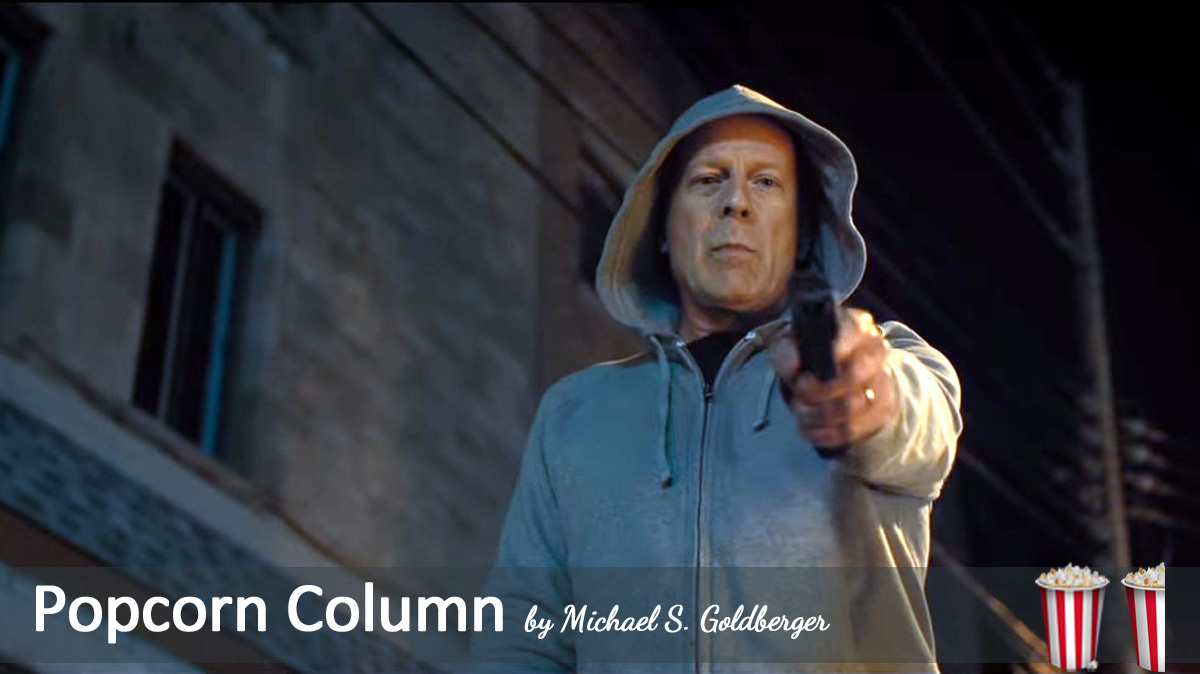
You see, what begins as the pursuit of retaliation might as well be a bizarrely surreal video game as Dr. Kersey each night exchanges his scrubs for a hoodie and takes to the mean streets in search of bad guys. With his first kill, he gets a taste for the sanguinary and, all but giving us a stage wink, invites our company on his hardly doctorial rounds. "Who shall it be tonight?" this imaginary comic bubble above his head might inquire. "A rapist, a drug dealer, the fence who assured bounty to the three butchers who invaded my home?"
A zealous media keep score of the nocturnal avengements while helping foment an enthusiastic, on-air dialogue among Chicagoans, pro and con. And just to keep things from getting tedious, as if rhetorically asking his prey, "How shall I kill thee? Let me count the ways," the Grim Reaper mixes it up. He is the wicked cousin. Bad enough he plays to the lowest of human instincts, his wholesale retributions become increasingly sadistic.
Though done in high relief and reflected in a smudged mirror, this unsavory snapshot says some searingly truthful things about the enigma sewn into the fabric of our civilization. Informing my assertion that folks from both sides of the aisle will find here rationalization for their convictions was the fact that when Peter Fonda and Dennis Hopper's "Easy Riders" were savagely blown off their choppers in 1969, audiences in some parts of the country cheered. Sadly, while our national shame remains very much alive and, well, quite deplorable, "Death Wish" arrives D.O.A.
"Death Wish," rated R, is an MGM release directed by Eli Roth and stars Bruce Willis, Vincent D'Onofrio and Camila Morrone. Running time: 107 minutes
Tags: movie review,