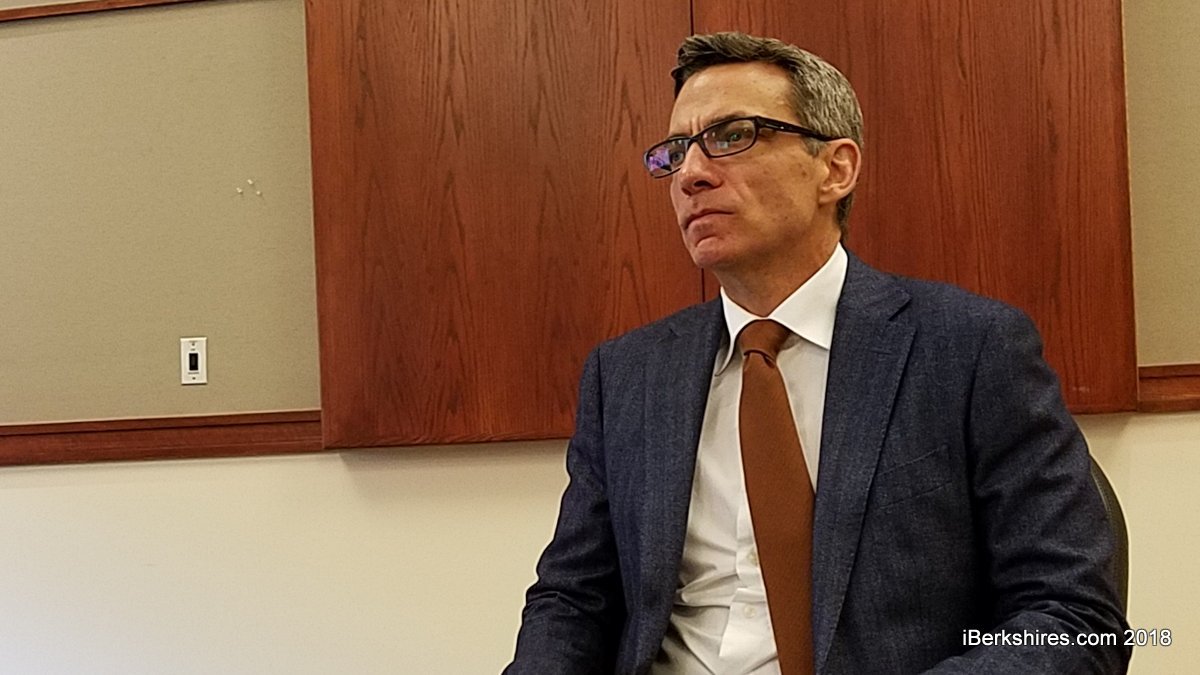
Q&A: Former FBI Agent Clint Watts on Social Media Manipulation
NORTH ADAMS, Mass. — NBC News contributor and former FBI agent Clint Watts spoke at Massachusetts College of Liberal Arts' spring public policy lecture on Wednesday evening, April 4 about the attacks and implications from the Russian propaganda campaign.
Watts earned a bachelor of science degree from the U.S. Military Academy at West Point, N.Y., and a master's degree from Middlebury Institute of International Studies in Monterey, Calif.
He is the author of "Messing with the Enemy: Surviving in a Social Media World of Hackers, Terrorists, Russians, and Fake News," which reveals how malefactors use social media information. He testified before the Senate Intelligence Committee last year on Russia's cyber warfare tactics.
Watts took questions from local reporters from iBerkshires.com, The Berkshire Eagle, and MCLA's The Beacon on Wednesday afternoon before meeting with students. Later on at 7 p.m., he spoke in front of community members and MCLA students on "Russian Spies, Social Media, and Fake News: An Inside Look at Russia's Cyber Warfare Campaign against American Democracy."
Below are some of the questions and Watts' answers that have been edited slightly for style and brevity.
Question: There's been a lot of debate over how much influence these Russian bots (automated replies on social media platforms) have. Do you think they are capable of pushing people to extremes?
Answer: So it's not just bots. I think that's important. In the case of Russia, the Internet Research Agency (a Russian company), they got busted again yesterday (Tuesday, April 3rd) for some accounts. It's a mix. So they use real personas that are operating the accounts and they combine bots on top of it. Social bots help you distort reality; they can make you stumble onto something at a greater frequency. The more you see something, the more you tend to believe it, or the more you tend to want to look into it. Even if people say "Well this bot only has 10 followers"... Yeah but there are 1,000 of those. So just seeing what looks like 1,000 people when it's really one can influence how you think.
Q: Why do you think it is important to inform the general public on terrorism forecasting?
A: I think the American terrorism discussion is silly and doesn't make any sense. Because it's so complicated to explain it in the news, they try and always frame it in one or two words like it's a team sport. So you'll hear people say it's Al Qaeda or it's ISIS, or if there's a terrorist attack, they'll be like ‘who did it? Al Qaeda or ISIS?' And the answer is it could be neither. It is a religious movement. When we portray them in the American media, we talk about it like it's a team sport; because it's easier for people to understand. I feel like with terrorism forecasting, it's important to understand ‘How does their belief system change? What's motivating people to join that belief system? And, really, where is it going to go next?', because that tells you a lot about their tactics and who's the target.
Q: What can our cyber security do to stop these kinds of attacks?
A: One thing is election security. One of the bigger ideas behind [the Russian propaganda campaign] was to make people doubt that the election was authentic. If you can do that, that at least dispels that this is all rigged. Election rigging, voter fraud; it's all likely to come back again in the future, especially if we are increasingly digital. The other thing is how do you deal with manipulated news, and that's really going to come down to the social media companies. I advocate for information consumer reports, which is independent agency outside of the government which provides to the consumer if they want to know a rating about the agency over time — how many fact versus fiction and reporting versus opinion.
Q: How do you see their tactics advancing?
A: I'm not so much worried about Russia, I'm more worried about political parties, lobbyists, and corporate groups that have way more money and more sophisticated technology. So people are excited about Cambridge Analytica (a political research firm), I think it's an example of what can come. This is going to crush those social media companies to the point where the only people there will be those that don't understand how their privacy is being violated, and how they're being manipulated — which is even worse.
Q: What's your advice for helping the individuals to suss out what's real and what's not?
A: There's not a good way. I would tell those people to just get off those platforms. If you're trying to figure out your political beliefs via Twitter, you're going to be in a weird world — you're not going to be able to make much sense of it. It's all being manipulated by someone, or pushed in one way or another. I think the biggest thing is to value physical relationships and conversations more than the virtual. I think that's a big part of the survival of democracy.
Tags: FBI, lecture, MCLA, news media, social media,