Berkshire Groups Ask Senate President For Flexible Funding To Combat Opioids
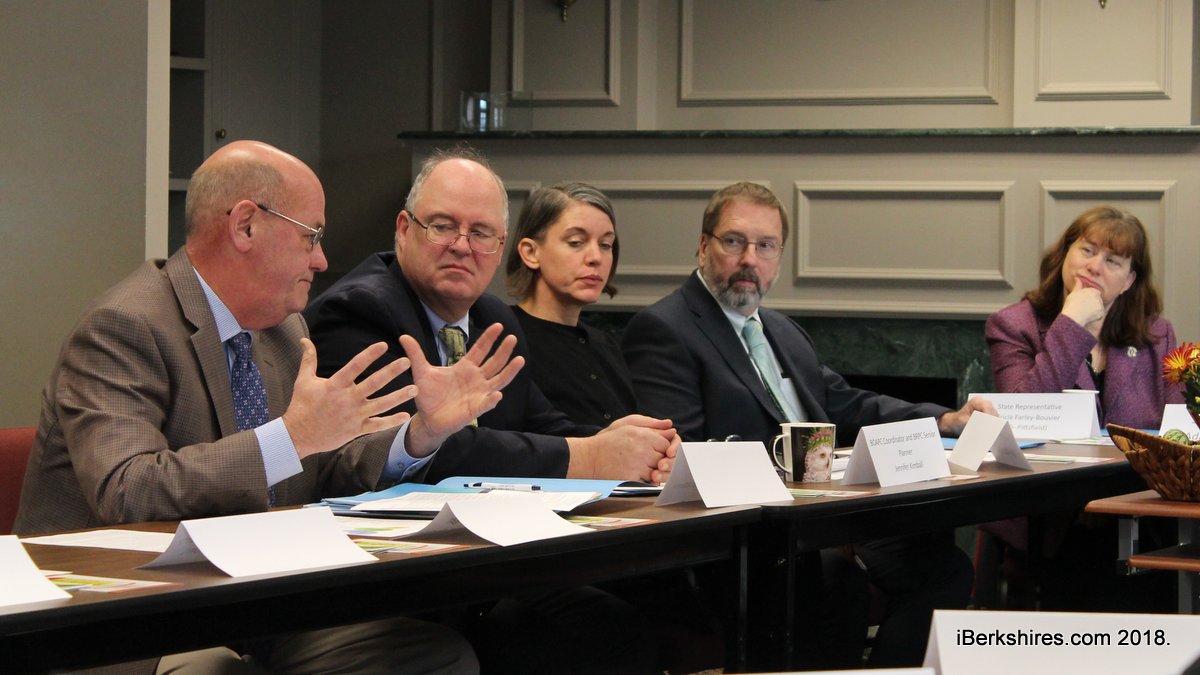
Franklin County Register of Probate John Merrigan and District Attorney David Sullivan shared how they were able to develop a model to specifically address the issues in Franklin County.
But in Franklin County, a line in the state budget created a much more locally focused opioid task force.
That flexibility in funding has helped officials there grow a collaborative and grassroots effort to combat the drug problem in their specific community.
"We've been able to become an organic, homegrown initiative. We are not under anybody's control," Franklin Register of Probate John Merrigan said.
"We kind of just came out of the ground and there are hundreds of people involved in our region. We've had an impact, we know for a fact we've had an impact."
Merrigan and Franklin County District Attorney David Sullivan was part of a group to retool how that more rural county addresses the issue. Merrigan said partners from health care, the justice system, law enforcement, and the recovery community all came together to work collaboratively on it.
"We are able to work on our own and what fits for the region," Merrigan said. "Others in the region have that same sort of ability to bring that together if they are allowed to work on their own."
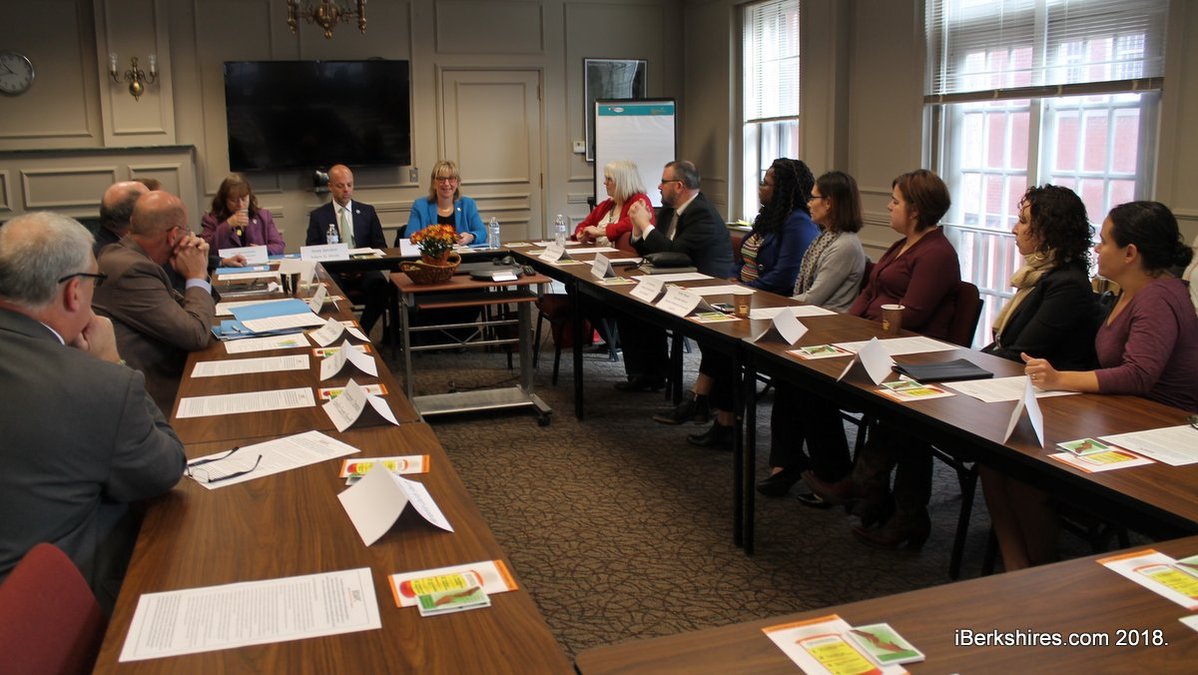
Merrigan told the story of the Franklin County Opioid Abuse Task Force to state Senate President Karen Spilka in a meeting on Friday.
Around the table with him, Sullivan, and Spilka were representatives of organizations in the Berkshires fighting the same battle here. Those include Gwendolyn VanSant from Multi-cultural Bridge, Gina Armstrong from the Pittsfield Health Department, Amber Besaw from the Northern Berkshire Community Coalition, Ananda Timpane of the Railroad Street Youth Project, Llana Steinhauer from Volunteers in Medicine, Christine MacBeth from the Brien Center, Sheriff Thomas Bowler, and Jennifer Kimball from the Berkshire Opioid Abuse Prevention Coalition.
Together the group of local professionals working in that environment is hoping the state will fund a similar project in the Berkshires. After all, the Berkshires aren't that different from Franklin County as the drug problem exploded at once in both counties.
"I think people, when you finally listen, you realize how bad the issue is," Sullivan said.
Franklin County had nothing in place to handle it. There were no recovery beds, no outpatient program, and programs such as Narcan to prevent overdose deaths. All groups involved were doubling down on their own efforts but were working in silos. The state funding helped turn that around and Franklin County officials say what they've now built addresses the addiction issue on all fronts.
And the Berkshires tell a similar tale, as the county had a similar lack of resources and but is now working collaboratively on locally-geared solutions.
"All of these things exist now in Berkshire County or has greatly improved," Kimball said, but there are not enough funds to cover all of the gaps in service.
Kimball said the Berkshires went from barely seeing enough of a problem to even qualify for grants funds to within a few years having one of the highest overdose rates in the state, so there is an urgency to the effort.
Those in the Berkshires really want to bring it all together now and would like the flexibility Franklin County has had to do so.
Timpane said the work she does to reach all corners of the county but often doesn't fit in the parameters of a grant program. She, too, urged for flexibility in the use of funds to make a bigger impact.
Besaw said rural communities are much different from urban areas. She said the Northern Berkshire Community Coalition is often working with the Department of Public Health's office of rural health. But, that office isn't funded. She would like to see that funded and serve as a resource for the rural communities.
North Adams Mayor Thomas Bernard added that the Berkshires are great at collaborative efforts and with the right flexibility, those here could come up with a model that can be replicated across the state.
"Give it to us in the Berkshires, we'll kick it around, and we'll hand you the model," Bernard said.
Bowler said one gap he continually sees is when those in jail go back into the community without enough support. He said 90 percent of the inmate population has some type of addition problem. The House of Correction works to restructure those inmates' lives but after they leave, there seems to be a lack of people ensuring they stay with that newfound structure.
"It is the continuum of services outside," Bowler said.
Bowler said he'd like to have a few "street workers" who follow up on individuals and make sure they are getting to narcotics or alcoholics anonymous meetings, doctor's appointments, and job interviews, and that they are doing what they are supposed to do to avoid ending up back in jail.
Spilka agreed that the state hasn't done enough on that front.
"We haven't done so well with the post-release and the continuum of care and we expect people to just make it," she said.
State Rep. Tricia Farley-Bouvier emphasized that the addiction problem isn't just related to individuals but also to children. She said the Department of Families and Children is overwhelmed by the epidemic. She also pushed for family resource centers to help parents.
"It has completely overwhelmed the Department of Children and Families. The long-lasting impact that the trauma created from opioid in a family will be felt not for years but for generations," Farley-Bouvier said.
Meanwhile, MacBeth is concerned about funding for organizations like the Brien Center. Particularly, she said the reimbursement for outpatient service is too low. Because of that, the center can't pay their employees as much as they could get paid elsewhere and often the Brien Center finds themselves training somebody, who later takes a job elsewhere.
She said in order for the center to grow large enough to handle such things as opening another residential outpatient center, it needs to have the "infrastructure" in place to handle the additional work.
"Our ability to really pull that off will depend on our infrastructure," she said.
Spilka said she started out as a social worker so mental health and addiction are of utmost importance to her. When it comes to addressing opioids, she said, "nothing is off the table."
"To me, dealing with addiction and mental health will be one of my hallmark, important, issues I want to tackle," she said.
Spilka was there mostly listening as a guest of state Sen. Adam Hinds. It was the second stop for Spilka as Hinds held meetings giving her a closer insight on what happens in the Berkshires, and why the Berkshires are different from the rest of the state.
Tags: health & wellness, Opioid abuse, president, state officials, substance abuse,