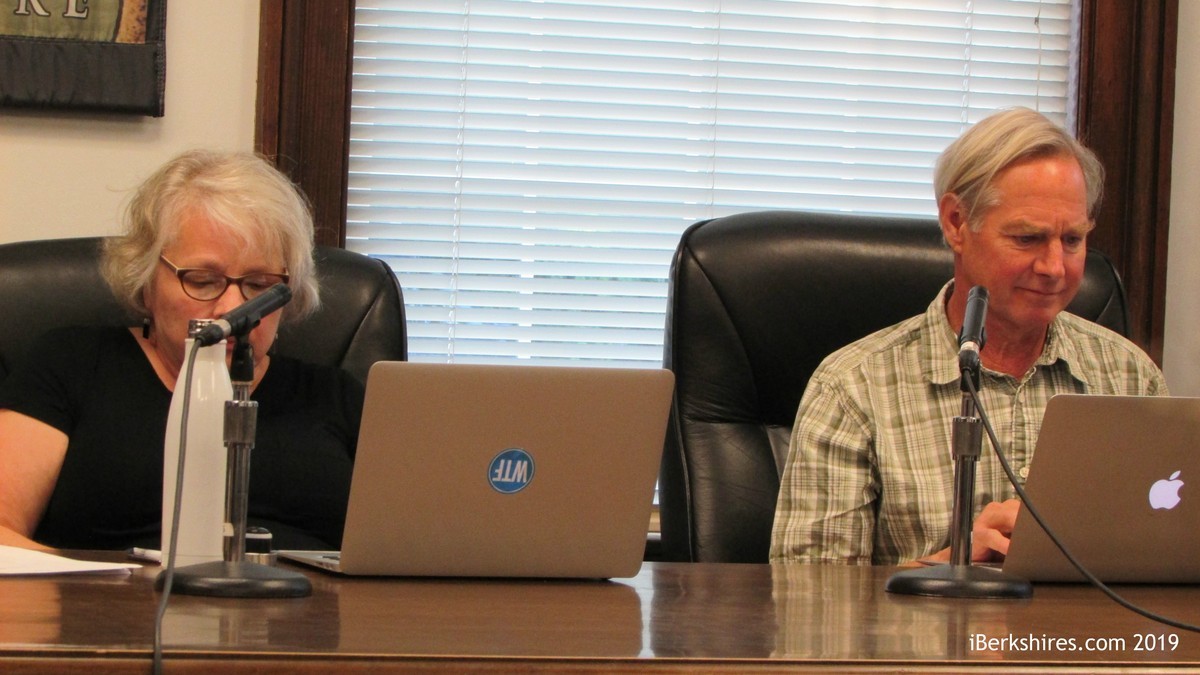
Williamstown Planning Board Grapples with Lighting Bylaw
WILLIAMSTOWN, Mass. — The Planning Board Tuesday took a first look at a draft revision of the town’s lighting bylaw that seeks to “reduce unnecessary and obtrusive lighting.”
Backed by mounting evidence of the adverse health effects associated with too much artificial lighting and cognizant of the growing options for temperature and intensity of lighting with the advent of LED bulbs, the board has for months been discussing the need for a new bylaw.
On Tuesday, Alex Carlisle presented his draft to his colleagues, who were on the same page in terms of his objectives but raised questions about the enforceability of his proposed regulations and whether the town has the authority to control illumination from streetlights through zoning.
Street lighting is the jurisdiction of the Williamstown Fire District, a separate municipal authority that stands apart from the rest of town government.
Recently, the Prudential Committee, which administers the fire district, was challenged at its annual meeting over the issue of street lighting — specifically an agreement with National Grid to swap out the town’s current street lights with LED fixtures. Some town residents have objected that the LED lights slated to be used burn at 4,000 degrees Kelvin, a range that has been linked to disrupted sleep patterns and even cancer, according to some medical studies.
At Tuesday’s meeting, Planning Board Chair Stephanie Boyd suggested that her board backburner the street lighting component of the bylaw and focus on other aspects — at least until it has resolution of the legal question of whether such an ordinance can be enforced on the Prudential Committee and National Grid, which owns the light fixtures atop the poles on town streets.
Boyd also said that the Prudential Committee has heard the community’s concerns and already is talking to National Grid about the issue.
Prudential Committee Chairman John Notsley said Wednesday morning that he hopes to have more information by the time his panel meets on July 17.
“I have a meeting with National Gridnext Monday where I’ll try to get some answers,” Notsley said. “There are so many unknowns to us that have been bandied back and forth regarding the situation.”
The Prudential Committee, which pays for the street lights from the property taxes it assesses to town residents, saw the National Grid program, which includes a rebate for switching to LEDs, as a win-win for the community.
“When we made the decision in December of last year, we had three points in mind: safety for the public, a reduction in cost to the district and also reducing energy consumption,” Notsley said.
As for the rest of the draft bylaw, Susan Puddester Tuesday was the first member of the board to press Carlisle on the idea of enforcement.
“I don’t know how we’re going to be able to enforce a lot of this,” she said. “It seems like not a good use of our time if there’s no enforcement of all these things.”
“This bylaw does enable to the police department, with a complaint, to ask a homeowner to remove an offending light or replace it,” Carlisle replied. “I don’t imagine there will be a ‘lighting police.’ But I do imagine if someone says, ‘I have a guy next door with a floodlight that’s in my yard all night long,’ they’d have an option.”
Chris Winters pressed the point, asking about how a neighbor with a complaint about an offending light could prove it violated the bylaw.
“A lot of this is independent feelings of what a light is that is too bright or not,” Carlisle said. “If a neighbor says, ‘That’s disturbing me,’ I think that’s reason enough to question the output of someone’s lamp. It’s a nuance between a neighbor who doesn’t care and a neighbor who cares a lot.”
Boyd said she didn’t think it was fair to put the police in the position of adjudicating spats between neighbors over a floodlight.
“I do share the concerns [Winters, Boyd and Puddester] raised on enforceability,” Town Planner Andrew Groff said. “I encourage the board to not create bylaws that enable neighbors to use the town in a neighbor on neighbor dispute.”
The lighting bylaw is just one item on the Planning Board’s radar for its 2019-20 year.
On Tuesday, the members of the board compared notes on a few other projects on their plates.
Puddester talked about a recent workshop she attended in Cheshire hosted by Age Friendly Berkshires and Walk Boston on the issue of walkable neighborhoods.
“They gave us a walking tour of a small part of Cheshire and showed us some of the places where their might be safety issues,” Puddester said. “Some of the things were crosswalks not being where they should be because they were faded. Or another issue was: Corners are cut wider than they used to be, allowing cars to go around the corner more quickly; they recommend painting a line that cuts the curb and people will use that as a guideline.”
The board voted unanimously to authorize Puddester to work with other stakeholders in town, like the Council on Aging, to see if the town can partner with Walk Boston to do a walkability study in the community.
Boyd said she is working on potential changes to the town’s solar bylaw, which has been seen as too restrictive for larger potential installations.
Dante Birch, who was elected to the board in April, said he has been working on a revision to the town’s bylaw regulating marijuana production in light of an aborted attempt earlier this year to get a special permit for an outdoor growing facility on Green River Road.
“It’s an industrial process,” Birch said. “It involves opaque fencing, security. It’s a little more complex than your hay field.”
And pot production also involves odor pollution that was a major concern for neighbors who came out in force to oppose the proposed farm.
Birch said he is still gathering information, including reactions from towns where outdoor marijuana farms have been allowed.
Groff informed the board about a recent ruling by the commonwealth’s Supreme Judicial Court that calls the town’s bylaw into question on the subject of making modifications to a nonconforming home.
Williamstown has a lot of properties that were developed before zoning, and those that could not be built under the zoning bylaw are considered “pre-existing nonconformities” and essentially grandfathered in.
If the owner of such a pre-existing nonconforming home wants to make a modification that does not increase the nonconformity, he or she should be allowed to do so by-right, according to the court. Williamstown’s bylaw allows such changes by special permit. Groff said that in light of the decision in Bellalta v. Brookline, it is time to bring the town’s bylaw into compliance with the precedent.
The Planning Board Tuesday also discussed a proposal by Carlisle that the town hold an architectural planning competition that invites firms to “reimagine” the use of private property on Spring Street, Walden Street, Meacham Street, Latham Street and Water Street to “include multi-use structures with businesses, offices, and housing that is more urban, modern, energy efficient, low maintenance, and located in the center of town.”
The board members said Carlisle was free to pursue the project on his own and find a group of community members willing to serve on a committee to organize such a competition, but no one made a motion that the board itself would take on the competition as its own project.