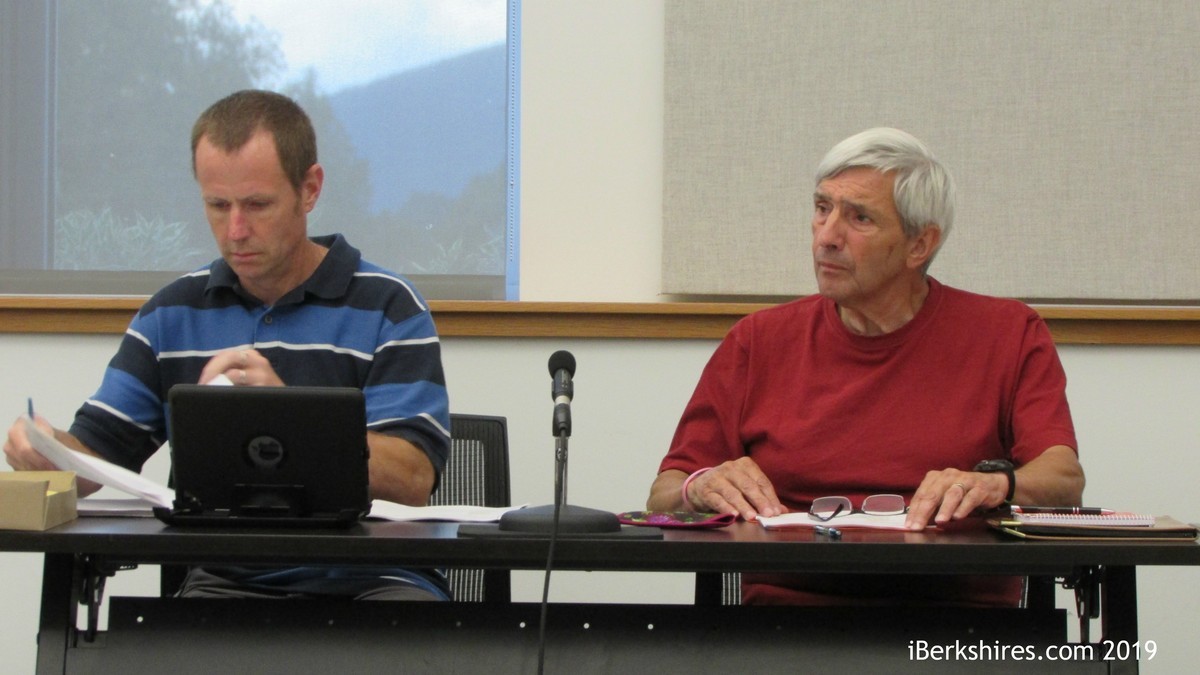
Field Debate Causes Friction on Mount Greylock Committee
WILLIAMSTOWN, Mass. — The Mount Greylock School Committee on Thursday discussed questions that were raised about the plan to install an artificial turf field at the middle-high school — including concerns raised by members of the committee itself.
But one committee member and strong advocate for maintaining the course that was agreed upon earlier this spring said the time for asking questions is over.
Chairwoman Regina DiLego penciled a discussion into the agenda of Thursday's monthly meeting so that the committee could reflect on the feedback garnered at a July forum on the issue. Numerous residents at the forum expressed concern about the environmental and health impacts of the field — particularly its crumb rubber infill made from recycled tires.
On Thursday, three members of the seven-person panel said they still had unanswered questions about the proposed field, which would be used for physical education classes and the school's interscholastic soccer, lacrosse and (currently dormant) football programs.
School Committee member Alison Carter, who is on maternity leave, did not attend Thursday's meeting but submitted her reaction to the forum to DiLego in writing. DiLego read the comments aloud for their colleagues.
Carter said there were a number of unanswered questions that made her "uncomfortable with moving forward."
"We cannot rule [the toxicity of crumb rubber] out, and being wrong about this could have a detrimental effect on our students," Carter wrote. "I'm not comfortable with the risk."
Carter also raised issues about the impact on the environment and the potential long-term cost of disposing of crumb rubber and replacing both the rubber and the synthetic "grass" down the road when it wears out.
Committee member Christina Conry later said she shared some of the same concerns raised in Carter's letter.
"I didn't know we were going to do this tonight," Al Terranova said after DiLego read Carter's thoughts.
"We keep going over this and over this and over this again ... I received 18 emails [after the forum]. I responded to the first two. Then the same emails started coming. Of the 18 I received, 17 of them started out by apologizing that they didn't go to the forum. If they didn't go to the forum, they didn't get both sides of the issues, including Ali [Carter]."
"Ali was there," DiLego replied.
"All the questions she asked were answered," Terranova continued. "I don't know what they want us to say. I'm befuddled what else they want us to say ...
"I'm thoroughly convinced artificial turf is the way to go. I don't want to be glib about this. The idea that playing soccer on an artificial field is going to produce cancer 20 years down the road? There's no proof that that's true."
The committee's newest member, Jamie Art, said he appreciated that the July 30 forum largely was free of rancor, and he said there are a lot of unknowns in the complicated questions about environmental impacts of artificial turf fields.
Art then brought up a question that was not raised at the forum: Whether the toxic chemicals in crumb rubber could run off the artificial turf field and find their way into the wells that supply drinking water at the middle-high school.
"We have a situation where we have past experience that our water supply is susceptible to chemical contamination from recharge on site," Art said. "One concern I have as a School Committee member is that whatever we do with the fields — whether improving the natural grass or going toward an artificial turf field — doesn't jeopardize our drinking water. I think we have to put that concern foremost."
Mount Greylock Superintendent Kimberley Grady emphasized the drinking water at the middle-high school is tested daily. Current water runoff from impervious surfaces is directed away from the well site, she said, and she would confirm that the same runoff plan would apply to the proposed artificial turf field.
Terranova said he was working hard to "contain himself" in the face of repeated challenges to the district's Phase 2 subcommittee, which brought forward the recommendation to install an artificial playing surface.
"It's really frustrating to listen to things that we go over and over again and bring up things that I think are red herrings," said Terranova, who serves on the Phase 2 subcommittee. "Whenever we answer a question, another question comes up. It's hard for me to sit here for three years listening to the same arguments.
"No one knows what's going to happen with the environment 15 years from now. We can't tell you that 15 years from now the water quality at Mount Greylock is going to be great. … We can only tell you we've studied this, we've asked pointed questions to a competent consultant. I don't know what else we can do to convince you this is the best thing we can do for our students and the community.
"It seems to me that no matter what answer we come up with there are some people who will never want us to have an artificial turf field."
Art did not place himself in that category, but said he was looking forward to getting more clarity on the financial impact of a turf field — short term and long term — after the district hears responses to the request for proposal that the School Committee agreed in May to issue.
On Thursday, Phase 2 Subcommittee Chairman John Skavlem told the committee that the project will go to bid on Aug. 21 and that the district could expect to have hard numbers to consider by Sept. 4.
Skavlem also said his subcommittee is developing an FAQ to address questions raised at the July forum and elsewhere in the community. He also sought Thursday to put one of those questions to rest.
It has been suggested by some in the community that the district's consultant, Traverse Landscape Architect, is pushing the district to invest in an artificial turf field.
"That's not the case," Skavlem said. "They have no vested interest in whether it's synthetic or grass. [Traverse's Arthur Eddy] pointed out that his company pushes harder against the synthetic turf industry than most in terms of making sure they're safe. … And he does more grass fields than synthetic turf fields."
School Committee member Dan Caplinger, who serves with Terranova and Skavlem on the Phase 2 Subcommittee, said he was disappointed that members of the full School Committee seemed to want to do a de novo review of the work done by the Phase 2 group.
He likened it to work done by the School Committee's Negotiations Subcommittee, which pores over hundreds of pages of contracts. The full committee may ask some questions but it does not seek to start from scratch when presented with a recommendation from the negotiations group.
Steven Miller said the Phase 2 subcommittee's development of an frequently asked questions sheet would help to address concerns both from committee members and the general public.
In other business, Caplinger reported from the district's Phase 1 subcommittee, which is looking at how to address building needs not covered by the state-funded addition renovation project at Mount Greylock.
Caplinger reiterated that the Phase 1 panel had explored every off-campus site it could identify and returned to the same conclusion that the best solution for the district is to build on campus to replace the district central office space, cross country ski wax room and interior storage lost in the demolition of the old Mount Greylock.
In the wake of a bid process on a new building that resulted in higher than anticipated bids, the Phase 1 subcommittee now is recommending the district look at two structures: one for the district offices, storage of "attic stock" that will meet the needs of the middle-high school and, potentially, public restrooms to serve the school's athletic facilities and a second building to house outdoor equipment (riding lawnmowers, etc.) and the waxing room.
As with the first iteration of bids for a multi-purpose building on the campus, the new proposal would include public restroom facilities as an "add alternate," Caplinger explained. At the very least, the new building would be designed with space and plumbing hookups for restrooms. If porcelain fixtures fit within the budget, they could be included, or the actual facilities could be added at a later date when funds are available.
Both the athletic fields upgrades and the multi-purpose buildings are expected to be paid for with proceeds from a $5 million capital gift given to Mount Greylock by Williams College at the outset of the addition/renovation project.
• The School Committee also Thursday held a formal reorganization in light of this summer's resignation of former Chairman Joe Bergeron. DiLego was elected to chair the panel with Caplinger serving as vice chair and Miller as secretary.
• The committee voted 6-0 to approve fund-raising plans for Lanesborough Elementary School's annual sixth-grade trip to Cape Cod and voted to accept a $5,000 gift from the Alice Shaver Foundation that will be used to support academic programming at the middle-high school.
• The School Committee also heard a report from Mount Greylock Director of Athletics and Co-Curricular Activities Lindsey von Holtz, who reported that extracurricular participation continues to be strong at the middle-high school, where 80 percent of the students do something after school and 68 percent participate in interscholastic athletics.
Von Holtz also reported back on the results of last spring's decision to open up the baseball program to students in seventh grade. Initially, she had restricted it to grades eight and up, but after pushback from parents, the district allowed all students at Mount Greylock to try out for the team.
That resulted in 37 players total — 15 on varsity and 22 on junior varsity.
"Twenty-two was a little high," von Holtz said, alluding to the reasoning behind her initial decision to limit it to students in the upper five grades.
"At home games, all 22 participated. At away games, 17 participated. Sometimes, that was determined by who was injured or sick on that day. Coach and I agree that there were probably just a couple too many who were on the team."
Von Holtz said five seniors graduated from the 2019 baseball team, which means that the school may find itself having the same discussion this winter about maximizing eligible participants without reducing the playing time for those on the team.
Tags: MGRS, turf field,