Mount Greylock School Committee Rejects Fields Bid, Reposts
Updated Friday morning to clarify the add alternates that the School Committee decided to include in a new RFP.
WILLIAMSTOWN, Mass. — The Mount Greylock Regional School Committee decided Thursday night not to take a leap of faith.
By a vote of 6-1, the committee rejected the low bid submitted for an athletic fields project after the price tag came in far higher than the committee expected when it authorized a request for proposals in May.
On Monday, the subcommittee steering the fields project — acting on the advice of the district's consultant, Traverse Landscape Architect — believed that the district had an option to extend the bidding process and engage all three qualified bidders in a discussion about value engineering options to reduce the project's cost.
By Thursday, officials learned that the "Option 3" considered by the Phase 2 Subcommittee was, in fact, not an option at all under the commonwealth's procurement law.
That left the School Committee with two alternatives: Accept a $2.85 million bid from the Clark Companies or reject that bid and put the project out to bid again.
Traverse was correct in one of the options it gave the subcommittee in a memo dated Sept. 22. The district could have chosen to accept the $2.85 million bid and work with Clark to bring the final cost down by up to 20 percent — a percentage that, in theory, would have brought the project in at a number close to the $2.3 million estimate Traverse gave the district in the spring.
But, as was noted by Phase 2 Subcommittee Chairman John Skavlem on Monday, that would have required a "leap of faith." The district would have been on the hook for the full $2.85 million if no such reductions were agreed to after the bid was accepted.
Clark's director of design and construction, James Catella, addressed the School Committee on Monday during its public comment period and indicated that the contractor had savings in mind that could be applied to the project.
"We have a number approaching $300,000 in value engineering savings to pass along that doesn't mean eliminating [elements of the project]," Catella said.
For the record, that $300,000 alone would have brought the project's cost to $2.55 million — still about $250,000 above the Traverse estimate.
In the end, Catella's assurances were not enough to sway the majority of the committee.
"At no time, do I remember us talking at the full School Committee level about $2.8 million being available [for the project]," said Dan Caplinger, who represents the School Committee on the Phase 2 Subcommittee. "That weighs on my mind against taking on a legal responsibility for that number, absent more assurance about what the [reduction] process is.
"I always thought a bidding process meant you'd bid what you want to bid. … I'm confused why a bidder wouldn't just bid a low number at the beginning."
Traverse architect Arthur Eddy, who has advised the Phase 2 Subcommittee throughout the process, responded via conference call.
"What [Clark's Catella] is recommending is a value engineering change," Eddy said. "They're saying they think they can do this less expensively with different materials, whatever that may be. He's recommending a change in the scope of work as part of the value engineering process."
Caplinger wasn't persuaded.
"That doesn't change the fact that, in some ways, you'd prefer to that conversation in the opposite direction: Agree to what you want to cut and then take on the legal responsibility to pay for it," Caplinger said.
At about that point in the 3 1/2-hour meeting, Superintendent Kimberley Grady interrupted to inform the committee that the district had been put on notice of a potential bid protest related to the fields project.
Grady said that earlier Thursday she received a voicemail from the president of the Berkshire Building Trades Council.
She said she was not informed of the nature of the potential protest, and she had no familiarity with how bid protests work, as the district did not face one over the course of the recently completed $64 million addition/renovation project.
It was not immediately clear whether the potential protest was related to the aborted "Option 3" plan recommended by Traverse Landscape Architects.
Al Terranova, who serves with Caplinger on the Phase 2 Subcommittee, was the lone holdout on the question of whether to reject the $2.85 million bid. Terranova continued his passionate defense of the work of the subcommittee in the face of months of discussion throughout the community about whether the fields project should include an artificial turf multipurpose field.
"If we're going to reject the bid, we have to have something to do," Terranova said. "We better have some plan. … Let's get going. We're barreling into October, and we still don't have a decision."
"So, we should go with a bid that's several hundred thousand dollars more than what this committee authorized so we can barrel ahead?" School Committee Chairwoman Regina DiLego asked Terranova.
"Yes," he answered.
Mount Greylock Assistant Superintendent of Business and Finance Andrea Wadsworth told the committee that the new bid could go on the central register as early as Oct. 10, with a deadline for new bids as early as Oct. 28.
Wadsworth said that such a schedule could line up the field bid deadline with the deadline for a multipupose building that the School Committee voted unanimously to put out to bid earlier in Thursday's meeting.
The multipurpose building and the fields project both are initiatives that the School Committee wants to fund with proceeds from a $5 million capital gift the Mount Greylock district received at the start of its building project.
On Thursday, the School Committee decided to send a scaled down version of the multipurpose building out to bid with an estimated price tag of $2.1 million.
The third identified use for the "Williams gift" is the preservation of a reserve that could be tapped for future capital expenses, like, say, new boilers or a new roof. The original $5 million gift has appreciated in time as part of the college's endowment. On Thursday, a School Committee member off-handedly referred to its current value as closer to $6 million.
The final vote to reject the Clark Companies bid — Terranova's strenuous objection notwithstanding — actually was less contentious than a subsequent vote related to the fields project.
On a vote of 5-2, the School Committee voted to charge the Phase 2 Subcommittee with creating an altered RFP that not only puts value engineer savings into its original plan but leaves the door open for a natural grass field on the site where the original plan envisions a synthetic turf field.
Jamie Art, the newest member of the School Committee, moved that the charge to the Phase 2 Subcommittee be that the revised RFP be constructed as follows: the base is to bring the middle-high school's fields into compliance with Title IX and the Americans with Disabilities Act, and the new field -- either grass or artificial turf -- and eight-lane track be included as "add alternates."
The track was an add alternate in the first RFP.
"I just think we owe it to the communities before we spend $2.3 million out of the endowment fund and commit ourselves to every eight to 10 years spend another $450,000 [to replace the artificial turf as it reaches the end of its useful life], to consider all the options," Art said.
Art was joined by committee members Caplinger, DiLego, Christina Conry and Alison Carter in voting for that plan.
Terranova and Steven Miller voted against Art's motion, choosing to keep the second RFP largely the same as the first, with the artificial turf field part of the project's minimum expectations.
Skavlem, whose Phase 2 Subcommittee met in a joint meeting with the School Committee on Thursday night, was visibly distressed by the vote to give that direction to the subcommittee.
"You voted to kick the can down the road, and you let the students down," Skavlem said.
Caplinger disagreed.
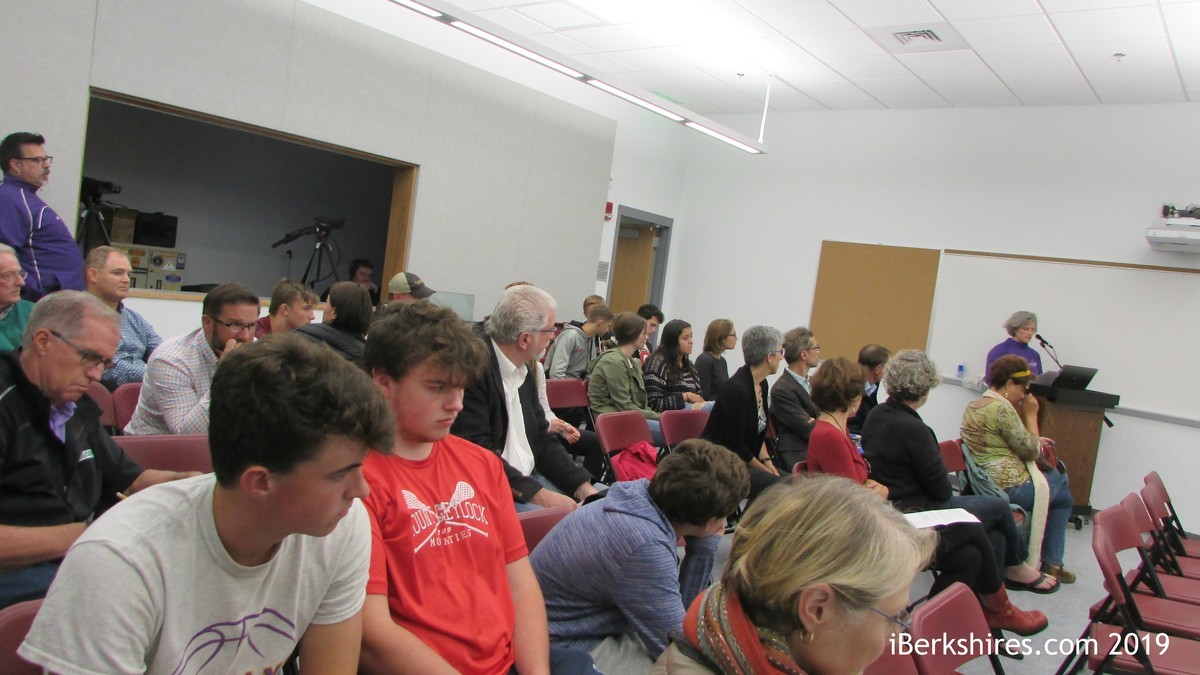
Alluding to an ongoing community conversation about the artificial turf that included 30 minutes of public comment by 10 local residents prior to Thursday's meeting, Caplinger said he thought looking at a grass option at this point will help ensure the public that the School Committee is getting all of the information it needs to make a decision.
"I don't think we kicked any can down the road," Caplinger said. "The process is going to happen concurrently with [the value engineering] you're already going to do.
"I don't think it slows things down terribly a lot. We're already at the time of the year where the slippage is not going to be relevant. We get these answers, and it appeases members of the committee who have their doubts. I, at least, am confident it will resolve those doubts, and we'll have a smoother process going forward that people outside this room will understand better than if we went the other way.
"I hear Al's frustration. But I don't share it."
Terranova said he didn't mind ruffling feathers if the district could get the artificial turf field he believes will provide the most benefit for the greatest number of students.
"I'm not particularly interested in getting the committee to get along," he said. "If we vote 5-2 or 4-3, that's what it is.
"The information I get against artificial turf is from people not working with students and not playing on the fields."
Tags: bidding, MGRS, playing fields, turf field,