Berkshire Delegation Tells Nonprofits: State Budget in Limbo
PITTSFIELD, Mass. — What is most striking about the fiscal 2021 budget discussions in Boston is how little is known by those in the know.
But what they can say does not sound good.
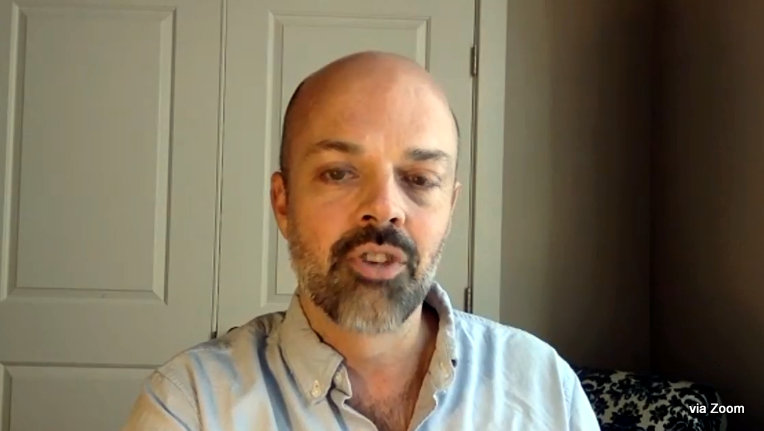
"We had essentially nine experts on Tuesday giving us their forecasting," Sen. Adam Hinds, D-Pittsfield, said on Friday morning. "I'd say the consensus there was our budget for fiscal '21 will be down between $4 [billion] to $5 billion. And, of course, that's based on current forecasting, so it's, honestly, still unpredictable."
Hinds joined Berkshire County's four members of the state House of Representatives for an hourlong webinar hosted by the Nonprofit Center of the Berkshires.
Moderator Stephanie Bosley, a member of the center's board, said the budget was one of the top questions raised by the local non-profit community, much of which depends on various grants and financial support from Boston.
Hinds, who chairs the Legislature's Joint Committee on Revenue, said it will be months, at least, before the commonwealth has a clear picture of projected FY21 revenues. In a normal year, the House would be finishing up its version of the budget this week, and the Senate would be deciding its spending plan in May.
"What I found useful [Tuesday] was they were starting to put a horizon that we could start to judge ourselves against," Hinds said of the virtual roundtable hosted by the state Senate and House Ways & Means chairmen. "Might it be the case that by July we're starting to see some return to normalcy? That's where a lot of their predictions were based. And, of course, that depends on restrictions being lifted in the social and economic sphere.
"That being the case, I think we would start to say how much of that support are we going to receive from the federal budget, the federal stimulus?"
Massachusetts already is on track to receive $2.6 billion in unrestricted aid from the federal government, Hinds said. U.S. Rep. Richard Neal, D-Springfield, the chairman of the House Ways and Means Committee, is talking about a second stimulus package in the neighborhood of $1 trillion, nationwide, Hinds said.
State Rep. John Barrett III, D-North Adams, who serves on the House Ways and Means Committee, echoed Hinds' point about the importance of the federal government's actions in clearing up the state's fiscal picture.
"We really have to wait to see what kind of federal money we're going to be able to get from Congress, from the Trump administration as to what they're going to put into the state to help us make up the spending," Barrett said. "We're fortunate we have a $3.6 billion [rainy day fund], but it's not looking like much of a surplus when we get done with that.
"I wish I could tell everybody today that I know what's going on. This is actually one time when Ways and Means has been kept relatively informed of the process. And there's nothing for them to tell us. They're working on a budget on both sides of the Senate and the House, and we're getting no clear direction right now because I don't think they have any clear direction.
"It all depends on the federal money and how much we're going to be reimbursed."
And there are priorities for some of that federal aid directly related to the response to the COVID-19 pandemic, Barrett said.
"A lot of that federal money is going to go to the community hospital here in Berkshire County as well as Baystate [Medical Center] and other hospitals around the state because they're taking it on the chin," he said. "Some are saying they're taking up to $20 million a month in losses.
"We've got problems."
One problem foreseen by state Rep. William "Smitty" Pignatelli, D-Lee, is the inability to have an effective budget discussion on Beacon Hill when legislators are not able to meet.
Pignatelli said he has recommended to the leadership in the Legislature that state government institute a 1/12th budget mechanism to allow the state budget to operate on a month-to-month basis when the fiscal year begins on July 1. He would rather hold off on addressing the full budget until the fall.
"I think it's almost impossible to have the Zoom call, voting by proxy with 160 state reps," Pignatelli said. "I think it will be a challenge for 40 senators to do the same thing. The ability to debate and lobby and negotiate what's important to our respective districts is very difficult from 150 miles away.
"And I would say the same for my colleagues down on the Cape. I really believe that in fairness for all of us in the Legislature and in the spirit of transparency, I really think it's critically important that we put a pause on the state budget, put us on a 1/12th — it's going to be pared down. … I think it's going to be a difficult budget under normal circumstances, but I think in fairness to all of us, the need to be there and participate … let's wait until after the November election to do that."
State Rep. Tricia Farley-Bouvier, D-Pittsfield, amplified Pignatelli's point about any short-term spending plan being "pared down."
"Along with the 1/12th issue, it would be multiple 1/12th budgets that we'd have to do," she said. "And it's not 1/12th the FY20 budget. People are using the words 'bare bones' budgets.
"For people, particularly on this call, it's really distressing because we don't know what we'll be able to fund. To put what's essential on that list is going to be really difficult. I think it's important for all of us on this call and through the delegation to be able to get the message that arts and culture are our economy here."
That's why the Nonprofit Center of the Berkshires put together Friday's webinar, one it hopes to try to duplicate next month.
"The nonprofit sector in the Berkshires employs a quarter of the Berkshire workforce and has a huge impact on our local economy," Bosley said. "Given the COVID-19 outbreak, the Nonprofit Center of the Berkshires felt like it was important to host a town hall with our [legislative] delegation."
Tags: COVID-19, state budget,
More Coronavirus Updates