Baker: Expect 'Forceful Guidance' on Business Reopenings
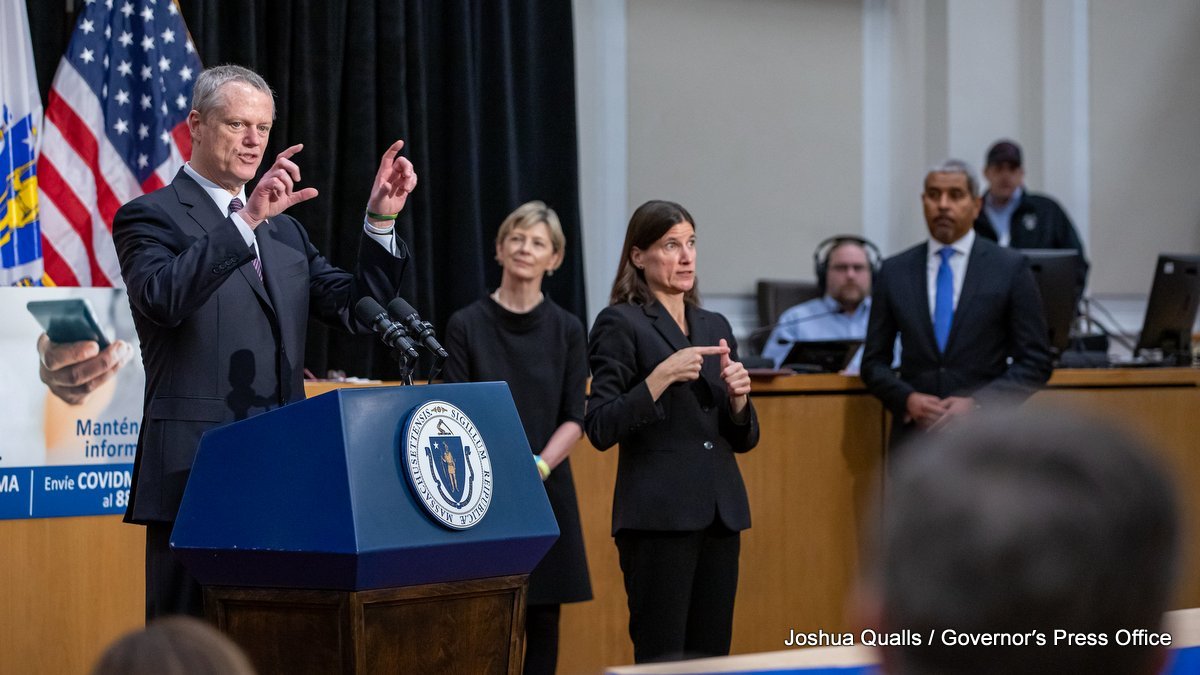
BOSTON — Officials, health experts and business leaders are trying to envision what a "reopened" Massachusetts might look like. But Gov. Charlie Baker says it's too soon to be thinking of putting any new rules into effect.
"We need to be on the other side of the curve before we do any of this stuff," he said at Wednesday's daily update on the novel coronavirus pandemic. "And then the question becomes what are going to be the rules, how are they going to work."
The state is in the midst of what is being described as a "surge" in cases of COVID-19, the highly contagious novel coronavirus that has killed more than 45,000 Americans and nearly 2,000 Bay Staters. Since mid-March, gatherings of more than 10 have been prohibited, industries deemed non-essential have been closed at least until May 4 and residents have been advised to social distance and wear masks to contain the disease.
Once those cases peak and begin to decline, officials say they can start talking about phasing a restart of the economy — with the knowledge that a second or third wave of the pandemic is likely. Schools have been closed through the end of the academic year but educators are considering what will have to be in place for them to open in the fall.
Baker referred to a question asked at Tuesday's briefing on whether the May 4 date would hold and how the state would look at essential versus non-essential. He noted he had answered it was less about date and type and "more about what we would describe as the rules of the road for reopening."
"I think those rules will be relatively relatively uniform and comprehensive at a certain level and then they're going to be defined a little more narrowly depending upon what kind of space or industry you're talking about," he said.
The governor said his administration — including Secretary of Health and Human Services Marylou Sudders and Secretary of Housing and Economic Development Michael Kennealy — have been in discussions with business leaders on the path forward.
A number of global corporations operate in the Bay State and are providing some ideas of how they are doing businesses in other parts of the world.
"But I think the way people ought to start thinking about this is a little less about essential and non-essential and a little more about, you know, what are the criteria that would make it possible for the business to open up, what's the context, right the prerequisite," Baker said. "We've talked about a variety of different mechanisms that states have come up with and that the federal government has proposed with respect to how you get to the point where you believe you're on the other side of the curve."
He added that "there will be guidance, and in some cases probably pretty forceful guidance, around what the rules should look like. And then, and then within that people are gonna have to figure out if they can comply with it."
The governor reiterated numerous times that nothing will happen until the state gets "over the hump" of the pandemic's spread and has enough testing to aid in its containment.
Nearly 4,000 patients are currently hospitalized with COVID-19 but the state appears to have enough beds should that rise, with 56 percent of the 18,000 beds mobilized now unoccupied. The number of tests have risen to more than 6,000 a day with a total statewide of about 175,000 tests done of which more than 41,000 were positive. The state is also investing heavily in contact tracing with Partners in Health to track the coronavirus spread.
"We now have more than 30 partners that are testing each day, Massachusetts remains a national leader in per capita testing and we're continuing and committed to building on this work," Baker said, adding that more testing sites will be coming online at community health centers in hot spots around the greater Boston area. "Today more than 30 community health centers are participating in the community tracing collaborative working with us to trace contacts and the neighborhoods in the cities and towns that they know so well. ...
"Over time, tracing is critical to helping us understand the spread of the virus and helping us return to the new normal."
"One of the major reasons why distancing, and why staying at home, and why dealing with the consequences of all this is so important is because this is not like the flu," the governor said. "If you get the flu, you know, and everybody else knows it. But when it comes to this particular virus. There are a number of people who get it, who don't know it."
Responding to questions about how other New England states may be partially reopening, Baker said he's spoken with neighboring governors about pointed out how some are ahead of Massachusetts in the surge cases.
"Those those six New England states are all in different places with respect to the surge," he said. "I think one of the reasons we want to be sort of regional in our dialogue and our discussions around this stuff is so that people don't surprise us with the decisions that they make."
That was the reason for joining the larger Northeast coalition, Baker said, to keep abreast of the status of the different states and what their next moves are so no one is surprised. He declined to expand on a comment about doing "whatever we need to do to make sure that we keep people this weekend in Massachusetts" should New Hampshire allow certain businesses to open or if that would mean travel restrictions.
"I don't want to speculate on that at this time we're going to put together a reopening group of our own," he said, and that it could have talks with the reopening teams neighboring governors have put together.
He acknowledged that the stay-home advisories and social distancing have caused disruption and angst across the state but asked citizens to stay the course. He referred to a story about a Whole Foods worker in Swampscott — "an amazing man with a beautiful family" — who died of COVID-19 as an example of the front-line workers putting their lives in danger every day.
"It's part of what makes this virus so insidious, it's so difficult and why I get so passionate when people start talking to me about why we can't do this, that or the other thing," Baker said. "We're trying to do the best we can to try to keep people safe."
Tags: COVID-19,
More Coronavirus Updates