WESTBOROUGH, Mass. — The state Division of Fisheries and Wildlife has documented more than 70 active bald eagle nests throughout Massachusetts this spring, indicators that the population continues to grow.

MassWildlife has seen a dramatic uptick in newly documented eagle nests and has confirmed nine new nests in Fitchburg, Wenham, Concord, Rutland, Wareham, Medford, Northampton, Hudson, and Barnstable.
The new Barnstable nest marks the first nest with eggs on Cape Cod in 115 years; the last was in Sandwich in 1905.
Eagles have been sighted along the Hoosic River and nesting pairs around Cheshire Reservoir and Pontoosuc Lake.
As the eagle population continues to grow, new challenges emerge as pairs try to establish new territories. For instance, this spring marked the first documented case of eagles nesting on Martha's Vineyard. An eagle pair took over an osprey nest and were incubating eggs when the ospreys returned from their wintering grounds. The osprey pair that most likely built the nest harassed the incubating eagle who would flip upside down with its talons in the air in defense.
Eventually the eagle cracked the eggs doing this, and this historic nesting attempt failed.
Two other eagle nests on the mainland have also failed as a result of an intruding eagle invading the territory and killing the chicks in the nest. Although difficult for observers to witness, these events are all signs of a thriving eagle population in Massachusetts.
On the upside, more and more people across the commonwealth are experiencing the thrill of seeing eagles in their own neighborhoods as these birds continue to expand their range to urban and suburban landscapes. Because of successful conservation measures, the status of the bald eagle recently improved from threatened to special concern on the Massachusetts Endangered Species Act list.
In related news, New Hampshire confirmed a new state record for its oldest bald eagle, a bird that hatched in Massachusetts. This eagle, identified by a gold leg band coded "W84," was photographed this spring in New Hampshire. Banding records indicate this 23-year-old male hatched at the Quabbin Reservoir in Ware in 1997 and it had been recorded nesting in New Hampshire between 2007 and 2014. The previous New Hampshire record holder was a 19-year-old bird that had also hatched in Massachusetts.
It is safe to say the eagle reintroduction program that MassWildlife conducted in the 1980s has not only reaped benefits in Massachusetts, but throughout New England.
Want to get involved? You can support the conservation of bald eagles and other rare species in Massachusetts by reporting sightings and donating to MassWildlife's Natural Heritage and Endangered Species Program.
If you would like to contribute information on this article, contact us at info@iberkshires.com.
Your Comments
iBerkshires.com welcomes critical, respectful dialogue. Name-calling, personal attacks, libel, slander or foul language is not allowed. All comments are reviewed before posting and will be deleted or edited as necessary.
No Comments
Social Service Organizations Highlight Challenges, Successes at Poverty Talk
By Brittany PolitoiBerkshires Staff
Dr. Jennifer Michaels of the Brien Center demonstrates how to use Narcan. Easy access to the drug has cut overdose deaths in the county by nearly half.
PITTSFIELD, Mass. — Recent actions at the federal level are making it harder for people to climb out of poverty.
Brad Gordon, executive director of Upside413, said he felt like he was doing a disservice by not recognizing national challenges and how they draw a direct line from choices being made by the Trump administration and the challenges the United States is facing.
"They more generally impact people's ability to work their way out of poverty, and that's really, that's really the overarching dynamic," he said.
"Poverty is incredibly corrosive, and it impacts all the topics that we'll talk about today."
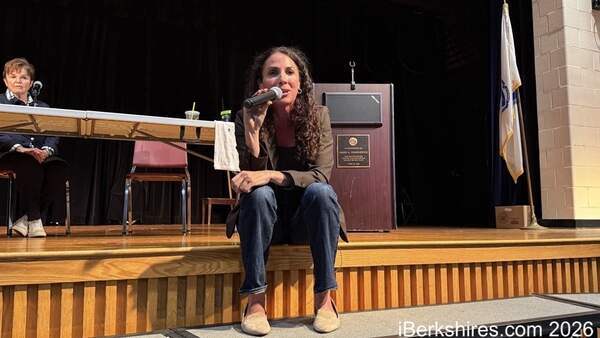
His comments came during a conversation on poverty hosted by Berkshire Community Action Council. Eight local service agency leaders detailed how they are supporting people during the current housing and affordability crisis, and the Berkshire state delegation spoke to their own efforts.
The event held on March 27 at the Berkshire Athenaeum included a working lunch and encouraged public feedback.
"All of this information that we're going to gather today from both you and the panelists is going to drive our next three-year strategic plan," explained Deborah Leonczyk, BCAC's executive director.
The conversation ranged from health care and housing production to financial literacy and child care. Participating agencies included Upside 413, The Brien Center, The Food Bank of Western Massachusetts, MassHire Berkshire Career Center, Berkshire Regional Transit Authority, Greylock Federal Credit Union, Massachusetts College of Liberal Arts, and Child Care of the Berkshires.
The federal choices Gordon spoke about included allocating $140 billion for the U.S. Immigration and Customs Enforcement, investing $38 billion to convert warehouses into detention centers, cutting $1 trillion from Medicaid over 10 years, a proposed 50 percent increase in the defense budget, and cutting federal funding for supportive housing programs.
Gordon pointed to past comments about how the region can't build its way out of the housing crisis because of money. He withdrew that statement, explaining, "You know what? That's bullshit, actually."
"I'm going to be honest with you, that is absolute bullshit. I have just observed over the last year or so how we're spending our money and the amount of money that we're spending on the federal side, and I'm no longer saying in good conscience that we can't build our way out of this," he said.
Upside 413 provided a "Housing Demand in Western Massachusetts" report that was done in collaboration with the University of Massachusetts at Amherst's Donahue Institute of Economic and Public Policy Research. It states that around 23,400 units are needed to meet current housing demand in Western Mass; 1,900 in Berkshire County in 2025.