State Grant Program Should Help Local Food Producers
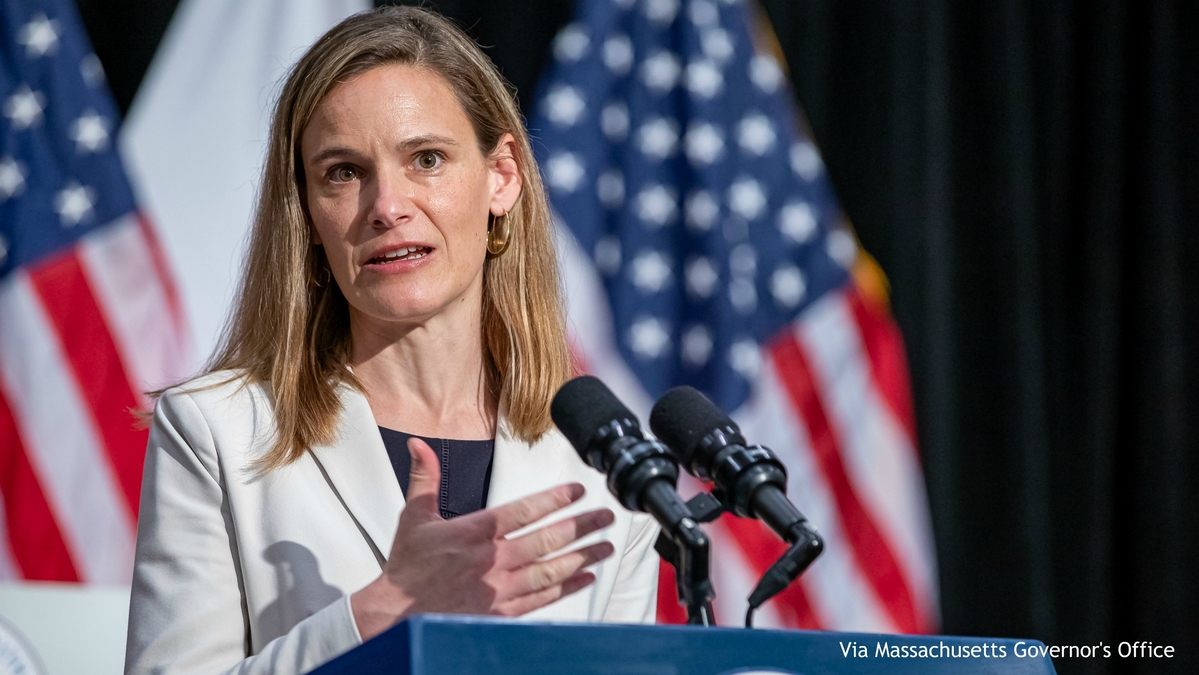
Secretary of Energy and Environmental Affairs Kathleen Theoharides talks about the state's new Food Security Infrastructure Grant Program.
So she was glad last month when Beacon Hill followed suit.
As part of its overall response to the COVID-19 pandemic, the administration of Gov. Charlie Baker recently announced $36 million in grants to build up the commonwealth's "food security infrastructure."
"The grants will fund investments in technology, equipment, increased capacity and other infrastructure to help producers distribute food, especially to food insecure communities, with a focus on addressing unique challenges in gateway cities, rural communities and other hard-hit areas," Secretary of Energy and Environmental Affairs Kathleen Theoharides said last week.
"The Baker-Polito administration is committed to supporting our farming and fishing families while helping families throughout the state access fresh, local food."
That sort of talk is encouraging to people like Gardner, currently the chair of Williamstown's Agricultural Commission.
"I think the grants could help," she said last week. "They could help bring more land into cultivation. They could help with season extension — a hoop house or something like that which could help earn money earlier in the season. It could help someone set up web platforms and get the infrastructure they need to do deliveries or online ordering or pickup. Maybe it will help them purchase more seed and buy more land or lease more land.
"The wonderful thing about the grant is it's giving money to the supply and the demand side."
The new grant program will provide recipients up to $500,000 apiece. Eligible recipients include farmers, fishermen, retailers, food pantries and distributors.
"Increasing food security is essential to protecting the health of the people of Massachusetts," Baker said during an appearance with Theoharides. "Our goal is to use this funding to meet a greater demand for nutritional assistance among vulnerable populations and those struggling with the economic impacts of the pandemic."
Local farmers are not immune to those economic impacts.
The anchor of Berkshire County's farm economy, the dairy sector, already was impacted by a huge drop in exports to China because of a two-year trade war with the Asian power. Those farms and other producers then were hit hard by the loss of restaurant and food service contracts when eateries and schools were closed in mid-March.
Then there is the systemic issue of development pressure that continues to eat away agricultural land throughout the commonwealth.
"Municipalities are largely responsible for land use decision making, and municipalities' budgets are primarily dependent on local property taxes," Gardner said. "Municipalities want to increase their revenue, so there's a tendency to favor development which increases tax revenue. Farming — people don't really consider it as a business.
"When the next farm goes out of business in Berkshire County, it's going to go up for sale, and it might be bought by a developer who wants to put in a subdivision, and there's nothing in place to stop that from happening. Most towns are going to want a subdivision because they're hurting financially, and they want that revenue. And you can understand why."
Gardner said the commonwealth needs statewide farmland planning to protect prime farmland from being lost forever to development.
"I know how people interpret that statement," she said. "They think that that's anti-housing. But we know we can do smart, high density development in areas not on prime farmland."
Gardner knows the 1966 Home Rule legislation that puts the land-use regulation power in the hands on municipalities is not going anywhere. In the meantime, she hopes programs like the Food Security Infrastructure Grant Program will help Massachusetts farmers deal with the hand they are dealt.
Theoharides said the grants are intended to build up the food system's capacity into the future.
"I think the other thing is with the resiliency fund, we're looking to help right now in this current crisis but also to scale beyond this so that we're looking at investments that will help now but also help build resiliency for the future," she said. "I do think the projects that are going to be scored well in this grant process will help now and help in the longer term as well."
Theoharides last Tuesday said she expected the applications for the grants to be posted in early June.
Gardner, who produced the documentary "Forgotten Farms" in 2016, said she does not know for sure of any Berkshire County farmers who would be applying under the program. But farmers stand to benefit wherever the grant money is allocated because programs that help food pantries allow them to be customers for local farms.
"That's where the grant could be helpful — in establishing new relationships," she said. "There's so much attention on local agriculture right now, and that's a good opportunity. This grant funding coming out is really helpful. Hopefully, it's enough. Hopefully, we can create some real new relationships that can help our farmers not just exist but thrive.
"That is the key. If farming isn't financially viable, people won't keep farming. They can't afford to keep losing money every year."
Tags: agriculture, farming,