Williamstown's Meeting Under the Lights Passes 'Light Plant' Proposal

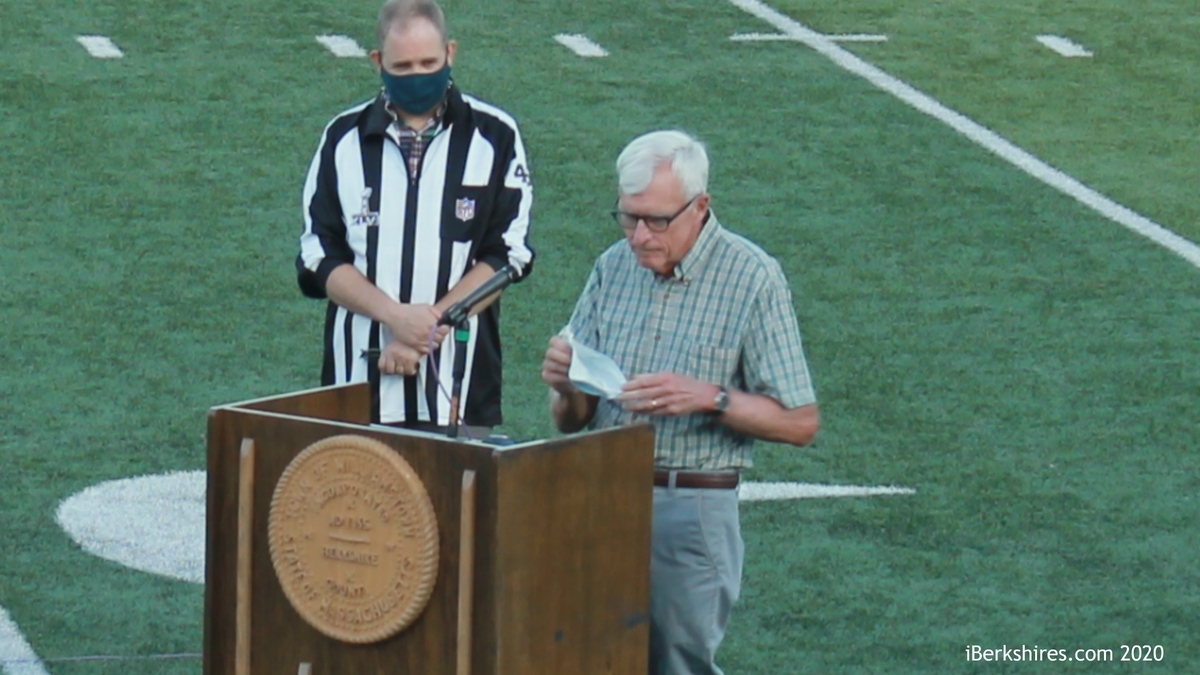
Moderator Adam Filson puts on a referee's jersey at his podium on the 40-yard-line of Williams College's Farley-Lamb Field on Tuesday evening.
As members left the outdoor annual town meeting at Williams College's athletic complex, they were asked to deposit secret ballots with their vote on Article 21, which came about halfway through the 37-article warrant of a meeting that ended up lasting nearly four hours.
Town Clerk Nicole Pedercini reported that the vote — like most town meeting actions — was a landslide, with 271 voters approving and nine voting against.
That means the town can proceed to look at the idea of creating a public utility to provide broadband service to residents and businesses.
By state law, such a utility — anachronistically called a municipal light plant — requires passage by two ballot votes spaced not fewer than two months and no more than 13 months apart.
The town meeting members Tuesday also approved $85,000 for further study of whether the town should pursue municipal broadband. Based on those studies, the question answered on Tuesday night could be back before the town in May 2021 for a final ratification.
Three hundred and sixty registered voters checked in to Tuesday's annual town meeting, delayed from its traditional May date and moved outside due to the COVID-19 pandemic.
Most hung on at least through the resolution of two heavily contested articles proposed to regulate recreational marijuana, numbered 33 and 34 on the 37-article warrant. Though it was noted at Wednesday's meeting of the town's Diversity, Inclusion, Race and Equity Committee that a number of members departed the 7 p.m. meeting at around 10:30 after both pot bylaws were defeated but before the meeting considered a pair of articles, Nos. 36 and 37, addressing issues of social justice.
Most of the meeting, despite the unique surroundings, had a familiar feel for regular attendees of the town gathering: routine consideration and quick passage of the town's spending articles followed by in-depth and sometimes passionate debate about proposals to amend the town's zoning bylaw.
The meeting's business began with a vote on 17 articles in a consent agenda that Town Moderator Adam Filson ruled to be unanimous.
That was followed by Article 18, which dealt with the nearly $8 million outlay for general government.
Bill Densmore suggested from "the floor" (actually the platform at the bottom of the Farley-Lamb Field bleachers) that Article 18 was the right place to have a discussion of last week's news that an officer in the Williamstown Police Department had filed a lawsuit in federal court against the town for unspecified damages claiming discrimination and retaliation against a whistleblower.
"I'd rule that out of order," Filson said, referring to the discussion in the context of the budget article. "There will be opportunities later on to ask specific questions."
Densmore said he would ask for a vote on that ruling unless Filson assured him there would be time to discuss the issue later in the meeting.
"You're welcome to bring it up later," Filson said.
Although the "recent news" was alluded to in the discussion of Articles 36 and 37, Densmore did not again go to the microphone to press town officials for a public statement on the lawsuit.
Other highlights from the meeting Tuesday included:
• Filson opened the night with a bit of levity, donning a referee shirt in recognition of the surroundings and his role to impartially foster debate and move the meeting through the warrant.
• The town and the meeting's members got lucky with the weather. Unlike some August nights, the evening when the town was forced to hold its first recorded outdoor meeting saw low humidity and temperatures in the 70s.
• Roger Lawrence, a frequent participant from the floor of various committee meetings at Town Hall, successfully proposed a pair of amendments to modify articles that ended up passing by overwhelming margins.
In Article 26, which authorized the Select Board to acquire property to facilitate creation of an east-west bike path along the Hoosic River, Lawrence suggested an amendment that struck the words "eminent domain" from the motion.
"In 35 years I've lived in Williamstown, so far as I've known, there never has been a need for property to be taken by eminent domain," Lawrence said. "I don't think it's necessary now. I support the bike path project … I just don't think there's a need for property to be taken from someone unwillingly."
Lawrence was back at the mic to address Article 29 to suggest a couple of minor typographical changes to the motion that the meeting members approved before passing the motion itself.
• The Planning Board's proposed amendments to regulate long and common driveways was withdrawn by Planning Board Vice Chair Susan Puddester after a protracted debate that saw, among other things, an entire section of the bylaw amendment stricken from the proposal by the meeting.
Among those speaking against the proposal was Jane Swift of Henderson Road, who pointed to a potential unintended consequence: By limiting the number of residences that could be served by a common driveway, the Planning Board might be placing a new restriction on accessory dwelling units, something the board has been pushing for years, culminating in passage at the 2019 annual town meeting.
Select Board member Hugh Daley recommended that the board withdraw the proposal.
"In the past, zoning by amendment at town meeting has not yielded the best results for us," Daley said.
The meeting by an overwhelming majority approved a motion to delay action on the driveway bylaw amendment.
• In another sign of normalcy in the abnormal surroundings, the annual town meeting began, as it always does, with the awarding of the Scarborough-Salomon-Flynt Community Service Award.
This year's recipient, Thomas Sheldon, is a former member of the Select Board and currently the chair of the town's Affordable Housing Trust. His service to the town also includes time on the board of the Milne Public Library, the Community Chest, the Williamstown Historical Museum and Higher Ground, the non-profit formed in the wake of the 2011 flooding at the Spruces Mobile Home Park.
"In a New England town, when you've lived there only 17 years, you're still considered to be from far away, but in that time, you've found a way to make a lasting impression," Filson said in presenting the award.
"We can't go to the museum, the library, Images Cinema — anywhere in town — without benefiting from your handiwork. We know now, deep in our hearts that, you are no longer from far away."
Sheldon credited his friend Helen Renzi, who has a service award for sixth-graders at Williamstown Elementary School named in her honor, for encouraging him to serve the town. He also noted the "cadre of volunteers essential to the well-being of Williamstown."
"I have many folks to thank for this honor, but I'll limit myself to one, she who whole-heartedly supports me in all my community activities while devoting even more hours than I do to good causes in town — my wife, Ginny," Sheldon said. "She exemplifies the hundreds of volunteers working in our town behind the scenes, doing good deeds in relative anonymity.
"I salute them."
Tags: broadband, recognition event, town meeting 2020,